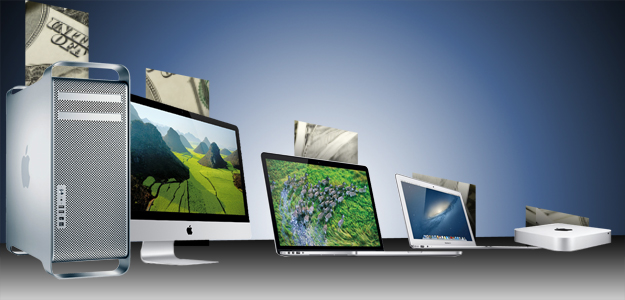
By nearly every measure, Apple had a fantastic holiday season. It sold 47.8 million iPhones and 22.9 million iPads with sales up significantly for both mobile product lines. But there’s an elephant in the room, and it’s the Mac. Mac sales were down 21 percent. Apple sold 1.1 million less Macs than it did last year (4.1 million compared to 5.2 million in 2011). You don’t have to be a rocket scientist to know that the PC market is struggling as smartphones and tablets get bigger and more powerful, but what’s the deal here? Is Apple losing its PC luster?
Apple has been a beacon of light in the PC and laptop market for a decade now, bucking static sales trends and getting people excited about buying a new PC while the Windows market essentially stood still. Apple’s Mac line – from the iMac to the MacBook Pro and the slim MacBook Air – has grown so recognizable in recent years that nearly every other PC and laptop maker has mimicked it. Like a twisted game of “Do your best Jagger,” just about every laptop on the market today has many of the design trademarks of Apple’s line: island-style keyboards, aluminum frames, clean lines, you name it. Intel liked the MacBook Air line so much that it has spent millions creating the “Ultrabook,” which began as the Windows 7 equivalent of the Air: super thin, fast-booting, and sleek. Desktop PCs have basically disappeared in favor of All-in-One computers that resemble the iMac.
So why has Apple’s Mac business suddenly dropped by more than 21 percent? Windows PC sales during the last three months of 2012 only fell by about 5 percent. Apple is the company that usually beats the market, but the Mac just dove off a cliff.
During Apple’s quarterly financial call yesterday, CEO Tim Cook could have won an Oscar for his lack of concern over the billion-dollar drop in sales, blaming it on constrained iMac sales (the redesigned iMac didn’t ship until December, and even then there were significant delays), the iPad, a short quarter, and the poor economy. Yes, minutes after his CFO announced that Apple made more than $54 billion in revenue and $13.1 billion in profit, Cook blamed poor sales on the economy. A massive 700,000 unit drop in iMac sales, he claims, accounts for a good portion of the decline.
Between June and October, Apple refreshed every single one of its Mac lines and even introduced a new Mac Mini. Yet even adding in the loss blamed on the iMac, the company was still down 400,000 units from a year ago. The world and U.S. economy has been poor for more than four years. What has Apple been doing the last three years? Hovering above the earth in a spaceship that prints money?
Cook also argued that the iPad is probably cannibalizing Apple’s PC sales. “We know iPhone has cannibalized some iPod business, we know iPad has cannibalized some Macs, and that doesn’t worry us,” Cook said.
Unless Apple plans to abandon the Mac, it might need to start worrying.
With Windows 8, Microsoft (and Intel) pushed computer manufacturers to completely rethink the laptop and PC. Most new Windows 8 laptops have a touchscreen, and many of them have other fancy features like the ability to convert into a tablet (See: Lenovo Yoga). They are all thin, light, and sometimes well designed. Windows 8, though not without issues, was a ground-up rethinking of Microsoft’s OS. By contrast, Apple’s evolution of the Mac is moving like molasses.
Apple knew about Windows 8 and the coming touch revolution for at least a year. It’s response: it made some extremely expensive ($2,200 minimum) high-resolution MacBook Pros, made the iMac thinner (and bumped the price up by $100), and basically phoned in the rest of its lineup with minimal processing power upgrades and no design changes. It introduced a new version of OS X (Mountain Lion), but the update’s biggest additions were relatively invisible, or the addition of small iOS apps like Notes and iMessage.
Assuming they aren’t rich and don’t intend to spend a minimum of $2,200 on a new Retina laptop, what reason does a current Mac user have to upgrade? Windows 8, while controversial, at least attempts to bring the benefits of the touch revolution to PCs; but Apple, the company that ignited this revolution, doesn’t seem to think anyone wants Macs to continue to evolve.
In April, Tim Cook compared Windows 8 to merging a toaster (a tablet) and a refrigerator (PC): “You can converge a toaster and a refrigerator, but you know those things are probably not going to be pleasing to the user.” Apple, he claimed, had no interest in combining large elements of its PC and iPad line.
The new iMac is extremely thin and Apple’s MacBooks have wonderfully crisp screens, but where is the actual innovation? Tim Cook has a lot of excuses why Mac sales dropped four times faster than PCs, but the bottom line is that Apple’s priorities seem out of whack. Who is Apple building Macs for? It used to build them for everyone. Lately, it’s hard to say.