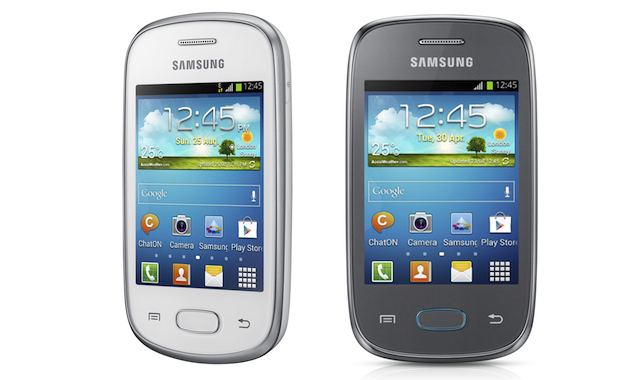
 While Samsung’s top-of-the-range Galaxy smartphones such as the Galaxy S4 and Galaxy Note 2 may grab the majority of the attention, there’s a whole universe of other Galaxy devices available at prices to suit all wallets. Samsung has announced two new Galaxy phones which are aimed at the most budget-conscious buyer – the Galaxy Star and the Galaxy Pocket Neo.
Samsung has done the decent thing and installed Android 4.1 Jelly Bean on both handsets, something which not even all, much more expensive smartphones can boast. Its TouchWiz user interface has been installed over the top, plus a couple of basic gesture controls – turnover to mute, and shake to update – have been added to spice things up.
Otherwise, we’re dealing with a couple of very basic phones. The Galaxy Star (on the left in the picture above) is the technically more advanced of the pair, as it has a single-core 1GHz processor, while the Pocket Neo must make do with an 850Mhz chip. It’s not all bad for the Galaxy Pocket Neo, as unlike the Star, it has GPS.
The remainder of the spec sheets are identical, with both phones sporting a 3-inch, 320 x 240 pixel touchscreen, a 2-megapixel camera, 512MB of RAM, 4GB of internal storage, plus a microSD card slot. There’s an FM radio onboard, along with Bluetooth 4.0 and Wi-Fi, and a dual-SIM version of each device will be produced. While neither phone is particularly exciting, they’re essential for Samsung to help maintain its position as the world’s number one phone manufacturer.
Samsung hasn’t provided a price or a release date for either the Star or the Pocket Neo, but we’d expect them both to be (very) cheap and make their way to emerging markets before, if ever, they appear in the UK or America.