  1. Home
  2. Mobile
  3. Legacy Archives

Samsung Galaxy Win is official, proving Samsung doesn’t win at naming phones

Add as a preferred source on Google

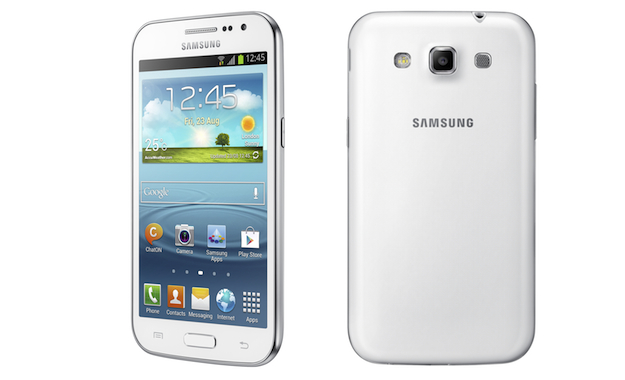
Samsung Galaxy WinThe Galaxy Win was leaked less than a week ago, and at the time we thought the name was for internal use only, and that the firm would come up with something a little less cringe-worthy if it was ever to be made official. We’ve got our answer today, as a press release has heralded its arrival under the name of the, um, Galaxy Win.

By calling it the Win, you’d expect it to be a killer handset, right? Wrong, it’s a relatively ordinary upper mid-range smartphone with a big screen, and yet another Galaxy s3-style design. It’s now almost impossible to see a line-up of Samsung’s Galaxy range handsets and be able to tell them apart.

Recommended Videos

So, what’s winning about the Galaxy Win? It has a 4.7-inch screen, which is a good size and therefore a bit of a win, but it’s a regular LCD and has a 480 x 800 pixel resolution, so less of a win there. A 1.2GHz quad-core processor with 1GB of RAM should provide enough power to keep the Win winning, but the 5-megapixel camera and the VGA video call lens probably won’t do the same when it comes to snapping pictures.

Android 4.1 Jelly Bean with TouchWiz takes care of the OS, plus the Win has a few software tweaks such as Smart Alert, Easy Mode and Samsung’s Motion UX gesture control system. The spec list is completed with Wi-Fi. Bluetooth 3.0, DLNA, a 2000mAh battery, 3G HSUPA connectivity and 8GB of internal memory, plus a microSD card slot.

Samsung hasn’t provided any firm release plans for the Galaxy Win, although it will be made available as both single-SIM and a dual-SIM device, suggesting it’s going to get a wide release when it does arrive. Buyers will have the choice of a white or gray chassis, and the knowledge they’ve chosen one of the stupidest named phones of all time.

Andy Boxall
Andy has written about mobile technology for almost a decade. From 2G to 5G and smartphone to smartwatch, Andy knows tech.
Snapchat Planets Meaning: Order, Rankings, and How Friend Solar System Works
Snapchat Planets turns your best friends list into a solar system, and yes, your orbit says a lot
Snapchat Planets being shown on the Snapchat app on iPhone.

Snapchat+ includes several exclusive features, but few have generated as much curiosity as Snapchat Planets. Part of the app's Friend Solar System, it transforms your Best Friends list into a planetary ranking, assigning each of your top eight friends a planet based on how often you interact.

From Mercury, which represents your closest friend, to Neptune, which represents your eighth closest, the system offers a quick visual snapshot of your interactions. But what do the different planets actually mean, and how does Snapchat decide who gets which one?

Read more
How to use WhatsApp Web
We'll show you how to use WhatsApp on your desktop or laptop
WhatsApp Web

As one of the most popular messaging services, you’ve already heard of WhatsApp. From its humble beginnings in 2009—two years before Apple introduced iMessage—to its acquisition by Facebook (now Meta) in 2014, WhatsApp has become the dominant messaging platform around the globe.

In recent years, it's grown even more potent with new features like video messages, self-destructing voice messages, the ability to edit sent messages, and more. We even finally got an WhatsApp iPad app in May 2025.

Read more
What is WhatsApp? How to use the app, tips, tricks, and more
From setting it up to mastering hidden features, here is your complete guide to WhatsApp.
WhatsApp app store listing open on iPhone

There's no shortage of messaging apps out there. The past decade has given us more options than we know what to do with, largely because smartphones demanded something better than plain old SMS.

Both the App Store and the Play Store are packed with apps that promise to revolutionize the way we communicate. Most of them didn't make it. The truth is, a messaging app is only as good as the number of people using it, and most apps never cross that threshold.

Read more