
Battery powered home audio components have come and gone over the years in an attempt to medicate audiophile nervosa over dirty power, but it’s a category that has never really found solid footing. Rather than disconnect from the wall, audiophiles seem to prefer spending thousands of dollars on power line conditioners and power cords to rid their audio gear of that dreaded “layer of haze” that stands between them and the absolute sound. Red Wine Audio thinks its time to cut the cord for good.
The knock against battery-powered equipment has always been that while it offers a lower level of background noise in a signal, it also robs the music of some of its dynamics. Your music should sound like it is emerging out of a quieter background and have improved resolution and spatial depth, but we have heard some examples that were dynamically limp instead. Red Wine Audio thinks that it has found a solution to that problem.
Red Wine Audio’s CEO, Vinnie Rossi, became a bit of a cult hero back in 2005 when he came out with a rather nifty little product called the iMod; a modified Apple iPod that turned the world’s most popular MP3 player into a genuine monster slayer. It wasn’t the cheapest mod job, but when you consider that audiophiles were still spending thousands of dollars at the time on CD players, and DACs, it was one of the biggest bargains in all of audio.
Red Wine Audio still offers the service, but Rossi now offers a modification job on the new Astell & Kern AK100 portable media player that can handle high resolution audio formats as well. Rossi, however, had much bigger targets in his sights and that market was the battery-powered component. Red Wine Audio started small with low-powered amplifiers, but that product line-up has grown over the past eight years to include power amplifiers, integrated amplifiers, headphone amps, DACs, phono stages, cables, and dedicated power supplies.
Red Wine Audio overhauled its entire line-up at CES 2013 with its new Renaissance series of products, and the overall consensus was that the sound quality in their shared room with Harbeth was one of the best at the show.
All of the RWA products run ‘off-the-grid’ on pure LiFePO4 (LFP) battery power, eliminating the AC-to-DC conversion process when listening. All of the components need to be recharged after 8-10 hours of playing time, and while you can run them plugged into the wall, that defeats the purpose of the design. The LFP batteries are the most environmentally friendly battery technology available, with five times the life cycle of lead-acid (SLA) batteries.
 The RWA components are hardly inexpensive, the Liliana 115 watt/channel monoblocks retail for $6,000 a pair so we’re not talking about entry level equipment. On the plus side, the sound quality is comparable to some of the best amplifiers we’ve ever heard so Rossi’s offerings are a mini-bargain in comparison to the more expensive offerings from the likes of Audio Research and McIntosh.
The real sleeper in the line-up is the brand new 16-watt Signature 16 integrated amplifier and while only appropriate for more efficient loudspeakers (89dB or higher with a rather benign impedance), it’s a bargain at $2,000. The Signature 16 can also be upgraded with an optional headphone amplifier.
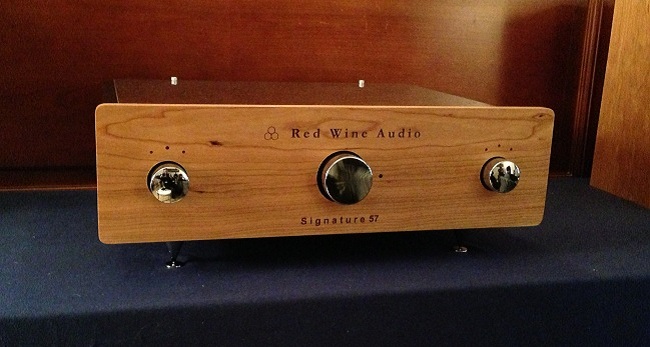
If sixteen watts are not enough for your system, Red Wine Audio has a more powerful integrated amplifier coming out in the near future that offers a lot for $4,000. The Signature 57 integrated amplifier puts out 57 watts into an 8 ohm load, but doubles that into 4 ohms; Magnepan users should seriously consider taking a look at this beast.
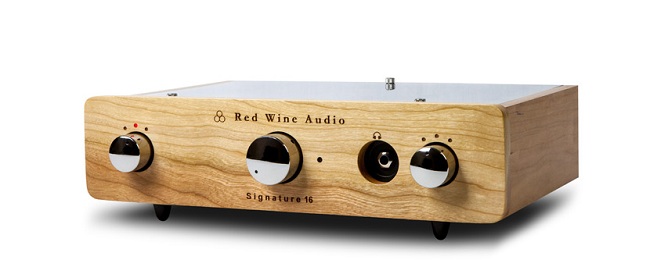 The Signature 57 is a high-current battery-powered design based on the reference Liliana power amplifier and comes with 4 inputs. Because of the modular design of the unit, Rossi can install his Bellina Pro DAC, Analogica phono preamplifier or headphone amplifier inside the integrated amplifier, giving you a one-box solution. It won’t be a cheap solution, but if the final production units deliver anything like the sound in his room where he drove a pair of Harbeth Monitor 30.1 ($5,900) loudspeakers, the Signature 57 is going to be really popular.


