

Harman Kardon has unveiled three of its newest AV receivers as part of its AVR 1×10 series that are designed to maintain the level of functionality audiophiles expect, but also open up support for streaming services and external devices.
The AVR 1510, AVR 1610 and AVR 1710 are all similar in concept, save for specific features that set them apart from each other. Here’s a breakdown of what they each have to offer:
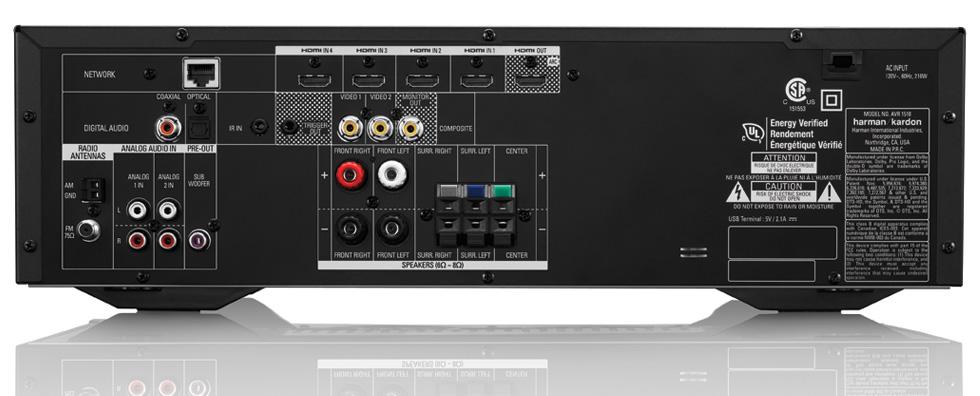
The AVR 1510 is the little brother of the group, but looks to be a capable unit. It provides 5.1 surround-sound at 75 watts per channel. There are four HDMI inputs, each with 4K pass-through, 3D, deep color and legacy AV inputs. On the front panel, there’s a USB port for Apple devices and USB sticks.
On the audio side, it has high-resolution Dolby TrueHD and DTS-HD Master Audio decoding for to support HD audio from Blu-ray discs. There is an Ethernet port for connecting the AVR 1510 to the home network, which then enables it to be controlled via a dedicated remote app for iOS and Android. There is DLNA 1.5 compliance for streaming media from compatible devices wirelessly, plus vTuner Internet radio built-in for streaming music from thousands of radio stations around the world. This unit will sell for $300.
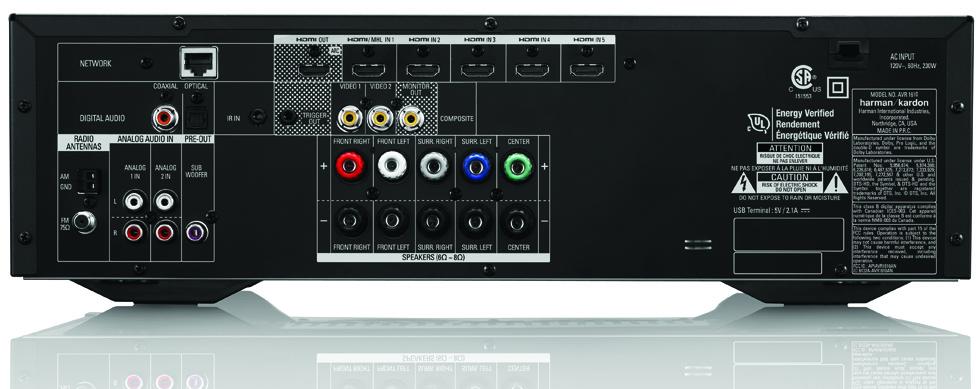
One step up is the AVR 1610, which offers the same 5.1 surround, albeit at a slightly higher 85 watts per channel. This one also has Bluetooth built-in for wireless streaming from any playback device using Harman’s TrueStream technology. It has five HDMI inputs covering the same features as the 1510, along with one output with Audio Return Channel (ARC) to stream audio back from a connected video device.
On the networking side, there is an Ethernet port for Internet connectivity, plus an MHL connection with Roku Ready certification, meaning that users can plug in a Roku Streaming Stick via the MHL port on the back to access the Roku interface and all its content. The AVR remote can also control the interface much like a Roku remote would. A secondary function of the MHL input is to playback content stored on a smartphone, tablet or camera directly to the TV. DLNA 1.5 is also included here for streaming media over from compatible devices. The AVR 1610 will sell for $400.

The premium of the three is the AVR 1710, which steps up on a few levels. It has 7.2 surround sound with 100 watts per channel. Bluetooth and AirPlay are built-in, both with Harman’s TrueStream technology. There are also dual subwoofer outlets and a multiroom system with an assignable amplifier. Six HDMI inputs, one of which is MHL and Roku-ready, cover 4K pass-through, 3D and deep color, plus two outputs with audio return channel. DLNA 1.5 is another staple in the unit. The AVR 1710 will sell for $550, and pretty much has all the features of the other two models that are either the same or enhanced.
The AVR 1610 and 1710 also both have EzSet/EQ III auto-calibration (for automatic setup and, according to the company better sound), plus Harman’s new Natural Sound Processing (NSP), a reproduction technology that aims to recreate an acoustic event as it’s meant to sound.
Harman explains it this way: “That not only includes traditional fidelity features such as low distortion and realistic loudness, but also the correct localization of individual sources and orchestras, their sizes, shapes and distances, and in particular a sensation of the performance space where the original recorded event took place, or a plausible artificial space created by the content producer.”
All three units are considered energy-efficient with environmentally-friendly designs. Harman’s GreenEdge technology promises dramatic energy savings without compromising performance, thanks to a digital power supply that supplies uninterrupted power.
They’re also available now for purchase and shipping from Harman’s website.


