  1. Home
  2. Computing
  3. Legacy Archives

Microsoft Research develops moving robotic touchscreen that interacts with the user

Add as a preferred source on Google
MicrosoftResearchTouchScreenRobotic
Image used with permission by copyright holder

With all of the Windows 8, Xbox One, and Microsoft tablet-based news circling the Internet lately, it’s easy to forget that Microsoft also has a dedicated research sector that is always dabbling in new and innovative technologies. Today, via IEEE Spectrum, we’re getting a glimpse at one such Microsoft Research project – a robotic, moving, interactive touchscreen.

Normally, these types of projects would contain intense development cycles and the introduction of new technologies. This is a rare case though, as Microsoft Research discovered it could create its desired effect by simply snapping a display onto a robotic arm (okay, so it’s a little more technical than that).

Recommended Videos

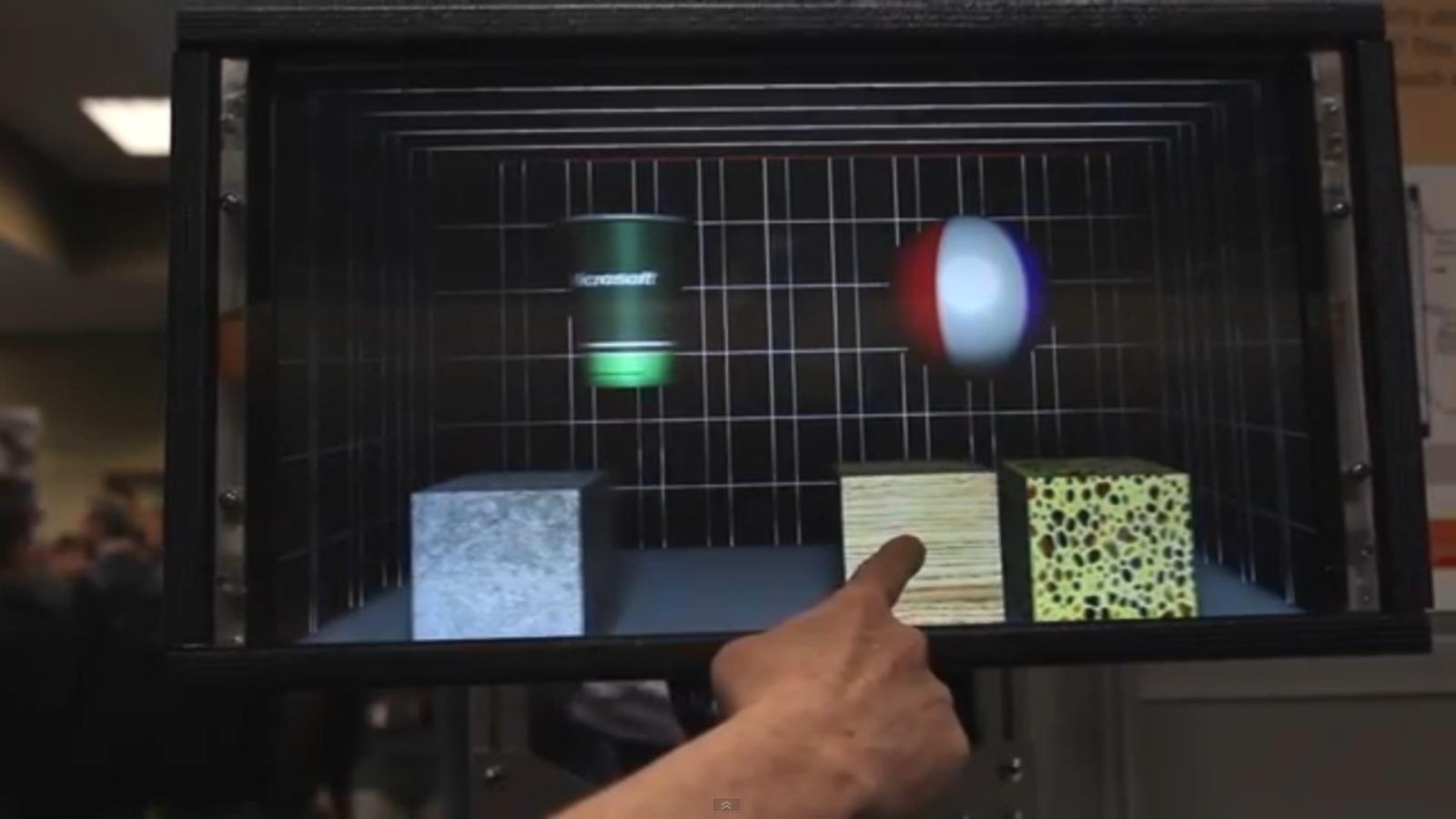
The screen is able to sense the intensity of a user’s touch and react accordingly. In the demonstration video, shown below, principal researcher of Microsoft Research, Mike Sinclair, showcases the device’s ability to create “life like” tension by pushing on some virtual blocks. Each block is made from a different substance, and they all vary in weight. Pushing on the “metal block,” in this instance, provides much more tension than pushing on the “wooden block.” The screen moves back and forth accordingly, pushing back against Sinclair’s finger in order to simulate return force. This makes for a much more interactive touchscreen experience.

The screen is also capable of virtually mimicking the shape of an object. Sinclair shows this by pushing on the rounded edges of a beach ball. Each touch causes the screen to adjust itself forward or backward, and, according to Sinclair, the effect causes the beach ball to retain a virtual surface where it actually feels as if the ball is round, even though you are aware that you are touching a plane that is completely flat.

Microsoft has no immediate plans for the discovery, although the video does showcase how doctors could use this technology to better understand MRIs and scans. This could also prove to be a very unique tool for entertainment purposes. Microsoft already has some creative features for its Xbox with Kinect, so it’s not entirely far-fetched that the group could implement this into its gaming system somehow (although its probably unlikely we’ll see this anytime soon). 

Russ Boswell
Former Digital Trends Contributor
Russ Boswell is an aspiring video game and technology journalist from Colorado. He's been an avid gamer since he was old…
AI browsers like Perplexity Comet can be tricked into spilling your password through BioShocking exploit
Six AI browsers were found leaking saved passwords and many of them haven't fixed it yet.
MacBook Air in hand, Comet browser loaded—let’s see what Perplexity’s AI can really do

Security researchers just found a strange way to trick AI browsers into handing over your passwords. They managed to trick AI browser agents into exposing sensitive data like saved passwords, session cookies, and private tokens by disguising the theft as part of a harmless "game."

The technique is called BioShocking, named after the popular video game BioShock, where a brainwashed character is manipulated into believing a false reality. Once an AI browser falls for the same trick, it stops following its own safety rules entirely.

Read more
Google Play’s latest speed boost goes way beyond the phone
Play Store v52.1 targets app install performance across Android devices, including cars, TVs, watches, tablets, and phones.
Google Play Store Photo

Google is rolling out Play Store v52.1 with changes built around a practical Android problem, getting apps installed more smoothly on very different kinds of hardware.

The update focuses on Play Store infrastructure, with Google pointing to stability, performance, and better memory use while a device adds an app. That install path now has to work on phones, tablets, Wear OS watches, Google TV, Android TV, Android Auto, and cars running Android Automotive.

Read more
Peacock Premium Plus joins YouTube as the streaming bundle battle gets messier
The $16.99 subscription brings Peacock’s sports-heavy catalog into YouTube, with account details still unclear.
Adult, Female, Person

Peacock Premium Plus is now available through YouTube Primetime Channels, giving viewers a new way to add a major streaming service inside YouTube.

The $16.99-per-month subscription brings Peacock’s live sports, NBC and Bravo shows, originals, Universal movies, Telemundo programming, and Spanish-language FIFA World Cup 2026 coverage into YouTube’s channel marketplace.

Read more