We come across quite a lot of cool technology here at DT, but it’s not every day that we find something that can literally cool you down.
Developed by four engineering students at MIT, Wristify is a prototype wearable device that leverages the physical phenomenon known as the Peltier effect to reduce your body temperature.
The Peltier effect, named for French physicist Jean Charles Athanase Peltier who discovered it in 1834, describes the phenomenon of heating or cooling caused by an electric current flowing across the junction of two different conductors. As the current moves from one conductor to another, the transfer of energy causes one side to heat up and the other to cool down.
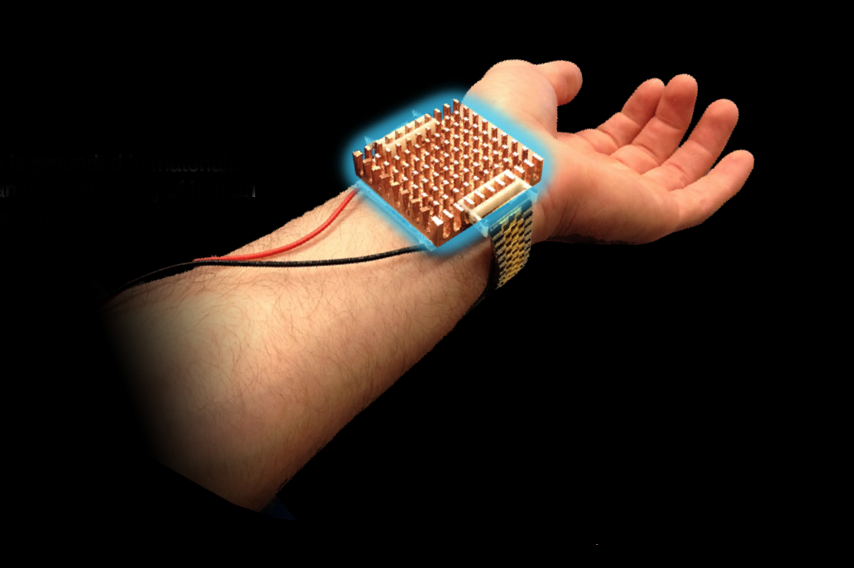 Wristify is basically a series of these junctions (called a Peltier cooler) powered by a small battery and attached to a wrist strap. When placed against the skin, the device makes you feel cooler by reducing the temperature of your wrist a few fractions of a degree per second for a couple seconds at a time. Over the course of a few minutes, this process will cause you to perceive a whole-body cooling of a couple degrees celsius. The team developing the device is still tinkering with it to figure out the optimal cooling cycle, but at this point in time they say the most effective method is to cool your wrist by 0.4 degrees Celsius (0.7F) per second for five seconds, and then turn off for 10 seconds.
The chief benefit of this device is that it offers a more personalized approach to temperature control, one that’s vastly more efficient than current heating and cooling methods. It takes millions of watts to raise or lower the temperature of an entire building, but Wristify can run on a small lithium battery. If everybody had one of these things on their wrist instead of relying on air conditioning or heaters all the time, the potential energy savings could be massive.
Of course, it’s still just a prototype, but the idea recently won the $10,000 top prize in MIT’s annual Making And Designing Materials Engineering Competition, and the team plans to put all that cheddar toward further development of the device. Find out more here.