
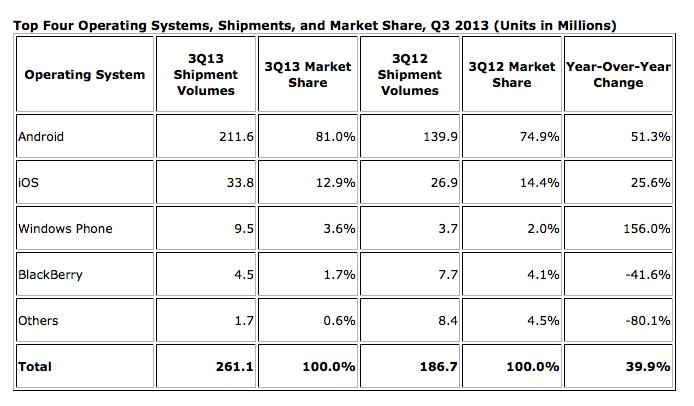
Google’s Android mobile operating system continues on its march to smartphone domination with data released by research firm IDC on Tuesday revealing the platform scored a colossal 81 percent of global smartphone shipments for the three months from July to September, pushing past 80 percent for the first time in its relatively short six-year history.
A total of 261.1 million smartphones were shipped in the quarter, IDC noted. Of these, Android devices accounted for 211.6 million shipments, compared to 139.9 million during the same period a year earlier. The smartphone space has grown by 39.9 percent over the last year, the figures showed.
Windows Phone and BlackBerry have effectively swapped places in the past 12 months as the latter continues in its struggle to convince consumers that its BB10 platform and devices are worth investing in.
While the Windows Phone platform in Q3 2012 saw 3.7 million handsets shipped, this year it more than doubled its share with 9.5 million shipments. BlackBerry, in contrast, shipped 4.5 million smartphones in Q3 2013, compared with 7.7 million in the same period last year. This puts BlackBerry’s share of Q3 2013 shipments at a paltry 1.7 percent, compared to Windows Phone’s 3.6 percent.
 “Android and Windows Phone continued to make significant strides in the third quarter. Despite their differences in market share, they both have one important factor behind their success: price,” IDC’s Ramon Llamas said in a release. “Both platforms have a selection of devices available at prices low enough to be affordable to the mass market, and it is the mass market that is driving the entire market forward.”
Despite selling more iPhones in Q3 compared to a year ago (33.8m from 26.9m), Apple’s iOS saw a drop in percentage terms, accounting for 12.9 percent of global smartphone shipments compared to 14.4 percent 12 months earlier.
It was clearly a great quarter for both Android and Windows Phone, with not only attractive prices but also the increasing availability of large-screen handsets helping to drive growth of Google’s mobile operating system.
“Almost all successful Android vendors have added one or more 5-7-inch phablets to their product portfolios,” IDC’s Ryan Reith commented. “And Nokia’s recent announcement of the Lumia 1320 and 1520 put them in the category as well.”
Reith said that in this year’s Q3, phablet shipments made up 21 percent of the smartphone market, up from just 3 percent 12 months ago, adding that Apple’s failure to launch a phablet could have contributed to the Cupertino company’s inability to increase its market share year-on-year.
Though a bit slow off the mark, Apple appears to have finally woken up to the idea that a large-screen iPhone could prove a hit with consumers, with the tech giant rumored to be developing two devices likley in preparation for a 2014 launch.


