  1. Home
  2. Cars
  3. Legacy Archives

2014 Chevrolet Camaro Z/28 sweats the small stuff with aerodynamic “Flowtie” badge

Add as a preferred source on Google

The Chevrolet Camaro Z/28 is a no-compromise car.

In the age of infotainment and motion-activated tailgates, the Z/28 is sold without air conditioning, and the only speaker is for the door chime. It’s not surprising, then, that even the iconic Chevy Bowtie badge was subjected to some tweaking to maximize performance.

Recommended Videos

As GM recounts, it became apparent during aerodynamic testing that the stock Bowtie was displacing air away from the radiator, which limits its ability to coll the engine. Not good.

Obviously, removing the badge altogether would invite the ire of Chevy loyalists and the marketing department, so, in what is sure to become a piece of Camaro lore, engineer Richard Quinn took a cutoff wheel to the badge, removing the gold trim around the edges.

The slimmed-down Bowtie allowed an extra three cubic meters of air into the engine per minute, dropping engine coolant and oil temperatures by 2 degrees Fahrenheit during extended track sessions, according to GM.
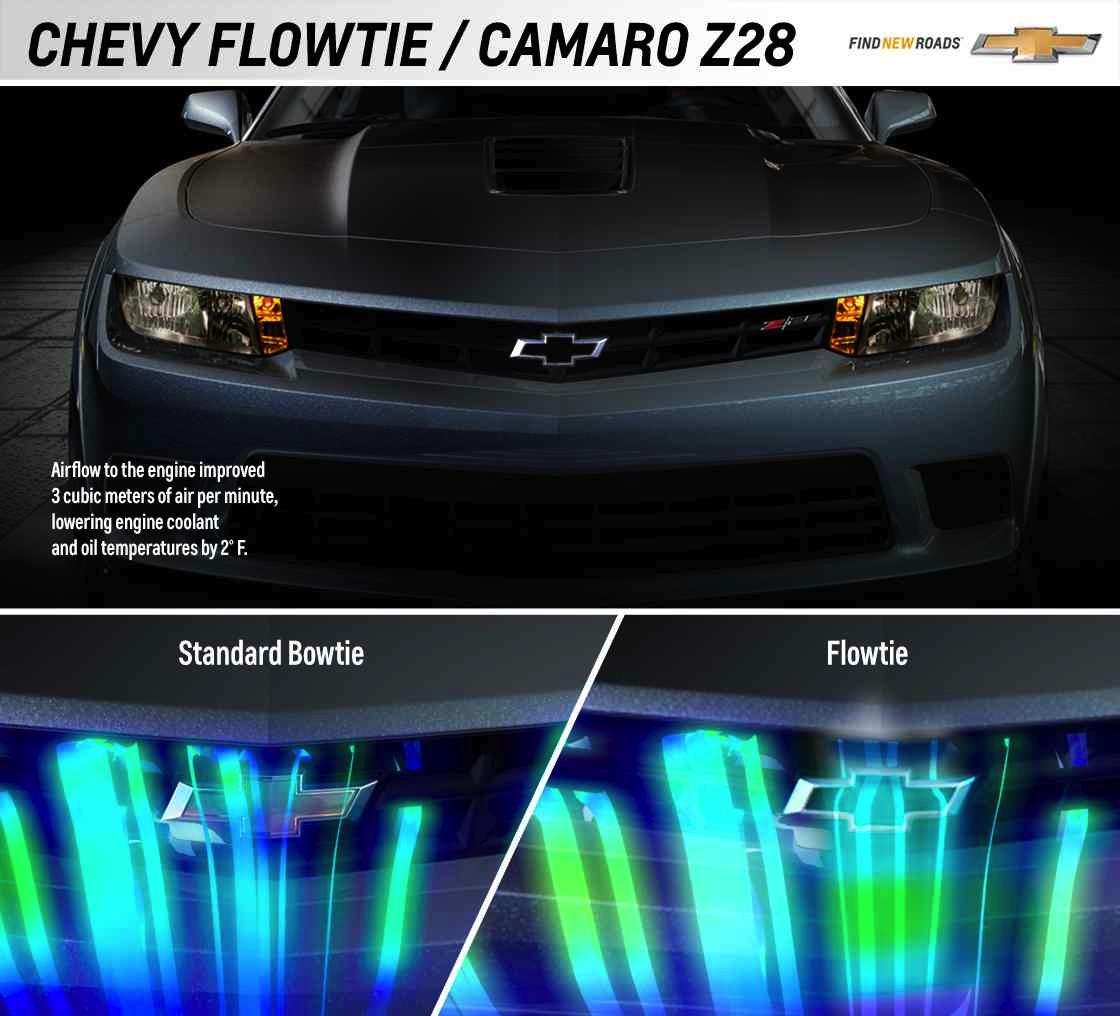
 Chevrolet Z28-Flowtie

Christened “Flowtie”, it was made standard equipment for the production Z/28. Presumably GM has figured out a way to make them without the need for cutting tools.

A modified badge might seem inconsequential, but it speaks volumes about the Z/28.

Like its Trans Am ancestor, the latest Z/28 was built to conquer racetracks. It’s less powerful than the supercharged Camaro ZL1, but also lighter. Consequently, Chevy says it beat the more muscular Camaro around its test track during development.

Even more impressive is the Z/28’s Nurburgring lap time of 7:37:40, which faster than the exotic Lexus LFA.

How many tenths do you think that “Flowtie” was worth?

Stephen Edelstein
Stephen is a freelance automotive journalist covering all things cars. He likes anything with four wheels, from classic cars…
Chery’s latest EV packs flagship tech for the price of a base Tesla, but you can’t buy it
Here's everything packed into Exeed's 2027 Exlantix ES, from its 27-sensor autonomous driving suite to its 860 km range, all starting under $31,000.
Car, Transportation, Vehicle

Chery's premium arm just dropped a sedan that makes you wonder why American EVs cost twice as much for half the tech.

Exeed's 2027 Exlantix ES ships with a driver-assist system called Falcon 700. It is built around an Nvidia Orin-Y chip and a genuinely stacked sensor suite.

Read more
A new AI model wants self-driving cars to think before they swerve
Forget guessing games, this self-driving AI actually shows its work.
Self driving car

Self-driving cars have gotten pretty good at driving. The harder problem is teaching them to drive safely in situations nobody planned for. We have heard horror stories of self-driving cars, behaving erratically in emergency situations, often times delaying first responders from reaching the scene.

A team at Seoul National University, led by professor Jun Won Choi from the Department of Electrical and Computer Engineering, thinks they have cracked part of that puzzle with a new AI model called SafeDrive. The research was recently selected as a highlight paper at CVPR 2026, a distinction that goes only to roughly 3% of all submissions.

Read more
Your next car’s software update could become its biggest security risk
Your next car could receive updates like your smartphone. That's also becoming a cybersecurity nightmare.
OTA technology allows manufacturers to remotely deliver software updates.

Modern cars are no longer machines that stay the same after they leave the showroom. Increasingly, they're becoming software-defined vehicles that receive new features, bug fixes, and security patches wirelessly, much like smartphones. But while over-the-air (OTA) updates have made vehicle maintenance easier and cheaper, cybersecurity experts are warning that the same technology could also become one of the automotive industry's biggest security challenges.

Researchers and policymakers are now calling for stronger oversight as connected vehicles become increasingly dependent on remote software updates. Their concern isn't just about hackers stealing personal data. It's about someone potentially interfering with the operation of a moving vehicle.

Read more