
This is not an April Fools Day joke. We promise.
Optical scientists at the University of Arizona and University of Central Florida have developed a new type of laser technology capable of sending high-intensity beams through the atmosphere much farther than what was previously possible. The research, which was recently published in the journal Nature Photonics, is still in the laboratory phase. However, with further development, this technology could be used to divert lightning bolts away from buildings in the future.
Here’s how that works. When the laser is fired, the high intensity beam leaves a channel of plasma (ionized molecules stripped of their electrons) in its wake. This column of plasma, in theory, could provide lightning bolts with a path of least resistance to the surface of the Earth, and thereby encourage them to strike in a specific place.
Up until recently, sending a laser beam high enough into the atmosphere to make this possible was difficult because, despite their intensity, singular high-intensity beams tend to 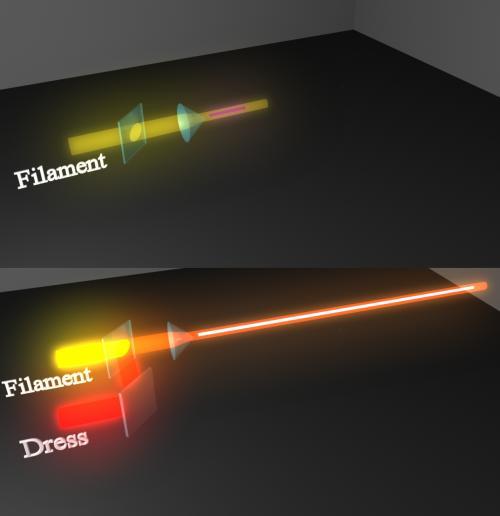 disappear over distances greater than a few feet. This is due to diffraction –the effect of light being bent and diffused as it passes through the air, which ultimately causes the beam to lose its focus as it travels further.
The researchers were able to overcome this phenomenon and achieve considerably greater distances with a clever trick: embedding the primary high-intensity beam inside of a second beam of lower intensity. As the inner beam travels through the air, the second beam (called a dress beam) refuels it, and provides it with enough energy to travel much greater distances than what was previously achievable. In lab tests, scientists were able to extend the range of the lasers from 10 inches to around seven feet — nearly a tenfold increase. Simulations have shown that by scaling up the technology to atmospheric proportions, the range of laser filaments could reach as high as 165 feet, thereby making lightning control a viable possibility.
The development of the new laser technology was supported by a five-year, 7.5 million-dollar US Department of Defense grant awarded to a group of researchers led by Jerome Maloney, a mathematics and optical sciences professor at the University of Arizona. Maloney is heading up the multidisciplinary, multi-institution research effort to investigate ultra-short laser pulses, with a focus on how they affect the atmosphere and ways to improve their propagation over large distances.
We’re sure the military is thrilled by the prospect of raining down lighting on its enemies. Find out more here.
[via Phys.org]
Looking for more crazy, cutting-edge, and borderline-unbelievable news? Check out this piece on brain implants that help paralyzed people walk again, or this one about a two-way dolpin-to-English translator.


