
  1. Home
  2. Emerging Tech
  3. News

Forget Starlink. ESA just tested gigabit-class satellite-to-airplane internet service

ESA and Airbus hit 2.6 Gbps from a plane to a satellite 36,000 km away, paving the way for streaming at 35,000 feet.

Add as a preferred source on Google
Runway, Aircraft, Airplane
Airbus Defence and Space

Airplane Wi-Fi might finally catch up to the 21st century. The European Space Agency and Airbus just proved it’s possible to beam gigabit internet from space to a moving aircraft using lasers.

The test hit 2.6 gigabits per second between a plane and the Alphasat satellite 36,000 kilometers above Earth. That speed held for several minutes. An HD movie downloads in seconds at that rate. The connection stayed stable the whole time, even with the aircraft moving and punching through clouds.

Recommended Videos

Keeping a laser locked onto a fast-moving target at that distance is brutally hard. The system had to account for the plane’s vibrations, its constant motion, and atmospheric disturbances that would break a normal radio link. It worked anyway.

A laser locked at 36,000 kilometers

The UltraAir terminal on the aircraft had to stay trained on the satellite while everything moved. Turbulence, turns, altitude changes. Any break in the beam kills the connection. Airbus built the terminal, and it held.

Laser communications beat radio in two big ways. The beams are narrow, so they pack more data. A laser link can carry way more information than a radio signal can. They’re also much harder to intercept, which is ideal for military and commercial users.

Radio spectrum is crowded so optical links skip that problem entirely. The key difference is in how the signal travels the final leg to your receiver. Starlink and most other satellite internet services use radio waves to beam data from space to your dish, but laser communications use focused light beams instead. Laser links can carry far more data, face less interference, and use significantly less power than traditional radio-based systems.

Why Europe is betting on laser links

This wasn’t a random experiment. It’s part of HydRON, ESA’s plan for a space-based optical network. Think fiber optic cables, but in orbit.

The ScyLight program backed the work, with funding from the Netherlands and Germany. Europe wants its own secure data infrastructure. Relying on crowded radio bands that anyone can jam isn’t a long-term strategy.

Laurent Jaffart at ESA said the test solves the hard problems around fast laser communications, especially evading interference in tough conditions. Airbus sees both defense and commercial potential. Francois Lombard called the precision required “extreme” and said it opens a new era for laser satellites.

When you’ll actually use this

Not on your next flight. Probably not the one after that. But the path is now visible.

ESA’s Harald Hauschildt said linking aircraft to networks like HydRON is a priority. That includes high-altitude platforms and regular planes.

The same tech works for ships at sea and vehicles in remote areas. Places cell towers don’t reach. Deserts, oceans, disaster zones. Laser links could keep them online.

The industry can strengthen Europe’s autonomy by leading in secure laser communications. The hard part is done. Now someone has to build the network.

Paulo Vargas
Paulo Vargas is an English major turned reporter turned technical writer, with a career that has always circled back to…
Bacteria could be the secret sauce to keeping your computers cool
Scientists find bacteria can grow thermal materials that outperform current cooling tech.
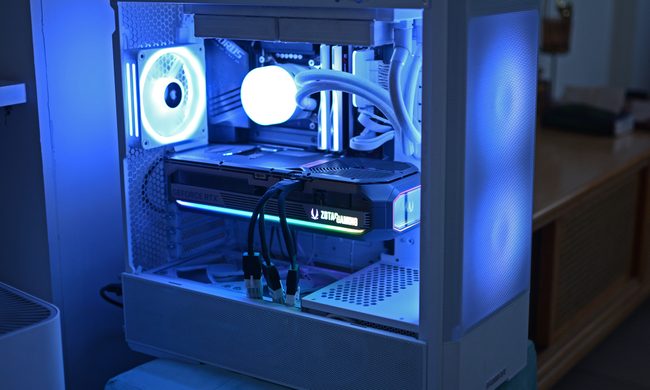
The Zotac RTX 5070 Ti Amp Extreme Infinity plugged into a white gaming PC

Your PC and laptop runs hotter every year, especially now that AI tools and heavy software push it harder than ever. Heat is a real bottleneck for performance, which is why people have gone to wild lengths to solve it, like strapping an actual ice machine to an RTX GPU. A new study points to a far less extreme fix for this problem, and it involves bacteria (via TechXplore).

Researchers have developed a new way to grow thermal interface materials, the substances that sit between a chip and its cooling system to help heat escape faster. The process involves feeding bacteria sugar and metal ions, letting the microbes build the material naturally instead of relying on traditional chemical manufacturing.

Read more
Bored of reading papers? This AI tool turns them into TikTok-like videos
PaperTok brings academic papers to people with short attention spans
Head, Person, Face

Academic papers aren't what you'd consider a fun read. For the average person, the dense, long, and field-specific language-filled papers can be quite intimidating to get into. These are usually packaged as PDFs that look like they were designed to test your willpower. A group of University of Washington researchers thinks there may be a better way to get that work in front of regular people. They are turning the papers into short-form videos.

The tool is called PaperTok, and it uses AI to help researchers convert academic papers into short, social-friendly videos. Think TikTok, except the idea is to explain research instead of sharing brain-rotting content. The best part? PaperTok is building a platform around scientists and researchers who are involved in the process, rather than simply using AI to summarize these papers.

Read more
As AI voices get harder to spot, ElevenLabs adopts Google’s SynthID to help you sniff the fakes
Artificial Intelligence

There was a time when spotting AI-generated content was almost a game. Images came with extra fingers, chatbots wrote like overly enthusiastic interns, and synthetic voices had an unmistakable robotic edge. Those days are disappearing fast.

Today, AI voices can laugh, whisper, pause naturally, and even sound emotional enough to fool many listeners. That’s exciting for creators, but it’s also creating a growing trust problem. If you can’t tell whether a clip is real or AI-generated, how do you know what to believe?

Read more