1. Home
  2. Space
  3. News

Blue Origin successfully re-uses a New Glenn rocket for the first time ever

Blue Origin achieves first New Glenn reflight despite payload setback

Add as a preferred source on Google
Blue Origin
Blue Origin Blue Origin

Blue Origin has achieved a major milestone in its spaceflight ambitions by successfully reusing a booster from its heavy-lift New Glenn rocket for the first time. The historic launch, conducted on April 19, marks a significant step forward for Jeff Bezos’ space company as it seeks to compete with rivals like SpaceX in the rapidly evolving commercial launch market.

A Milestone With A Mixed Outcome

The mission represented the third flight of the New Glenn rocket and featured a previously flown first-stage booster, underscoring Blue Origin’s push toward reusable rocket technology. The booster successfully landed after launch, demonstrating that the company can recover and reuse key hardware – a capability that has been central to reducing launch costs in the space industry.

However, the mission was only a partial success. While the rocket launched and deployed its payload – a BlueBird 7 communications satellite for AST SpaceMobile – the satellite was placed into a lower-than-intended orbit. Due to limited onboard propulsion, the satellite is unlikely to function as planned and may eventually be deorbited.

Why This Matters

Despite the payload setback, the successful reuse of the New Glenn booster is a crucial breakthrough. Reusability is considered the key to making space launches more cost-effective and sustainable. SpaceX has long leveraged reusable rockets to dominate the market, and Blue Origin’s achievement signals its intent to challenge that leadership.

NG-3 Update: We have confirmed payload separation. AST SpaceMobile has confirmed the satellite has powered on. The payload was placed into an off-nominal orbit. We are currently assessing and will update when we have more detailed information.

— Blue Origin (@blueorigin) April 19, 2026

New Glenn itself is designed as a partially reusable heavy-lift rocket capable of carrying large payloads into orbit, with its first stage built to fly multiple times. Demonstrating reuse in real-world missions validates years of engineering and brings the company closer to routine, lower-cost launches.

Why You Should Care

For consumers and businesses, advancements in reusable rockets can translate into cheaper satellite launches, improved global connectivity, and faster deployment of space-based services. This includes everything from broadband internet to Earth observation and navigation systems.

The success of reusable systems also accelerates competition, which historically drives innovation and lowers costs across industries.

What Comes Next

Blue Origin is expected to continue refining the New Glenn system, particularly its upper-stage performance, which caused the mission’s primary failure. The company has multiple launches planned as it works to scale operations and increase launch frequency.

Recommended Videos

Future missions will likely focus on achieving full mission success – combining reliable payload delivery with consistent booster reuse – as Blue Origin aims to establish itself as a serious contender in the global space race.

Moinak Pal
Moinak Pal is has been working in the technology sector covering both consumer centric tech and automotive technology for the…
Space is becoming Bezos and Musk’s next data center site, and we have every reason to worry
The AI boom is coming for the night sky
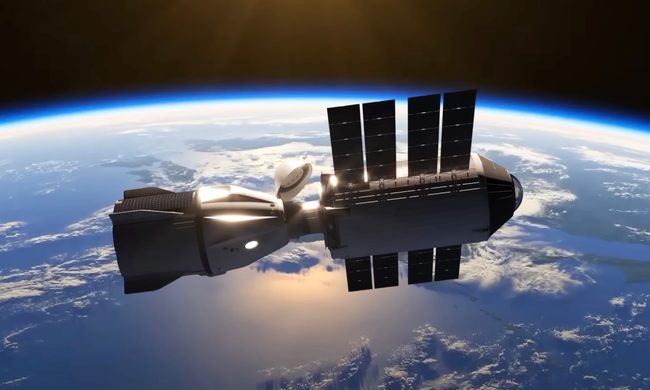
How Vast's space station will look in orbit.

AI data centers already consume vast amounts of electricity and water on Earth, so Silicon Valley has begun looking somewhere considerably more spacious... literally.

Elon Musk's SpaceX and Jeff Bezos' Blue Origin, along with several other companies, have proposed enormous constellations of satellites designed to operate as orbital data centers. However, environmental groups and former space officials are now warning that putting them into orbit at the proposed scale could have severe consequences for Earth's atmosphere and the night sky.

Read more
The first possible exomoon is here, and it makes our Moon look hilariously tiny
Scientists may have found the first exomoon, except this one is the size of Jupiter
This artist’s concept depicts a potential volcanic moon between the exoplanet WASP-49 b, left, and its parent star. New evidence indicating that a massive sodium cloud observed near WASP-49 b is produced by neither the planet nor the star has prompted researchers to ask if its origin could be an exomoon.

We have already discovered more than 6,000 planets outside of our immediate neighborhood. Yet, finding a moon orbiting one of those distant worlds has proved considerably harder. Astronomers may finally have something close to the real deal, but this particular object stretches the word “moon” almost beyond recognition.

Using the European Southern Observatory’s Very Large Telescope in Chile, researchers detected strong evidence for a moon-like object in the CD-35 2722 system. Further observations are still necessary to confirm the discovery, but it could become the first confidently detected natural satellite outside our solar system. There is still one tiny complication though. This moon is apparently massive.

Read more
China’s answer to SpaceX’s reusable rockets literally catches boosters in a net
SpaceX catches boosters on legs. China just used a net.
Ammunition, Missile, Weapon

SpaceX's playbook for recovering a rocket booster generally involves legs, a precisely controlled vertical landing, and either a concrete pad or a drone ship. 

China just managed to pull off something similar, but in a slightly different way, and on July 10, it tested the method as well.

Read more