Developers in the US and UK are increasingly putting Glass through its paces in an effort to fully understand its current capabilities and future potential.
A UK startup, for example, appears to have taken Google’s face-based computer to a whole new level, developing software that allows you to snap a photo just by thinking about it.
That’s right, folks. Glass can read your mind.
Actually, it’s not Google’s gadget itself that’s diving into your gray matter, but software – together with another piece of kit that attaches to Glass – that performs the magic.
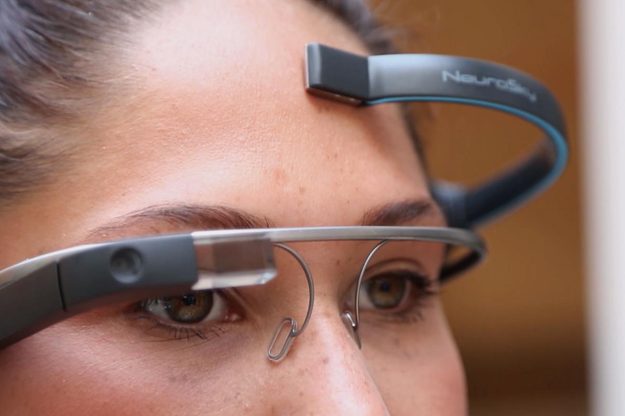
London-based This Place has developed an app called MindRDR that works together with commercially available brain monitor MindWave Mobile (from NeuroSky) to gather information from your mind. The device can interpret brain activity, with the setup offering users the ability to take photos and even post them on social media sites like Twitter and Facebook.
MindRDR works with the monitor to detect extra levels of activity in the brain, so when the user begins to concentrate on an object, a horizontal line appears on Glass’s screen. The more the user concentrates, the higher the bar moves. When it reaches the top, the device’s camera shutter fires. Continue to focus your mind and the white line will once again reach the top, sending your photo off to social media sites.
The novelty of Glass still ensures users stand out in a crowd, though as you can see, the addition of NeuroSky‘s EEG headset will make you stick out like a sore thumb, as the attachment sits above Glass, with a pad on the end of a bar pressing against the user’s forehead.
No affiliation
While the device and its functionality may attract the attention of privacy campaigners with its ability to discreetly snap shots (although until the design is refined, the pad stuck to the forehead is a bit of a giveaway), or generate fears that Google is about to start compiling a database of our thoughts, we’d better make clear that the Mountain View company has no affiliation with This Place.
“We have not reviewed nor approved the app so it won’t be available in the Glass app store,” a Google spokesperson told the BBC this week.
This Place, meanwhile, is keen to see what other developers make of it, and so is offering the software for free. However, to get everything up and running, you’ll need to fork out 89 euros ($120) for NeuroSky’s headset.