1. Home
  2. Emerging Tech
  3. Mobile
  4. Legacy Archives

No network? No problem. GoTenna lets you message your buddies without cell service

Add as a preferred source on Google

Now that most of us have become accustomed to ubiquitous cellphone networks, losing service is a terribly frustrating experience. Being stuck in an area without service definitely isn’t the worst thing in the world, but depending on the situation, it can be anything from a minor inconvenience to weekend-ruining experience as your plans fall apart.

But not to worry; thanks to a nifty innovation from the folks at goTenna, you might never have to suffer through dead zones and spotty service ever again. The company has developed a clever technological workaround that allows you to send messages without a connection to your cell phone provider’s network. It doesn’t use cell towers or Wi-Fi at all, so it’ll work even if all other forms of communication are unavailable.
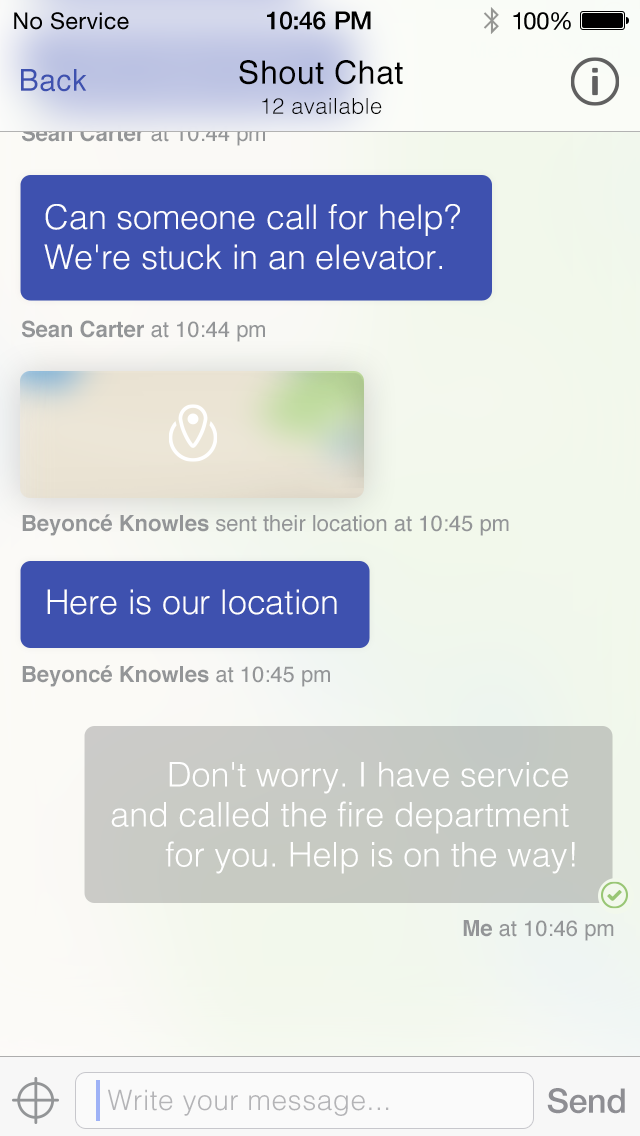
goTenna app screenshot
goTenna app screenshot Image used with permission by copyright holder

Their product, which bears the same name as the company itself, is basically a low-power radio transceiver that makes your phone function like a CB radio. To use it, you start by pairing your smartphone to goTenna wirelessly, using Bluetooth-LE. One you’re connected, you simply fire up the accompanying smartphone app and type out a text message like you would in any other situation. When you hit send, your smartphone will beam the message to goTenna, which will then shoot it out via long-range radio waves (151-154 MHz) to the intended recipient (who must also have a goTenna). At the other end, the exact same thing happens, but in reverse: the recipient goTenna sends your message over Bluetooth-LE to the smartphone app it’s paired with. It’s basically like turning your phone into a long-range walkie talkie.

Recommended Videos

In optimal conditions, the device is reportedly able to send messages to other goTennas up to 50 miles away — but that number can vary greatly depending on the elevation and environment you happen to be in.

Daniela Perdomo, CEO of the company, says the idea for the device came during Hurricane Sandy, when downed cell towers hampered communication. But she says goTenna has applications well beyond disasters and emergencies, such as traveling abroad or trying to text friends during musical festivals. It’d also be ideal for backpacking and hiking trips, as it would allow trekkers to communicate with each other despite being nowhere near a cellphone tower. 

Currently, the GoTenna is being offered for pre-order at a cost of $150 per pair, but once enough units are sold to fund the initial production run, the price will double. So, if you dig the idea of communicating on an alternative, low-bandwidth network, we highly recommend jumping on that fast.

Drew Prindle
Former Senior Editor, Features
Drew Prindle is an award-winning writer, editor, and storyteller who currently serves as Senior Features Editor for Digital…
The Apple Car may be dead, but it became the foundation of Apple Intelligence
A decade of work on a canceled car project reportedly laid the groundwork for Apple Intelligence.
Apple Intelligence in Apple Car

The Apple Car may have never left the garage, but it apparently gave birth to Apple's AI ambitions. According to Bloomberg's Mark Gurman, Apple's canceled autonomous vehicle project, one that consumed more than a decade of work and over $10 billion before being scrapped in 2024, ended up laying the technological foundation for Apple Intelligence. In a rather ironic twist, one of Apple's most expensive failures may also become one of its most important long-term investments.

The Apple Car forced Apple to think like an AI company

Read more
Researchers hid a prompt injection inside a PNG, and AI fell for it
Hacker

AI coding assistants like Claude are becoming every developer's favorite coworker. They can review code, explain confusing functions, and even write entire features with a single prompt. But new research suggests that this growing trust could also become their biggest weakness.

A team of security researchers (professor Sudipta Chattopadhyay and researcher Murali Ediga) has demonstrated an unusual attack that doesn't target the AI model directly. Instead, it targets what the AI doesn't pay enough attention to during code reviews. Rather than hiding malicious instructions in lines of code, the researchers tucked them inside an image file. Since many AI review tools treat images as decorative assets rather than as something worth inspecting, the pull request can appear perfectly harmless and sail through the review.

Read more
AI has already fallen into the wrong hands and they’re using it to make bombs
Logo, Text

Artificial intelligence has quickly become the go-to tool for everything from writing emails and summarizing meetings to helping students study or developers debug code. But the same technology that saves people time can also be misused, and a new report suggests that terrorist organizations are finding ways to do exactly that.

According to a research paper shared with The New York Times ahead of its publication, researchers found evidence that members of Boko Haram have been using popular AI chatbots to support both day-to-day activities and combat-related tasks. Interviews with 27 former members conducted in Nigeria over the past two years suggest that tools such as ChatGPT, Gemini, Claude, Grok, Meta AI, and DeepSeek were used to gather technical information, troubleshoot weapons, and even assist with planning attacks.

Read more