  1. Home
  2. Cars
  3. News

Callaway turns the Chevrolet Corvette into a weekend-ready shooting brake

Add as a preferred source on Google

American tuner Callaway has announced that the stunning Corvette AeroWagon concept that it presented all the way back in 2013 will become a reality in a few short months.

The production model will be all but identical to the concept (pictured). Starting with a stock, seventh-generation Chevrolet Corvette, Callaway will add a longer roof panel accented by a spoiler and a more upright C-pillar in order to turn the Stingray coupe into a sleek shooting brake. Every body panel added during the conversion will be crafted out of carbon fiber in order to keep weight in check.

Recommended Videos

The conversion is compatible with every seventh-generation Corvette regardless of whether it’s a base model powered by a 455-horsepower V8, or a range-topping Z06 model equipped a supercharged V8 rated at 650 horsepower. Understandably, only coupes are eligible to become wagons; convertibles need not apply. What’s surprising is that the conversion is reversible in just a matter of hours, though going back to a coupe is likely out of the reach of the average DIYer.

The AeroWagon is head-turningly stylish, and it’s markedly more practical than a standard Corvette coupe because it offers more cargo capacity. It’s still a sports car, though, and Callaway told Boldride that there’s not enough space to bump the ‘Vette’s seating capacity up to four by adding a rear bench. Similarly, a full-blown four-door model has been categorically ruled out.

Enthusiasts who want to turn their Corvette into a shooting brake will need to ship it to Callaway along with a $15,000 check. Having the carbon fiber add-ons painted in the same color as the body will set owners back another $1,500. Production will take place in either California or Connecticut, depending on where the donor car is located, and the first deliveries are tentatively scheduled for later this year.

Ronan Glon
Ronan Glon is an American automotive and tech journalist based in southern France. As a long-time contributor to Digital…
Volvo is rolling out Apple Music to over 2 million cars with a simple OTA update
Your Volvo may soon get Apple Music without needing CarPlay
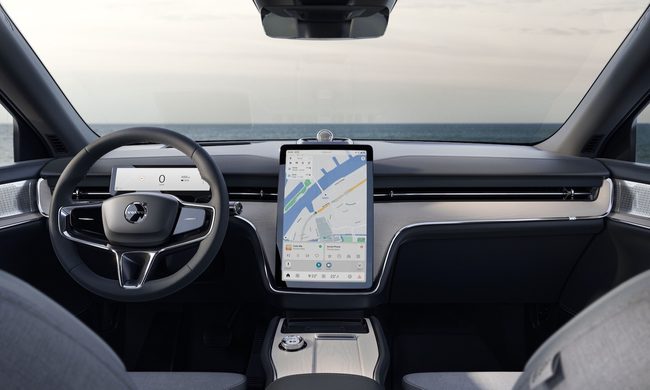
Interior view of the 2024 Volvo EX90.

The line between your smartphone and your car continues to blur. Volvo has announced that it is rolling out an over-the-air software update that brings Apple Music directly to the infotainment systems of more than 2 million vehicles worldwide. Instead of relying on Apple CarPlay or plugging in an iPhone, eligible drivers will be able to stream music natively from their car's built-in system, making Apple Music another integrated feature of Volvo's software experience.

The update is arriving for a wide range of Volvo models, including the EX90, ES90, XC90, S90, V90, XC60, S60, V60, XC40, EX40 and EC40, covering model year 2020 onwards. Availability, however, may vary depending on the vehicle.

Read more
Chery’s latest EV packs flagship tech for the price of a base Tesla, but you can’t buy it
Here's everything packed into Exeed's 2027 Exlantix ES, from its 27-sensor autonomous driving suite to its 860 km range, all starting under $31,000.
Car, Transportation, Vehicle

Chery's premium arm just dropped a sedan that makes you wonder why American EVs cost twice as much for half the tech.

Exeed's 2027 Exlantix ES ships with a driver-assist system called Falcon 700. It is built around an Nvidia Orin-Y chip and a genuinely stacked sensor suite.

Read more
A new AI model wants self-driving cars to think before they swerve
Forget guessing games, this self-driving AI actually shows its work.
Self driving car

Self-driving cars have gotten pretty good at driving. The harder problem is teaching them to drive safely in situations nobody planned for. We have heard horror stories of self-driving cars, behaving erratically in emergency situations, often times delaying first responders from reaching the scene.

A team at Seoul National University, led by professor Jun Won Choi from the Department of Electrical and Computer Engineering, thinks they have cracked part of that puzzle with a new AI model called SafeDrive. The research was recently selected as a highlight paper at CVPR 2026, a distinction that goes only to roughly 3% of all submissions.

Read more