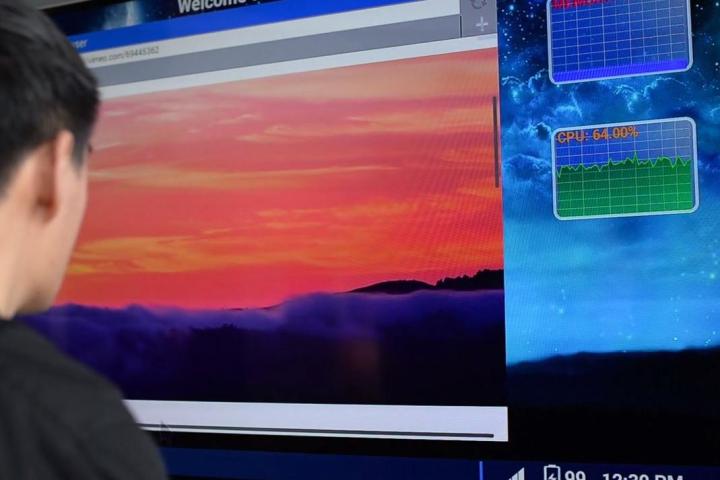
The interface is said to be “desktop style” which means the usual shortcuts will work. Double-clicking opens software and folders, right-click open a menu, and windows can me resized, maximized and minimized just as in Linux. It work as “an entire Linux based desktop.”
The company also said it’s working on an SDK that will let developers create apps for the operating system.
The pocketable PC has been a dream in the mind of inventors since the release of the first smartphones. We’ve seen previous attempts at the idea, like the Ubuntu Edge, but most have proven too isolated to see success. Andromium, a new company founded to launch a Kickstarter for a product of the same name, hopes it can avoid the fate to its forefathers by piggybacking popular devices.
Andromium is, put simply, an alternative environment for Android that looks and feels like a desktop operating system. It has a taskbar, is designed for a screen that’s in landscape orientation, and provides full support for a keyboard, mouse and monitor. All of this is enabled through a combination of software and a custom dock with video outputs and USB ports.
The dock itself is about the size of a Roku and has a flip cover that protects it during travel. Originally Andromium intended support only for the Samsung Galaxy line of smartphones, but backer pressure has encouraged the company to extend support to the HTC One, LG N4/N5, and the Nexus 6. “Large screen tablets” will be supported as well, though details on that are vague.
While the project looks promising we did notice a few oddities. The most serious concern is how support for windows (the UI concept, not the Microsoft product) will work. This is something Android can’t handle natively, though it appears there’s some effort to handle the problem based on the screenshots we’ve seen. In any case, the developers could be clearer on this point.
The company is also promoting the gaming capabilities of its software by claiming players will be able to play Super Smash Brothers, Grand Theft Auto and other games (presumably through emulators). Using the intellectual property of others to promote a Kickstarter strikes us as a bit sketch.
A goal of $100,000 has been set and the project, which just launched, still has 40 days to go. So far it has managed over a tenth of its goal, so it looks on track. Backers need to pledge at least $10 to get the software (which can technically work on docks besides the one made b y Andromium) and pledge $29 for the dock. A sky-high $340 pledge level promises ten docks for businesses that want to convert an entire office.
What do you think? Does this look promising, or will this end up an interesting but ultimately limited tool like the Ubuntu Edge?
Editors' Recommendations
- How to remove the Recycle Bin from your desktop
- Should you turn your computer off at night? We asked an expert
- Your PC problem could probably be fixed with a BIOS update
- How to transfer files from Android to your PC
- Best microSD cards in 2023: top picks for your computer, camera, or drone