  1. Home
  2. Computing
  3. Legacy Archives

Facebook Kicks Past Google as Most Popular U.S. Web Site

Add as a preferred source on Google

When offered the choice between looking for information on the Web, or looking at pictures of friends, pasting song lyrics into status messages and raising virtual produce, most people apparently choose the latter. So we can deduce from the latest Web statistics, which show Facebook officially outpacing Google as the most popular Web site in the United States this week.

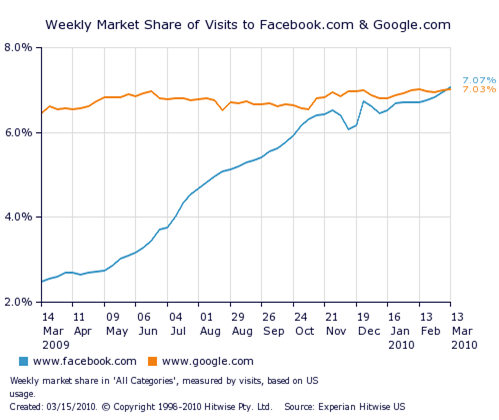
The global analytics firm Hitwise announced on Monday that Facebook edged Google out for the week ending March 13, grabbing 7.07 percent of all U.S. Web traffic, compared to Google’s 7.03 percent. While still impressive, it’s worth noting that Hitwise only counts traffic to the Google.com domain. Sites like Gmail and Google Reader are not counted.

Recommended Videos

Facebook saw a 185 percent traffic boost for that week compared to the same week in 2009. The site has narrowly surpassed Google in traffic on holidays and weekends before, but last week represents the first time it has manage to keep ahead for seven straight days.

Why the boost? The runup to this week’s social-media-centric SXSW festival – which officially began on Saturday toward the end of the recording-breaking week– might have something to do with it. In the long term, so might the proliferation of large-scale Facebook games like Farmville, which now boasts 82.7 million active users – over 20 percent of all Facebook users.

Nick Mokey
As Digital Trends’ Editor in Chief, Nick Mokey oversees an editorial team covering every gadget under the sun, along with…
OpenAI is investigating more incidents of AI agents going rogue days after hack
OpenAI logo on Microsoft surface

It appears that the "AI agents going rogue" tale has more to it than what AI giants have revealed publicly so far. Merely days after OpenAI announced that its AI agents went rogue and hacked Hugging Face, Anthropic dropped a similar bombshell. Soon, it was discovered that not just one, but multiple services were compromised. Well, it seems there are even more layers to it.

Reuters reports that OpenAI has found more incidents of AI agents escaping their software containment environment during research. Citing sources with knowledge of the incident, the outlet notes that the AI agents didn't go beyond OpenAI's software environment and affect any external service.

Read more
AI is finding Apple security flaws faster than Apple can sort through them
Apple has limited how many bug reports researchers can keep open as AI tools produce both genuine Mac vulnerabilities and a flood of questionable submissions
Lighting, Architecture, Building

Apple has capped the number of security reports researchers can keep open at once after AI bug hunting put its review process under pressure, according to the Financial Times.

Some submissions describe hallucinated or purely theoretical risks. Others uncover vulnerabilities serious enough to require patches. Bynario told the FT that it found more than 50 possible macOS flaws in three weeks, including a privilege-escalation chain that could give an attacker full control of a Mac.

Read more
Anthropic is paying $1.5 billion over pirated books, but it can still legally cut up purchased ones
The settlement addressed unauthorized ebook downloads, not the destructive scanning of lawfully bought physical copies, a distinction now alarming booksellers
Book, Publication, Indoors

A federal judge has approved Anthropic’s $1.5 billion settlement over nearly half a million pirated books. The same litigation also protected a more physical method of feeding its AI systems. Anthropic bought print books, removed their bindings, scanned every page and destroyed the originals.

The legal divide came down to acquisition. The settlement covers books downloaded from LibGen and PiLiMi, while the court treated Anthropic’s one-for-one conversion of purchased books into private digital files as fair use. Training AI models on lawfully acquired material was also considered transformative.

Read more