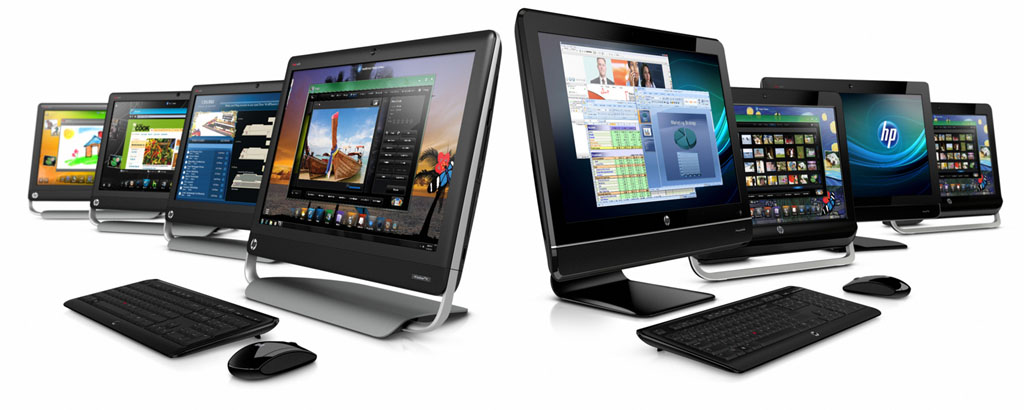
For a company that’s looking to get rid of its PC business, Hewlett-Packard is certainly making a major play for both consumer and business desktops, today unveiling no fewer than seven new all-in-one models designed to appeal to both small- and medium-sized business as well as consumers looking for an elegant computer for the home. HP’s investment in all-in-ones rather than traditional desktop form factors is a result to research showing both consumers and businesses are gravitating towards all-in-one systems with their integrated displays and small form factors—IDC research says in the next year 15.7 percent of commercial PC buyers worldwide intend to buy all-in-ones, while over a third of consumer desktop PC purchases in July 2011 were all-in-ones.
“The popularity of the all-in-one form factor continues to grow, and HP’s contribution to this market is significant,” said HP Personal Systems Group executive GP Todd Bradley, in a statement. “We continue to expand our portfolio to remain the global leader in Windows-based all-in-one PCs, introducing innovation that matters to business customers and consumers alike.”
HP’s new Omni and TouchSmart PCs feature HP LinkUp, enabling users to shift content from a notebook PC to the all-in-one without file-transfer hassles: users can view and interact with content on their notebooks from the all-in-ones, but the data never actually leaves the notebook, so users can pick up and go without having to worry about re-syncing.
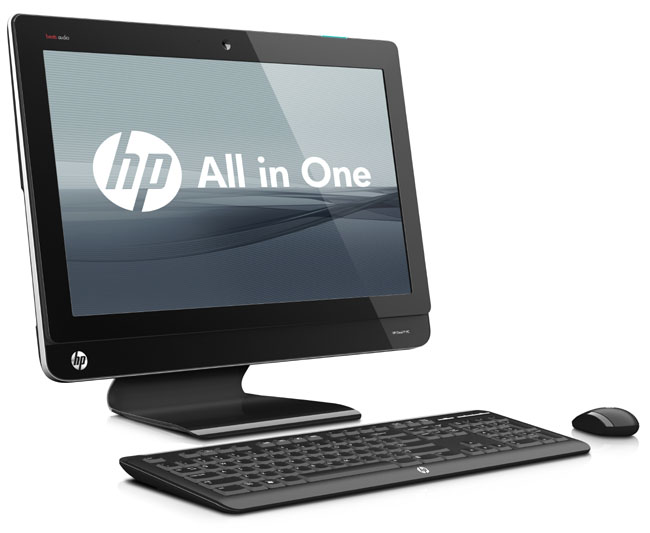
First up, HP is introduction the HP Omni 120 and HP Omni 220 PCs, with integrated 20- and 21.5-inch displays, respectively. Both feature HD-capable displays for entertainment and multimedia; the 120 will be available with either Intel or AMD processors and up to 750 GB of hard drive storage, while the 220 features a new cantilevered design, second-generation Intel Core processors, and selected models will sport Beats Audio. The OMni 220s will be available September 11 with prices starting at $799.99, while the Omni 120s will be available September 21 for starting prices of just $399.99.
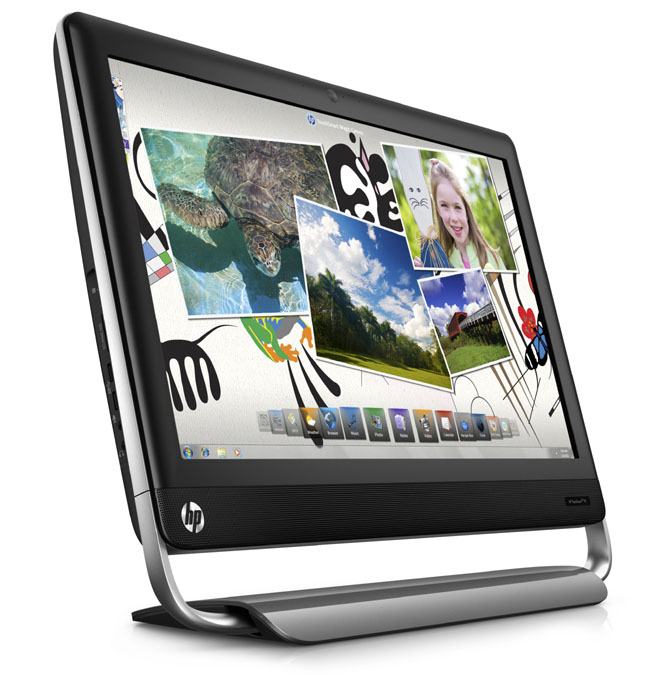
Next, the TouchSmart 320, TouchSmart 420, and TouchSmart 520 are designed to offer premium multimedia and touch experiences, with a new tilt-enabled display that’s intended to compliment a room rather than stand out as a high-tech über-gizmo. HP’s TouchSmart software enables users to get into Windows apps and use built-for-touch applications without having to fuss with a keyboard or mouse. The TouchSmarts feature Beats Audio technology, and the 520 and (previously released) 610 are available with an optional HP Pulse subwoofer. The TouchSmart 320 sports a 20-inch display, while the 420 steps up to a 21.5-inch display and a Blu-ray disc player, while the TouchSmart 520 moves to a 23-inch display and sports an HDMI input. The TouchSmart 520 and 420 will be available on September 11 with starting prices of $899.99 and $699.99, respectively; the TouchSmart 320s will follow in early October with starting prices of $599.99. The HP Pulse Subwoofer will run $149.99.
HP isn’t leaving business-types out of the loop: the HP TouchSmart Elite 7320 All-in-One business PC sports a 21.5-inch display, a choice of second-generation Intel Core i3, i5, or i7 processors, along with backing from HP’s premium support program for 24/7 security and help. Meanwhile, the HP Pro 3420 All-in-One aims at small businesses that rely on video chats and conferences: it features a 20-inch display, a second-gen Intel Core i3 processors, and handles up to 8 GB of RAM and 2 TB of storage. The TouchSmart Elite 7320 should land on September 21 for starting prices of $850; the HP Pro 3420s should be available in October for prices starting at $599.