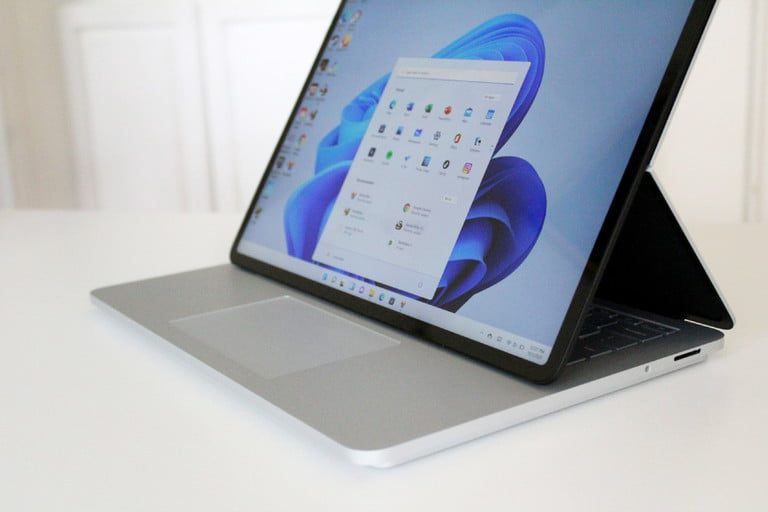
Microsoft’s Surface Book was an incredibly innovative laptop when it was first introduced, with its tear-off display and discrete graphics making for the most striking and powerful Surface ever. The Surface Book 3 is the latest iteration, and while it’s still around, it’s getting a bit old in the tooth even while remaining on our list of best 2-in-1s. The Surface Laptop Studio is the heir apparent, although it’s not an update. It’s an entirely new pull-forward convertible 2-in-1 design, and it equips even more powerful components.
Can the Surface Book 3 keep up with the Surface Laptop Studio? Or is the new kid on the block the better laptop?
Specs
| Microsoft Surface Laptop Studio | Microsoft Surface Book 3 13.5-inch | |
| Dimensions | 12.72 inches by 8.98 inches by 0.746 inches | 12.3 inches x 9.14 inches x 0.51 – 0.90 inches |
| Weight | 4.0 pounds | 3.38 pounds |
| Processor | Intel Core i5-11300H Intel Core i7-11370H |
Intel Core i5-1035G7 Intel Core i7-1065G7 |
| Graphics | Intel Iris Xe Nvidia GeForce RTX 3050 Ti |
Intel Iris Plus Nvidia GeForce GTX 1650 Max-Q |
| RAM | 16GB 32GB |
8GB 16GB 32GB |
| Display | 14.4-inch 3:2 IPS 2,400 x 1,600 | 13.5-inch 3:2 IPS 3,000 x 2,000 |
| Storage | 256GB PCIe SSD 512GB PCIe SSD 1TB PCIe SSD 2TB PCIe SSD |
256GB PCIe SSD 512GB PCIe SSD 1TB PCIe SSD |
| Touch | Yes | Yes |
| Ports | 2 x USB-C with Thunderbolt 4 1 x Surface Connect 3.5mm audio jack |
2 x USB-A 3.1 Gen 2 1 x USB-C 3.1 Gen 2 2 x Surface Connect 3.5mm audio jack SD Card reader |
| Wireless | Wi-Fi 6 and Bluetooth 5.1 | Wi-Fi 6 and Bluetooth 5.0 |
| Webcam | 720p | HD |
| Operating system | Windows 11 | Windows 10 (upgradable to Windows 11) |
| Battery | 58 watt-hour | 69 watt-hour (Core i5) or 75.3 watt-hour (Core i7) |
| Price | $1,599+ | $1,600+ |
| Rating | 4.5 out of 5 stars | 3.5 out of 5 stars |
Design

The Surface Book 3 13.5-inch model represents the third generation of Microsoft’s incredibly innovative tear-off display 2-in-1. Even though it’s a couple of years old, it’s still the only laptop of its kind. The 13.5-inch display houses most of the laptop’s components except the bulk of the battery and the discrete GPU on equipped models, both residing in the keyboard base. Tear off the display and you’re carrying most of the computer with you, only with limited battery capacity and integrated graphics.
The Surface Laptop Studio is a different beast altogether. It uses a pull-forward 2-in-1 design where the display is hinged in the center and can be pulled forward into media and tablet modes. It doesn’t detach, and it doesn’t lose functionality in any of its modes. They’re different, but both are innovators.
Both laptops are also well-built, with the Surface Book 3 using a magnesium alloy chassis and the Surface Laptop Studio using magnesium and aluminum. They’re rock-solid, with no flexing, bending, or twisting, and they’re built to tight tolerances that give them both an air of modern elegance and rigidity.
The Surface Book 3 is narrower than the Surface Laptop Studio, but it’s deeper. The Surface Laptop Studio is also thinner at 0.746 inches compared to the Surface Book 3 that reaches 0.90 inches in the rear where the fulcrum hinge is located. That hinge is necessary to balance the heavy display in clamshell mode, something the Surface Laptop Studio doesn’t require. The Surface Book 3 is also lighter at 3.38 pounds versus 4.0 pounds. Neither of these laptops is particularly svelte, however.
Aesthetically, they fit the Surface mold with a Platinum silver color throughout. Both are stunning designs in their industrial simplicity, but the Surface Studio Laptop is the standout given its more striking 2-in-1 configuration. It also looks more like a traditional clamshell in that mode, where the Surface Book 3 looks a little extended in the rear. The venting along the bottom of the Surface Laptop Studio lends a final touch that separates it from the Surface Book 3.
The Surface Book 3’s keyboard has copious amounts of travel and a stiffer mechanism, and it’s precise with a firm bottoming action. The Surface Studio Laptop’s keyboard has a lighter touch reminiscent of the Surface Pro 8‘s Type Color. There’s plenty of travel, although not as much as with the Surface Book 3, and it, too, has a precise switch mechanism with a precise action. Both are excellent keyboards, and the Surface Studio Laptop’s version benefits from a darker grey color than the silver on the Surface Book 3 that’s sometimes challenged to show off the backlighting.
The touchpad is where things are really different. The Surface Book 3 has a medium-sized traditional physical touchpad. It’s just fine, with excellent responsiveness and multitouch gesture support thanks to Microsoft Precision touchpad drivers, but it’s nothing special. The Surface Laptop Studio, though, uses a larger haptic touchpad that we found works even better than Apple’s Force Trackpad. At 75% sensitivity, our reviewer found it hard to differentiate the response from physical clicks. We loved it and look forward to all laptops utilizing haptic touchpads if they’re this good.
Connectivity is another Surface Laptop Studio strength. It offers two USB-C with Thunderbolt 4 and a Surface Connect. While that’s less than the Surface Book 3’s two USB-A and one USB-C ports, and Surface Connect, it’s more modern and supports hooking up an external GPU enclosure for more gaming performance. You’re trading dongles for flexibility, and we’ll take the latter approach. The Surface Book 3 does have an SD card reader, something we miss on the Surface Laptop Studio.
Performance

The Surface Book 3 equips 10th-gen Intel 28-watt U-series CPUs, and its discrete GPU option is the Nvidia GeForce 1650 Ti. That’s eclipsed by the Surface Studio Laptop’s 35-watt H-series CPUs and optional Nvidia GeForce RTX 3050 Ti. Across the board, the Surface Laptop Studio is the faster laptop.
For example, in our Handbrake test that encodes a 420MB video file as H.265, the Surface Book 3 took 275 seconds to complete the test while the Surface Laptop Studio took 179 seconds. These tests were performed in different versions of Handbrake, but we’ve found at most a 10 second or so difference in results on a given machine. The Surface Laptop Studio also scored significantly higher on the Geekbench 5 test, at 1,321 in single-core mode and 5,131 in multi-core mode compared to 1,315 and 4,009.
In gaming, the Surface Laptop Studio will be a much faster machine as well. The RTX 3050 Ti runs rings around the GTX 1650 Ti, as evidenced by the former’s 4,266 3DMark Time Spy test compared to the latter’s 3,214. The Surface Book 3 achieved 43 frames per second in Fortnite at 1080p and epic graphics, compared to the Surface Laptop Studio’s 57 fps.
Overall, the Surface Laptop Studio is a meaningful step up in performance over the Surface Book 3. For both productivity workers and creative types, it’s the faster machine.
Display

Surface machines are known for having excellent, high-resolution displays in the productivity-friendly 3:2 aspect ratio. The Surface Book 3 and Surface Laptop Studio are no exceptions. Once again, though, the newer machine provides a better overall experience and offers some innovations as well. To begin with, the Surface Studio Laptop’s display is brighter at 443 nits versus 422 nits (not a huge difference), and it offers wider colors at 100% of sRGB and 82% of AdobeRGB compared to 94% and 73%. The Surface Laptop Studio also has more accurate colors at a DeltaE of 1.21 (less than 1.0 is considered excellent) compared to the Surface Book 3’s 2.1.
The older device does have a slightly higher contrast at 1,420:1 compared to 1,270:1, but both are excellent. And the Surface Book 3’s 13.5-inch display is higher resolution at 3,000 x 2,000 compared to the Surface Laptop Studio’s 14.4-inch display at 2,400 x 1,600.
What really sets the Surface Laptop Studio’s display apart, though, is its 120Hz refresh rate, giving it smoother animations and on-screen movement compared to the Surface Book 3’s more typical 60Hz. And the Surface Laptop Studio supports Microsoft Surface Slim 2 pen, which has haptic feedback built in that more accurately mimics writing on paper. There’s even a dock for the pen that charges it while not in use.
The Surface Laptop Studio provides more dynamic colors, a faster refresh rate, and better pen support. It wins this category, hands down.
Portability

As mentioned earlier, neither of these laptops is particularly thin or lightweight. Neither is egregiously heavy, though, so you can slip them in your backpack and not break your back carrying them around.
The Surface Laptop Studio has less battery capacity overall, compared to the combined capacity in the Surface Book 3 split between the tablet portion and the base. Even so, the two laptops split our battery tests. The Surface Laptop Studio has better battery life, at 10.5 hours in our web browsing test versus 9.8 hours and 13.6 hours. In our video looping test, though, the Surface Book 3 hit 14 hours versus 13.6 hours. But there’s a catch. Tear off the Surface Book 3’s display and use it in tablet mode, and battery life drops considerably, to just over two hours in the web browsing test and about 3.5 hours in the video looping test. That means the Surface Laptop Studio will achieve a much longer battery life in tablet mode.
The Surface Laptop Studio is the current 2-in-1 state of the art
The Surface Book 3 starts at $1,600 for a Core i5, 8GB of RAM, a 256GB SSD, and integrated graphics. It tops out at $2,700 for a Core i7, 32GB of RAM, a 1TB SSD, and discrete graphics. It’s an expensive laptop from start to finish.
The Surface Laptop Studio starts at $1,600 for a Core i5, 16GB of RAM, a 256GB SSD, and integrated graphics. It maxes out at $3,100 for a Core i7, 32GB of RAM, a 2TB SSD, and discrete graphics. It’s an even more expensive laptop.
The Surface Book 3 had its time in the sun as the most innovative 2-in-1 around. The Surface Laptop Studio has arrived to take its place at the top of Microsoft’s lineup, offering a more practical design overall, a better display, faster performance, and more useful battery life. It’s the more attractive laptop by a long shot.