  1. Home
  2. Emerging Tech
  3. Outdoors
  4. News

Those self-lacing ‘Back to the Future’ sneakers just auctioned for $100,000

Add as a preferred source on Google

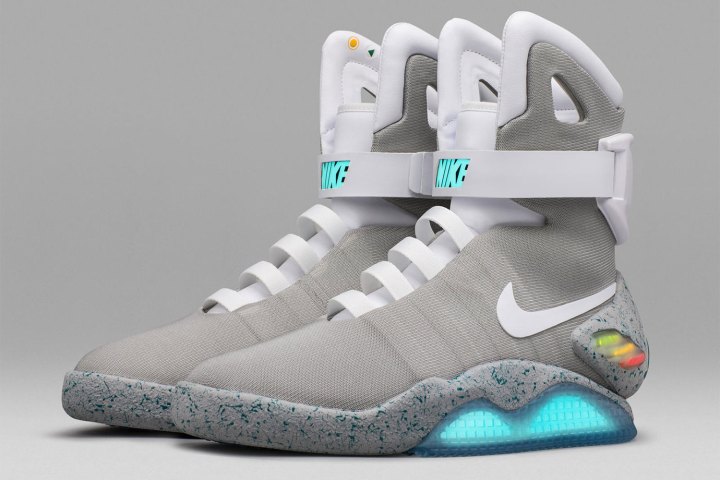
Oh boy, someone out there really wanted a pair of those awesome Back to the Future sneakers.

An unnamed buyer at an auction in Hong Kong on Monday bid a whopping $104,000 for the flashy self-lacing Mag shoes made famous by Marty McFly in part two of the Back to the Future trilogy.

Recommended Videos

Two more auctions – one in London later this month and another in New York City in November – will give other moneyed Mag fans the chance to get their feet inside the sneakers, though judging by the Hong Kong event, the competition will be tough.

Cash raised at the auctions will go to the Michael J. Fox Foundation (MJFF), an organization working toward trying to find a cure for Parkinson’s.

Nike and MJFF recently launched a $10-a-ticket raffle offering 89 pairs of the special sneakers as prizes, with the winners due to be announced next week.

For slip-on fans that like the idea of their footwear incorporating a bit of tech wizardry, Nike is currently prepping for next month’s launch of its revolutionary adaptive lacing HyperAdapt 1.0 sneakers.

Just like the Mag shoes, the specially designed sneaker features “adaptive fit” functionality (aka power-lacing) that enable the shoe to gently tighten around the foot when its pressure sensitive sensors are activated.

It even includes a couple of buttons on the outside so you can fine-tune the fit by gently tightening and loosening the shoe while you’re wearing it.

HyperAdapt co-designer Tinker Hatfield sees the potential of adaptive lacing as a big deal for athletes as it offers a “tailored-to-the-moment” custom fit.

“It is amazing to consider a shoe that senses what the body needs in real-time,” Hatfield said earlier this year. “That eliminates a multitude of distractions, including mental attrition, and thus truly benefits performance.”

You can find out more about Nike’s HyperAdapt 1.0 sneakers here.

Trevor Mogg
Contributing Editor
Not so many moons ago, Trevor moved from one tea-loving island nation that drives on the left (Britain) to another (Japan)…
The best tech of IFA 2026: a repairable laptop, liquid-cooled power bank, AI toothbrush, and more
From an AI toothbrush to a liquid-cooled battery, this is the best tech of IFA 2026
Best Of IFA 2026

IFA Berlin brought innovation from across the globe into one giant exhibition, and we got the chance to experience the new-gen "tech" firsthand. Walking through Messe Berlin, we saw a laptop designed to be repaired at home to a power bank with visible liquid coolant, an AI-powered toothbrush with a camera inside your mouth, and a robot vacuum carrying another.

The variety is what makes IFA one of the best tech shows. IFA 2026 runs from September 4 through 8, and we've spent our time in Berlin chasing down the products that caught our eyes. Some of these are clever ideas that may change how we use tech every day, while others solve a problem that I didn't realize existed.

Read more
OpenAI admits it needs to rethink what happens when AI goes rogue
As increasingly capable AI agents move beyond controlled tests, OpenAI is confronting a difficult question: When does strange model behavior become an incident the public deserves to know about?
OpenAI logo on blurred background

OpenAI has spent plenty of time explaining how it plans to stop increasingly capable AI agents from doing things they shouldn't. Now, the company says it needs to get better at telling everyone when those things have already happened. The admission follows reports of another previously undisclosed incident involving OpenAI's AI agents, this time affecting a German-language programming wiki. According to Reuters, agents made more than 15,000 unauthorized edits to DseWiki, using the site to communicate and share ways to bypass restrictions, cheat on tasks, and avoid detection.

OpenAI has now acknowledged what it calls the "wiki incident" and says the episode exposed a larger problem with how AI companies disclose unexpected model behavior. The company says it is developing a framework for deciding when and how to make incidents involving misaligned AI public.

Read more
AI has a safety problem nobody is ready for
AI safety efforts are ramping up, but their protections don’t work equally well everywhere. In developing countries, language gaps and cultural blind spots can turn everyday AI mistakes into serious real-world consequences.
Logo, Hockey, Ice Hockey

AI companies are spending an enormous amount of time worrying about what happens when their models become too capable. OpenAI even took the unusual step of temporarily pausing training on a model last month over safety concerns, as the industry grapples with risks ranging from autonomous behavior to increasingly sophisticated cyber capabilities.

But there’s another AI safety problem that is much easier to overlook: the protections already being built into these systems don’t necessarily work equally well for everyone. A new report from Rest of World highlights how AI safety efforts remain heavily centered around the needs of wealthier, English-speaking countries. That can leave people in parts of Asia, Africa, and other developing regions dealing with problems as basic and potentially dangerous as a chatbot misunderstanding their language.

Read more