  1. Home
  2. Emerging Tech
  3. News

How to watch the launch of the ESA and NASA Solar Orbiter on Sunday

Add as a preferred source on Google

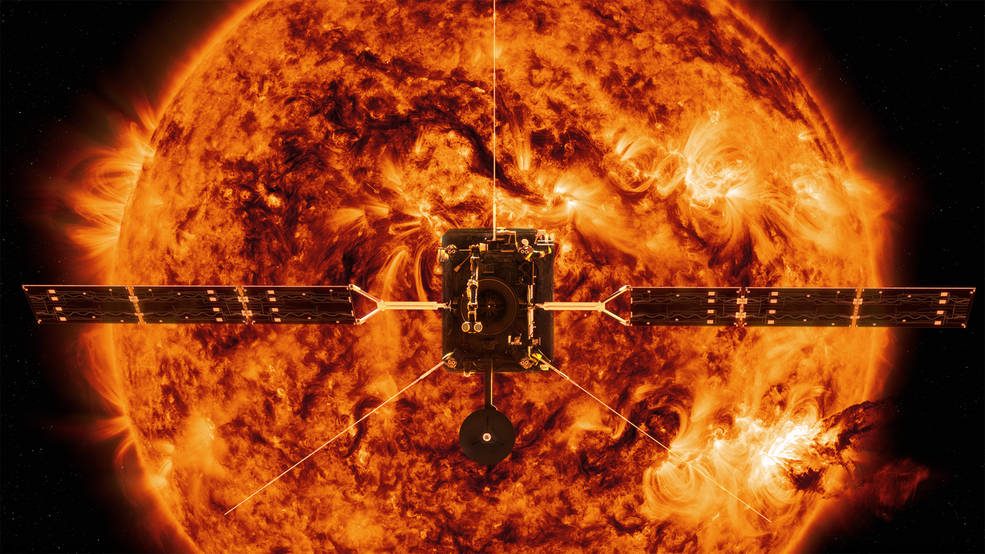
An illuratrion of ESA’s (European Space Agency’s) Solar Orbiter spacecraft
ESA’s Solar Orbiter spacecraft is shown in an illustration against the backdrop of an image of the sun captured by NASA’s Solar Dynamics Observatory. Solar Orbiter will capture the very first images of the sun’s polar regions. These images will provide key insights into the poorly-understood magnetic environment there, which helps drive the sun’s 11-year cycle and its periodic outpouring of solar storms. ESA/ATG MediaLab/NASA

On Sunday night, a joint mission between NASA and the European Space Agency (ESA) will launch the Solar Orbiter from Space Launch Complex 41 at Cape Canaveral, Florida. The spacecraft will image the surface of the sun, coming closer to the star than any European satellite has before.

Recommended Videos

The satellite will enter an elliptical orbit around the sun, meaning it will come closer at some times than at others, and it will view some areas of the sun which have never been seen before, such as the poles. The aim of the mission is to study the sun’s effects up close, including trying to understand more about its magnetic field and its solar winds, which affect the rest of the solar system in the form of space weather.

At its closest, the Solar Orbiter will come just 26 million miles from the surface of the sun, which is around one quarter of the distance between the sun and the Earth. This means the craft will have to survive blistering temperatures of up to 932 degrees Fahrenheit. To allow the scientific instruments to view the sun, the craft has small sliding doors with heat resistant windows which let in the light, while the instruments themselves are kept cool behind a sunshield.

You can watch the launch live using the NASA TV video below. Alternatively, you can also watch on the ESA website.

NASA Live: Official Stream of NASA TV

Launch coverage begins at 7:30 p.m. PT on Sunday, February 9. The launch itself is targeted for just after 8 p.m. The separation of the spacecraft should occur at 8:55 p.m., and the earliest opportunity for signal acquisition, when the scientists discover if they can communicate with the craft as they hope, is at 9 p.m. PT. The solar array is set to be deployed just before 9:40 p.m.

Georgina Torbet
Georgina has been the space writer at Digital Trends space writer for six years, covering human space exploration, planetary…
Anti-surveillance clothing is getting cheaper, but don’t expect an invisibility cloak
Affordable shirts now claim to confuse facial recognition, although their protection depends heavily on the camera and software watching you
Chart, Plot, Adult

Anti-surveillance clothing is starting to look less like an art-school experiment and more like something you could actually wear outside. Shirts designed to confuse facial recognition systems now cost about as much as ordinary streetwear, although buying one won’t make you disappear.

The Guardian reports that designers are using face-like prints, unusual cuts and infrared lights to interfere with computer vision. These techniques target specific weaknesses, so their success depends on what happens to be watching you.

Read more
This spinning drone hides in plain sight using a visual illusion
This drone doesn't turn invisible. It tricks your brain into thinking it has.
Phantom Twist

For decades, engineers have chased the dream of an invisible drone. The usual approaches have involved transparent materials, camouflage coatings, or complex optical systems that bend light around an object. Researchers at Northwestern University decided to take a completely different route. Instead of hiding the drone itself, they chose to fool the human eye.

The result is Phantom Twist, an experimental drone that spins so rapidly it almost disappears into the background. It's not technically invisible, but to anyone watching, it looks more like a faint blur than a flying machine.

Read more
This smart knitted fabric can flip switches, count your steps, and even change shape
Grandma's knitting just entered its Iron Man era
Representative Image

For most of us, knitting brings to mind sweaters, scarves, and perhaps an ambitious grandmother determined to make winter more fashionable. Researchers at Harvard University, however, have a far more futuristic vision. They've transformed ordinary knitted fabric into a programmable material capable of changing shape, acting as an electrical switch, sensing movement, and potentially forming the foundation of tomorrow's wearable technology.

The research, published in Advanced Functional Materials by scientists at the Harvard John A. Paulson School of Engineering and Applied Sciences (SEAS), demonstrates how machine-knitted textiles can "snap" between multiple stable shapes without relying on motors or rigid mechanical parts.

Read more