1. Home
  2. Emerging Tech
  3. News

This six-legged spider drone can crawl into places quadcopters can’t reach

Add as a preferred source on Google

When you hear the word “drone,” your mind probably conjures up images of quadcopters and other UAVs — but despite the fact that the word has become more or less synonymous with “airborne robot,” the term doesn’t exclusively refer to robots that can fly. Sure, flying drones tend to get all the attention these days, but as autonomous robotics technology continues to advance, drones are increasingly making their way onto land and sea as well.

Case in point? This awesome six-legged spider drone from Spanish upstart Erle Robotics. Rather than patrolling the skies and giving you a bird’s-eye view of the world, this beast scuttles along the ground and lets you to explore places that would typically be of reach for an airborne drone.

Recommended Videos

It’s certainly not the first land-bound drone that’s ever been invented, but Erle-Spider does have a few things going for it that other drones don’t — the first and most obvious of which is its six legs. By walking around instead of rolling on wheels, the drone can scramble over more complex and varied terrain without getting stuck.
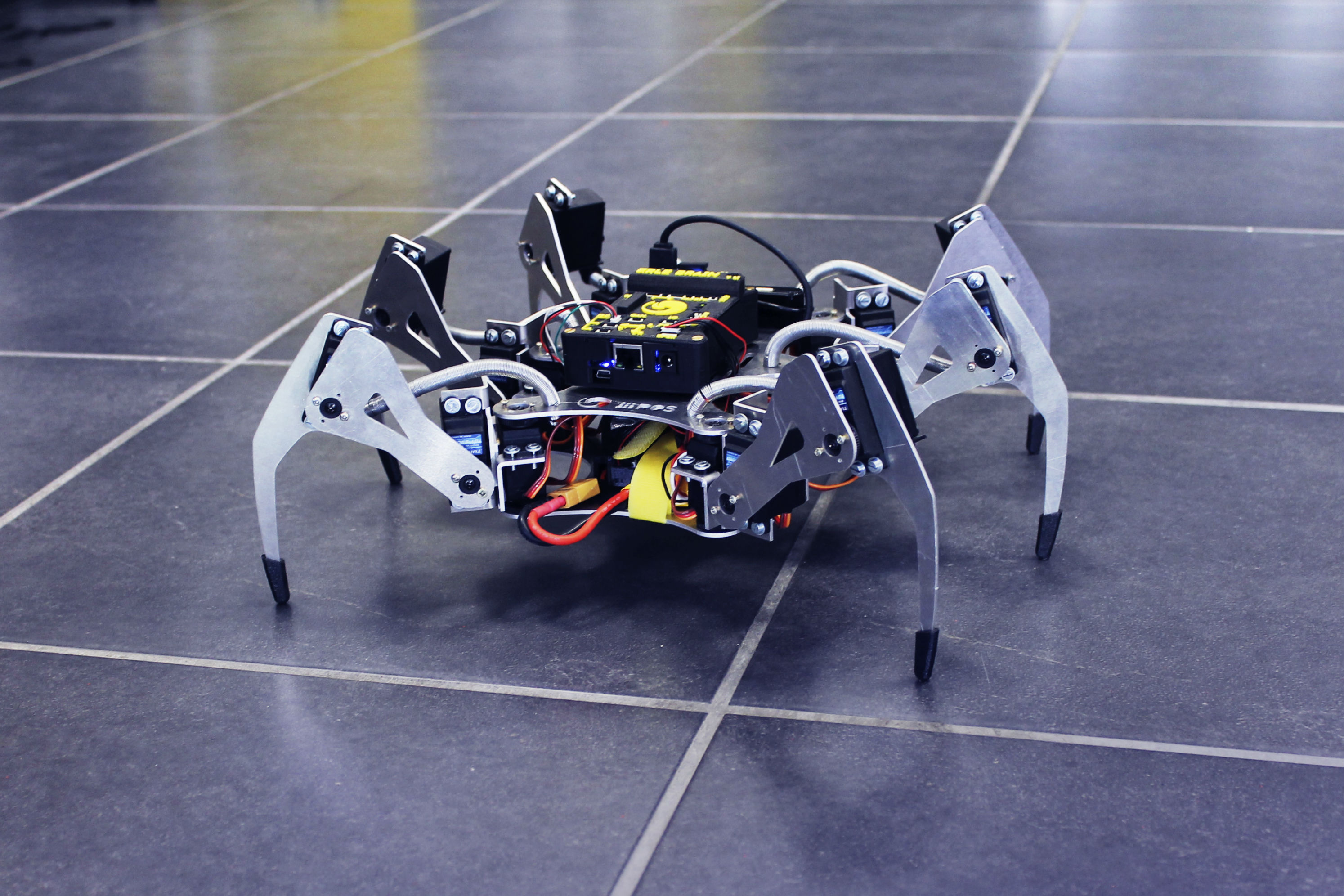
Erle-Spider

It can also carry a lot more tech. Not bound by the same weight restrictions that airborne UAVs have, Erle Robotics packed some serious computing power into the spider. The bot hauls around what the creators call the “Erle Brain 2” — a Linux-based onboard computer that sports a 900MHz quad-core ARM Cortex-A7, 1 GB RAM, and a dizzying array of sensors (gravity sensor, gyroscope, digital compass, pressure sensor, and temperature sensor).

With all this sensing and processign power at its disposal, the Erle-Spider can perform all kinds of nifty stunts — such as walking around and autonomously avoiding obstacles, or using computer vision to navigate new environments. And of course, because Erle Robotics has also created a software development kit for the bot, it can be programmed to do just about anything you want — except flying, of course.

The Erle-Spider isn’t quite ready for prime time yet, but it’s creators have recently turned to the crowdfunding community on Indiegogo for help with production costs, so you can lock one down for a pledge of about $400 to $570 (depending on the configuration you choose). Barring any major setbacks during manufacturing, Erle Robotics expects to have its spider bots ready and shipped out by December.

Drew Prindle
Former Senior Editor, Features
Drew Prindle is an award-winning writer, editor, and storyteller who currently serves as Senior Features Editor for Digital…
Starlink V5 is here, and it’s lighter, smarter, and far more efficient
The next-generation satellite internet kit promises improved efficiency while maintaining high-speed connectivity.
Starlink V4 vs V5

Not every hardware upgrade needs to be about speed. With Starlink V5, SpaceX is betting that a lighter design and lower power consumption matter just as much. The company has officially introduced its next-generation Starlink V5 kit, featuring a smaller and lighter design with significantly improved power efficiency.

Smaller, lighter, and far more efficient

Read more
Frontier joins the Starlink club with high-speed in-flight internet
The carrier plans to roll out SpaceX's satellite-powered Wi-Fi across its fleet starting in 2027.
Frontier Starlink partnership featured

If there's one thing budget airlines aren't exactly known for, it's great onboard Wi-Fi. In Frontier Airlines' case, it hasn't offered in-flight internet at all. That's about to change. Frontier Airlines has announced a partnership with SpaceX's Starlink to bring high-speed, low-latency internet across its fleet. Installations will begin in early 2027, making Frontier the first ultra-low-cost carrier in the United States to adopt Starlink's satellite-powered connectivity.

Streaming, browsing, and even gaming at 35,000 feet

Read more
OpenAI’s first hardware product sounds more like a companion than a speaker
The AI company is reportedly building a mobile home device that understands context and proactively helps users.
OpenAI press image

For months, rumors have suggested that OpenAI's first hardware product could be a wearable AI device, or perhaps even the beginning of its long-term smartphone ambitions. As it turns out, the company's first gadget may be something far simpler, yet arguably far more ambitious. It will help control smart-home appliances, play media, answer questions, respond to messages, and tap into the range of capabilities offered by OpenAI's ChatGPT, according to people familiar with the matter.

OpenAI's first AI device could end up being a speaker, following plenty of hype that the company is actually working on a wearable AI device and might even launch a smartphone down the road. According to a Bloomberg report, the speaker will serve as a human-like AI companion that will integrate directly with the smart home ecosystem.

Read more