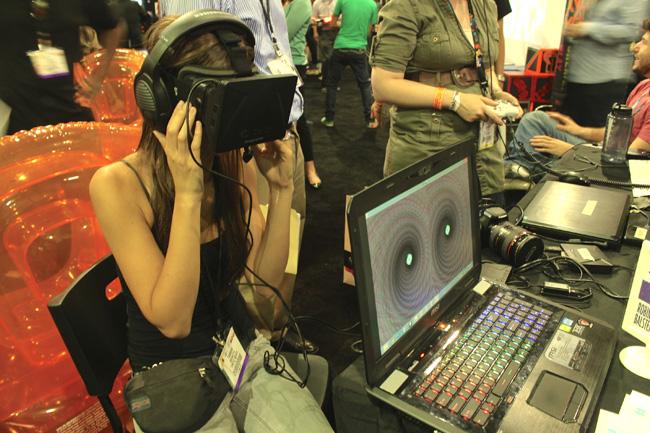
IndieCade is a strange anomaly at E3, offering up plain tables and single-player stations where interested parties can check out the latest and great indie games. It’s located just a few steps away from the towering booths, cacophonous sounds, and siren-like draw of the massive publishers, creating a show-within-the-show. The things going on at IndieCade are often more exciting than the big named Shooter Sequel 17, but they still have to compete for eyeballs next to the big players, and it can be difficult making an impact when you don’t have the same resources.
The team at IndieCade has been bringing the wonderful world of indie gaming to E3 for the past seven years, and while it remains a challenge for them, festival director Sam Roberts said this year was the steadiest for traffic by far. In the past its traffic tended to spike at certain times during the show, but the sheer volume of games they were showing, along with the fact that the Oculus Rift was there, was enough to keep them busy and seemingly very happy throughout E3.
We spoke to Roberts just as the curtain came down on E3 2013 to talk about being a small player on the world’s biggest video game stage. Although we really shouldn’t say “small,” because Indiecade brought 44 awesome games with them during the show.
Digital Trends: What’s it like bringing the IndieCade experience to E3?
Sam Roberts: It’s hard. It’s a very large event. It’s also not our focus. Our focus is the festival, this is just sort of a satellite showcase. It’s an opportunity for us to increase our mission by reaching out to a different audience and showing them the cool games that we like to show at the festival.

Is it difficult to catch someone’s attention here, or are most people excited to see what you have to offer just out of range of the giant booths?
I actually find it’s much more the second. One of the things that’s nice for us about showing at E3, particularly since they went through sort of a dip and then recover in of size and loudness over the past several years. As it’s gotten louder people have been more and more appreciative of having a place to come that’s a little quieter, where the games are a little more reflective, and where it’s more content and less booth. Where they can just sort of get in and play some stuff.
What have been some of the standout games?
I think everything is a standout all the time, but this year we had a lot of attention at Sound Self, which is an Oculus Rift demo that’s super cool, made by Robin Arnott. He also made Deep Sea which we showed a couple of years ago. Also doing well this year is Legend of Dungeon which is a multi-player, rogue-like dungeon crawl with a pixel art style sort of in the vein of Sword & Sorcery.
“But [Sony], out of all the console makers, are the only ones who seem to have made a really dedicated sort of push towards getting indies on their side and making a console that indies feel comfortable trying to be on.”
I mean, we have a ton of amazing stuff. We also had Spaceteam in the booth this year which, I just love that game. It’s quite difficult but a lot of fun. So those were successful games this year. It was fun. We have Johann Sebastian Joust back this year. We showed that three years ago when it was just an independent game and now we’re showing it as a part of our sponsorship relationship with Sony because they have it coming out on the console later this year.

It feels like Microsoft has not really been endearing themselves this time around to indie developers, but Sony has gone out of their way to do that. Has that been rippling through the community?
It has. So, Sony decided that this is something they wanted to do and have spent the last three or four years doing it right. They’ve been involved in sponsoring us for a few years. From year one where it was like “Why is Sony here?” now people are like, comfortable and happy to see them. But also in year one when they did it, they didn’t have anything, and we were like, “Well we can show some games if you have independent Sony stuff” and they were like “Uhhhh, what is that?”
Now we’re like “independent Sony stuff?” and they say “Here’s 20 games we can suggest,” all of which were fabulous. I think they really have just worked hard at it. They’ve done a lot of outreach to the community. They’ve made the development kit available and easy to use which is a crazy, big, important deal. And they seem to be, I haven’t seen it in talking about the Playstation 4 but in talking to developers who are working with them, developers feel confident that Sony is going to help support them through discovery. Which of course is the hardest problem for every indie. It’s like, it’s fine that my game is out there on a console but if nobody buys it – it doesn’t matter.
Sony has convinced the development community that they’re going to back them in that part and as long as they do it, I think it will continue to go very well for them. So, we’ll see how that goes. But they, out of all the console makers, are the only ones who seem to have made a really dedicated sort of push towards getting indies on their side and making a console that indies feel comfortable trying to be on.
So, where are the burgeoning indie game centers in the US right now?
The cities with the largest communities in North America are Toronto, Austin, Los Angeles … San Francisco has a ton of people but not a very organized community and New York’s the same way. There are a million indie devs in New York right now and they just aren’t organized. Whereas Boston has way less devs but they really are all together. So, you know, that’s not a surprising list of cities right? Those are major American cities but those are most of the places you’re finding large communities building up.
There are some secret surprise places like PIttsburgh on that list. But Pittsburgh is on that list because of Carnegie Mellon. And as more and more universities have similar game programs, that’ll sort of even out a little. Like, Chicago has a surprisingly small indie development scene. There’s some people there but there’s not really a community. Even though there are several more traditional studios there.

What can we expect to see at IndieCade this year?
I mean, we grow every year so I expect it will be a bigger event yet again. We’ll probably show a few more games. We showed some new things at the booth at E3 this year that I was really excited about, one of which is new technologies and new hardware. Those are a great way to encourage new kinds of development and new kinds of games. I think we’re going to have more of that at the festival. Not just Oculus and Sifteo but hopefully some of these other interesting pieces of hardware and interface that are coming out.
“We showed some new things at the booth at E3 this year that I was really excited about, one of which is new technologies and new hardware.”

As far as the curation of indie games goes, where do you recommend people find them? Is it Venus Patrol? Is it somewhere else?
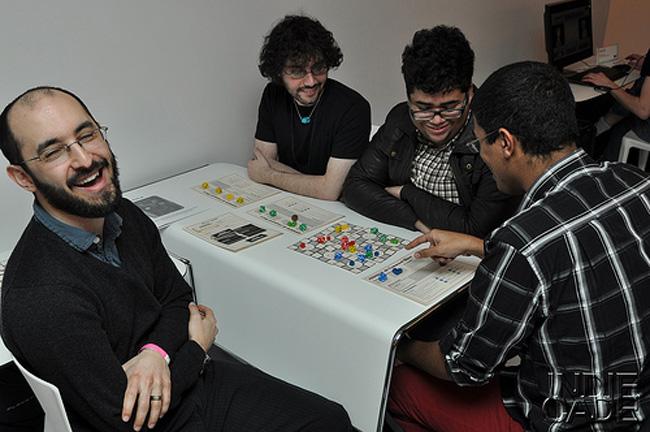
I would use as many resources as you can find. Part of the thing that’s amazing about indies is that it’s a huge space and there’s all this stuff in here that is games. At IndieCade, we showed board games, table games, physical games. You know, if you want to find some of that stuff you’re better off going to like the Tabletop show on Geek and Sundry than you are to Venus Patrol. But if you want cool indie stuff with retro art styles, Venus Patrol is going to really show that to you. If you want stuff that’s experimenting with the form, then Kill Screen covers that really well.
I tend to think if you want a broad view of as much stuff as possible, then we’re the best place to go. Because we focus very hard on including everything. My mission is to be more and more inclusive every year. I drive to get a new part of the gamer community in. Last year we managed to finally have submitted and showed tabletop role playing games which was really exciting for me. I’m a huge tabletop nerd. So, I think we’re a great place to go to get a broad view. And then if you have a specific thing you’re excited about, find out who the guys really covering it are and start to dive in there.
There are tons of great resources, not just Kill Screen and Venus Patrol and Geek and Sundry but you know, Indiegames, the web blog, covers tons of stuff. If you like small, short, flash style or mobile style experience, Jayisgames is still a fantastic website that covers tons of the stuff that comes out. So there’s still a lot of places out there to go and look.
Editors' Recommendations
- E3 needed to end, but its demise is a net negative for the gaming industry
- The ‘Indie’ label is losing its meaning, and that’s a big problem for gaming
- ESA denies E3 2024 and 2025 have been canceled, despite LA tourism board’s claims
- E3 2023 has officially been canceled by the ESA and ReedPop
- Ubisoft will not attend E3 2023, but it will still host a summer live stream