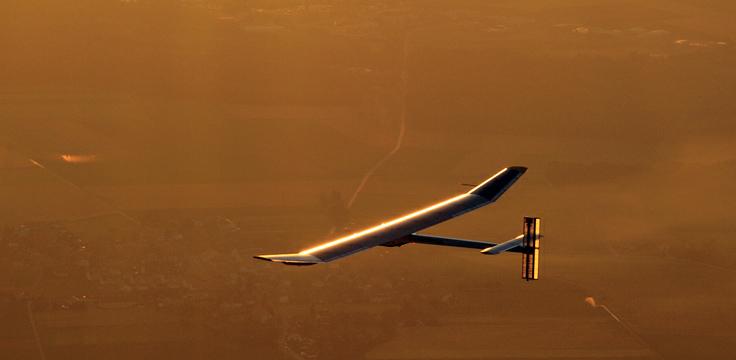
 The Solar Impulse aircraft glided into the history books over the weekend by becoming the first solar-powered plane capable of flying day and night to cross the US.
The plane completed the final leg of its journey when it landed at New York’s JFK airport late Saturday after taking off in Washington, DC, earlier the same day. The coast-to-coast adventure began in San Francisco in early May and included scheduled stops in Phoenix, Arizona, Dallas, Texas, and St Louis, Missouri. During its journey it also picked up the record for the longest distance for a solar-powered flight, traveling 958 miles (1,541 kilometers) from Phoenix to Dallas.
At the controls on its final leg to New York was André Borschberg, though Swiss compatriot Bertrand Piccard also piloted the single-seat aircraft on other legs of the journey
Fly-past aborted
Borschberg was supposed to make a fly-past of the Statue of Liberty on Saturday but a large tear in the fabric of Solar Impulse’s left wing led the pilot to cancel the plan and instead head straight to the final destination.
Speaking about the flight shortly after landing, Borschberg said, “This last leg was especially difficult due to the damage of the fabric on the left wing. It obliged the team to envisage all the possible scenarios, including bailing out over the Atlantic. But this type of problem is inherent to every experimental endeavor.”

Called the Across America project, the flight marked “the first time a plane capable of flying day and night powered exclusively by solar energy has crossed the USA from the West to the East Coasts without using a single drop of fuel,” the team behind the project said on its website.
Powered only by the sun’s energy, Solar Impulse has a wingspan of 63 meters and weighs just 3,500 lb (1600 kg). Nearly 12,000 solar cells on the plane’s wings and stabilizer drive its four propellers and work to charge its 880 lb (400 kg) of lithium-ion batteries for night-time flying.
Records
Solar Impulse is no stranger to the record books – in 2010 it completed the world’s first solar 26-hour day and night flight, while last year it hit the headlines when it became the first solar plane to make an intercontinental flight, from Europe to Africa. The flight, which began in Madrid, Spain, and ended in Rabat, Morocco, took Solar Impulse and pilot Piccard 19 hours to complete.
Piccard explained at the time that the purpose of Solar Impulse is to “to make a revolution in the mindset of the people when they think about energy issues.”
Pioneering
“Solar Impulse is really a pioneering adventure,” Piccard said. “We open new doors. We are not an industry that’s planning to put solar airplanes on the market.”
He added, “We want to demonstrate how sexy and exciting the new technology can be that can protect the environment and reduce the dependency on fossil energy. We can say ‘even if this airplane is not transporting any passengers, all these technologies can be implemented in daily life, for cars, or for heating systems or for the construction of houses.’ All the technology exists, we should use it much more in our daily life.”
The team behind Solar Impulse is planning to embark on a round-the-world flight some time in 2015.