Contemplating your next TV purchase, but unsure if you should wait around for the coming wave of OLED TVs we’ve all been hearing about? In this article we’ll offer up a plain-english explanation of how OLED and plasma displays work, and in the process help you understand the pros and cons of each technology.
How OLED TVs work
As you probably know by now, OLED stands for Organic Light Emitting Diode. It’s true that this is just a slight variation on traditional LED, but don’t let the acronym fool you – when we’re talking about display technology, the two are vastly different things. If you’ve read our LCD vs LED comparison piece, you know that the “LED” in LED TV is really just a reference to the TV’s backlighting technology, and that these types of TV are really just LED backlit LCD displays. OLED displays are completely different. Rather than relying on an LCD filter to turn an individual subpixel on or off, OLED pixels are independently lit, so they don’t require backlighting and filters to function. Here’s a simplified cross-section of an OLED pixel:
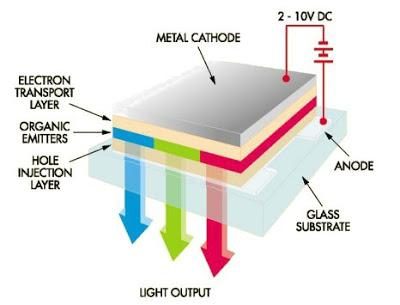
Basically, an OLED subpixel is comprised of a thin layer of organic carbon-based compounds sandwiched between two electrodes. When electricity passes from one electrode to the other, it excites the sandwich layer of organic materials, and through a miracle of chemistry and physics, this causes the compound to emit light. Depending on which organic compound is used, it will emit either a red, green, or blue glow. This technology has been used in smartphone displays for years, but wasn’t utilized by television manufacturers until recently.
How Plasma TVs Work
In comparison to OLEDs, plasma displays work in a slightly different fashion. Instead of using organic light-emitting materials for each pixel, images on a plasma TVs are created by ionized gas (plasma) that lights up when you run an electrical current through it. The easiest way to understand it is by thinking of each individual subpixel on the TV as a tiny neon light, or perhaps a miniature version of the florescent tubes you might be sitting under right now. The pixels that make up a plasma display are almost exactly the same technology, just on a much smaller scale.

For those of you who care to understand the science behind it all, here’s how the magic happens: An electrode applies an electrical current to a small cell filled with a noble gas mixture (usually neon and xenon). This excites the gas, ionizing it and transforming it into a plasma. This plasma emits ultraviolet light – which we can’t see – but when the UV light hits a phosphor coating that lines each cell, it causes the phosphor to glow and put out light that we can see. Depending on which particular phosphor the cell is coated with, it will create a red, green, or blue glow. Each cluster of red green and blue subpixels makes up one pixel on the screen.
Which is Better?
Because plasma and OLED displays produce light through different means, the two technologies carry different virtues and shortcomings. To help you get a clearer idea of where they excel, where they fall short, and why; we’ve put together the following table:
| Category | Winner | Explanation |
| Color Gamut | OLED | OLED has a much wider color gamut than plasma, and is close to the DCI movie theater standard |
| Black Levels | OLED | Both plasma and OLED displays offer excellent blacks since they can completely turn off individual pixels, but OLED does it better. The way plasma panels are constructed causes a small amount of ambient light to be refracted out to the viewer, and OLED displays don’t have this problem. They’ve got some of the deepest blacks we’ve ever seen. |
| Brightness | OLED | OLEDs can get ridiculously bright, and win this category by a wide margin. |
| Response Time | OLED | OLED currently offers the fastest response time of any TV technology in use today, making it a clear winner in this category, but it doesn’t really matter. Both OLED and Plasma displays are so fast that we mere mortals won’t see any motion blur |
| Viewing Angle | Plasma (for now) | Plasma wins this category for now, but only because the few OLED TVs on the market right now are curved, which complicates things. If we were comparing plasma and OLED on flat displays, it’d likely be a tie between the two – both technologies offer excellent viewing angles because they don’t rely on LCD panels to block out light, but the currently available curved OLEDs introduce the following problems: First of all, the side that is curved away from an off-axis viewer will be less visible than the side curved toward that viewer, and second because of the curve, anti-glare coatings can tend to tint the image when viewed from extreme angles. |
| Power Consumption | OLED | OLEDs are vastly more energy efficient than plasma TVs. It’s not even close. |
| Thickness | OLED | by virtue of their composition, OLED displays are among some of the thinnest we’ve ever seen. We’re talking wafer thin – often under 5mm – so not even the slimmest LED or plasma screens can compare. |
| Screen Size | Plasma (for now) | At this point in time, plasma displays beat out OLEDs in terms of size, but this is simply because the only two OLED screens on the market right now are 55-inches. This is definitely going to change in the not-so-distant future when more manufacturers release OLED TVs, but for now plasma displays come in larger sizes. |
| Lifespan | Plasma | OLED is unproven when it comes to lifespan, and there is some cause for concern here because the compound used to create the color blue in OLED televisions is known to have a shorter life span. As one color degrades, the rest will go out of whack. Samsung appears to be battling this issue by using a blue pixel that is twice the size of other colors and reducing the amount of voltage applied to it. LG uses white sub-pixels and lays a color filter over them to create the desired red, green and blue colors. These bandages may very well work, but only time and use in the public arena can tell how OLED will hold up on the long term. For that reason, we have to call LED/LCD the winner, as its lifespan has proven itself to be adequate |
| Price | Plasma | OLED tv’s are just now reaching the market, and as such, they’re still really freaking expensive. With some models costing up to $10,000, they’re still out of reach for most consumers at this point. As with any new technology, we expect the price of OLEDs to drop drastically in the next few years, but until then, plasma is definitely the best option for us mere mortals |
Bottom Line
In terms of performance, OLED displays are definitely the superior technology. They’re thinner, more efficient, and mind-bogglingly color accurate. The only problem is that they’re prohibitively expensive, and at this point we’re still not sure how long their pixels last before the organic materials start to degrade and lose brightness. For this reason we’d recommend holding off and waiting for the technology to mature before you bust out your wallet. In just a couple more years, it’s likely that manufacturers will work out the major kinks, but in the meantime we suggest sticking to LED and plasma displays.