
  1. Home
  2. Emerging Tech
  3. Mobile
  4. Legacy Archives

ARM debuts eight-core mobile graphics processor

Add as a preferred source on Google

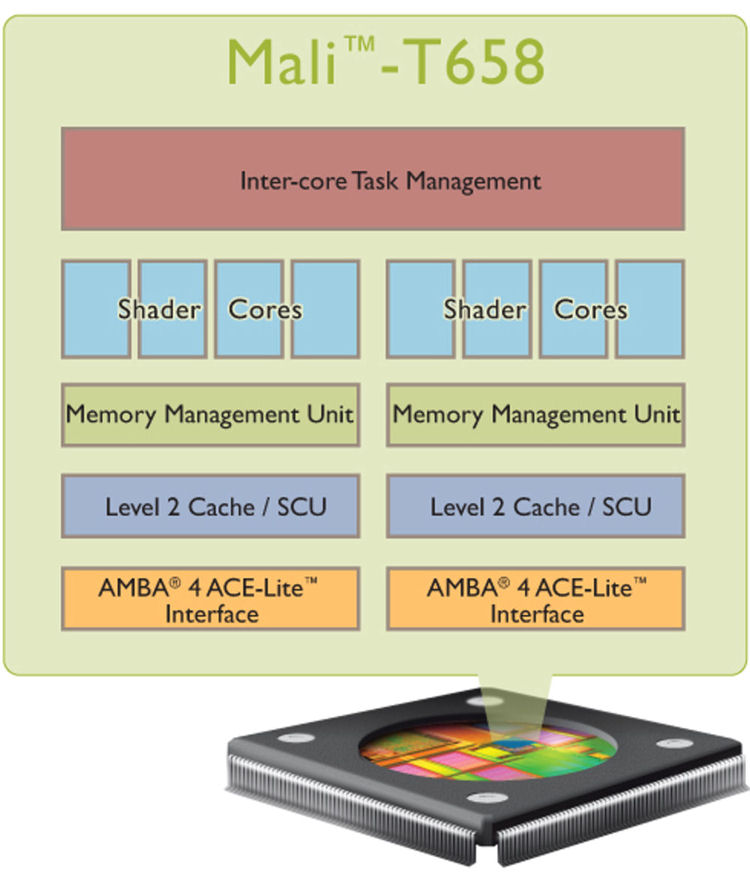
British processor ARM Mali-T658 Chip Diagramdesigner ARM has taken the wraps off its new Mali-T658 graphics processor, which packs eight graphics processing cores where the company currently offers only four—and each of those eight cores runs twice as fast as its predecessors. According to ARM, the Mali-T658 will be an important step in delivering PS3-quality graphics on smartphones and tablets—and it could start appearing in mobile devices by 2013. The chip will likely also get consideration from makers of smart TVs and in-vehicle information and entertainment systems.

“Next generation consumer devices based on the Mali-T658 GPU will address the growing user expectation for slick user interfaces and desktop-class graphics,” said the general manager of ARM’s Media Processing Division Pete Hutton, in a statement. “Intuitive user interfaces will mean that consumers can access the full functionality of their connected devices, for richer user experiences. This includes HD gaming and new compute-intensive applications, such as augmented reality.”

Recommended Videos

The Mali-T658 is designed to worth seamlessly with ARM’s Cortex A7 and A15 processors, either as a standalone system or in ARM’s big.LITTLE mode, which essentially combines ARM’s Cortex A15 and A7 processors, enabling hardware to jump up to more serious (and more power-consumptive) processing when needed, while scaling back to power-sipping processing during less demanding tasks. The availability of GPU units to take on discrete processing tasks could also help with non-graphical mobile applications, including speech recognition and augmented reality apps.

The 2013 date for the Mali-T658 graphics processor reflects the length of ARM’s technology roadmap: the T658 is actually the follow-on to the Mali-T604, which has four graphics processing cores. The T604 itself hasn’t shipped in any products yet: it should start appearing in smartphones and tablets during 2012.

Although a wide variety of portable devices use processors based on ARM designs, not all use ARM’s graphics technology: Samsung’s Galaxy line is perhaps the best-known user of ARM graphics, and Fujitsu and LG have also signed on to use the Mali-T658 when it’s available. However, Nvidia and Qualcomm also makes graphics processing systems for ARM-based systems (Nvidia and Adreno, respectively), and the UK’s Imagination Technologies designed the graphic processors used by Apple’s iPad and iPhone products.

Geoff Duncan
Former Contributor
Geoff Duncan writes, programs, edits, plays music, and delights in making software misbehave. He's probably the only member…
AI doesn’t have to turn evil to put you at risk 
emo-robot-that-can-lip-sync

An AI assistant that agrees with everything you say might feel like the perfect companion — until you need someone to tell you you’re wrong. That’s one of the more immediate dangers behind the idea of AI “going rogue.” A chatbot can cause harm without developing intentions of its own. It can reinforce a false belief, encourage an unhealthy attachment, or follow instructions planted by someone trying to hijack it.   

On October 15, AI safety company Alice announced new software to address those everyday risks. Working separately with Inflection AI and AI21, the company says it helped train NVIDIA’s Nemotron models to resist harmful conversational behavior and malicious instructions while preserving their usefulness.  

Read more
Elon Musk says Neuralink’s brain implants could help people with paralysis and blindness
Neuralink's Telepathy helps people control computers through thought, while Blindsight aims to restore visual perception.
elon-musk-neuralink-brain-implant

Elon Musk has revealed ambitious plans for Neuralink, and they go beyond controlling computers with your thoughts. The company is developing two brain implants, Telepathy and Blindsight, aimed at helping people with paralysis and severe vision loss. Musk also believes future advances could help people regain control of their hands and legs by reconnecting the brain with their limbs.

How Neuralink's Telepathy can help people with paralysis

Read more
Sony has shrunk its glasses-free 3D technology into a tiny screen, and it can bring anime characters to life on your desk
It's almost like having a digital, three-dimensional companion on your desk.
Sony's smaller 3D display for desk

Glasses-free 3D has always felt like a luxury I could admire from afar. Those screens were built for design studios, not smaller desks like mine. But Sony’s new version is small enough to sit beside my keyboard, and I’m genuinely excited.

The company has unveiled the ELF-MN1, a 6-inch display that makes 3D characters and avatars look like they’re coming out of the screen without any special glasses or a headset. It plugs into a phone or PC with one USB-C cable, and that’s pretty much it (via Sony).

Read more