  1. Home
  2. Space
  3. News

This weird exoplanet is regrowing its atmosphere

Add as a preferred source on Google

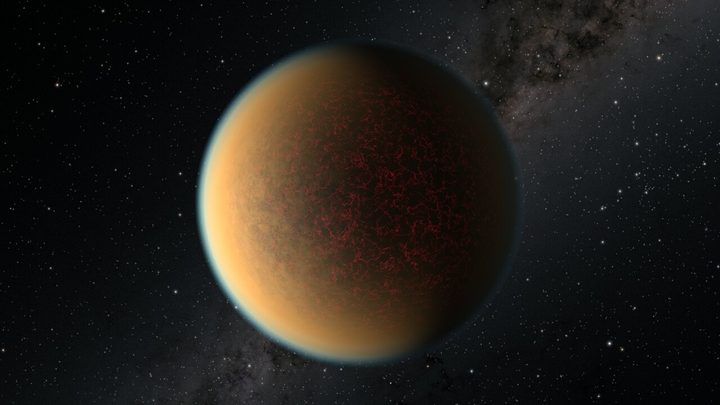
This image is an artist’s impression of the exoplanet GJ 1132 b. For the first time, scientists using the NASA/ESA Hubble Space Telescope have found evidence of volcanic activity reforming the atmosphere on this rocky planet, which has a similar density, size, and age to that of Earth.
This image is an artist’s impression of the exoplanet GJ 1132 b. For the first time, scientists using the NASA/ESA Hubble Space Telescope have found evidence of volcanic activity reforming the atmosphere on this rocky planet, which has a similar density, size, and age to that of Earth. NASA, ESA, and R. Hurt (IPAC/Caltech)

Scientists know that the atmospheres of planets change over time — Mars, for example, is gradually losing its atmosphere as it evaporates into space. The examples we know of suggested this was a one-way process, where an atmosphere developed and then was subsequently lost. But now, researchers using the Hubble Space Telescope have discovered a very odd planet that seems to be regrowing its atmosphere after having lost it in the past. This is the first time such a thing has been observed.

Recommended Videos

Planet GJ 1132 b is several times the size of Earth, making it a type called a sub-Neptune, and it started out with a thick atmosphere of hydrogen and helium. But, being close to its hot, young star, this atmosphere was quickly lost and the planet was reduced to a core around the size of Earth. So far, so typical.

Where it gets weird is recent observations from Hubble which show the planet has a secondary atmosphere of hydrogen, hydrogen cyanide, methane, and ammonia. Researchers think that hydrogen from the original atmosphere was absorbed by the planet’s mantle, and is now being released once more by volcanic activity. The atmosphere seems to be replenishing itself even as hydrogen continues to be lost into space.

“It’s super exciting because we believe the atmosphere that we see now was regenerated, so it could be a secondary atmosphere,” said study co-author Raissa Estrela of NASA’s Jet Propulsion Laboratory (JPL) in a statement. “We first thought that these highly irradiated planets could be pretty boring because we believed that they lost their atmospheres. But we looked at existing observations of this planet with Hubble and said, ‘Oh no, there is an atmosphere there.’”

The unusual system seems to have developed due to a phenomenon called tidal heating, in which friction from the planet’s elliptical orbit causes heat to build up inside the planet. This heat keeps the planet’s mantle hot, which keeps the volcanic activity going.

This finding has implications for how atmospheres might have developed on other exoplanets, and also gives an opportunity for researchers to learn more about the geology of this planet.

“This atmosphere, if it’s thin — meaning if it has a surface pressure similar to Earth — probably means you can see right down to the ground at infrared wavelengths,” said lead author Mark Swain of JPL. “That means that if astronomers use the James Webb Space Telescope to observe this planet, there’s a possibility that they will see not the spectrum of the atmosphere, but rather the spectrum of the surface. And if there are magma pools or volcanism going on, those areas will be hotter. That will generate more emission, and so they’ll potentially be looking at the actual geological activity — which is exciting!”

Georgina Torbet
Georgina has been the space writer at Digital Trends space writer for six years, covering human space exploration, planetary…
China’s answer to SpaceX’s reusable rockets literally catches boosters in a net
SpaceX catches boosters on legs. China just used a net.
Ammunition, Missile, Weapon

SpaceX's playbook for recovering a rocket booster generally involves legs, a precisely controlled vertical landing, and either a concrete pad or a drone ship. 

China just managed to pull off something similar, but in a slightly different way, and on July 10, it tested the method as well.

Read more
Dimming the sun sounds unhinged, but this new study on El Niño makes a surprisingly good case for it
A natural test case, Australia's worst-ever wildfire season, suggests the idea deserves serious consideration.
Nature, Outdoors, Sky

When I first saw "scientists propose dimming the sun," I rolled my eyes. It sounds like a science fiction movie cooked up after watching many climate documentaries. But a new study, published on July 8, 2026, in the journal Science Advances, seems to have a genuinely compelling argument.

A Super El Niño is currently forming in the Pacific, feared to be the most intense in decades. It could escalate floods, wildfires, and extreme heat events worldwide. However, Researchers at UC San Diego's Scripps Institution of Oceanography, led by climate scientists Kate Ricke and Jessica Wan, are now proposing one of the most interesting solutions I’ve come across.

Read more
You can now walk through space and gaze into a black hole at this VR exhibit
Smithsonian Starstruck lets you drift past dying stars and see the origin point of the universe for as little as $18 a person.
Smithsonian Starstruck featured

Most planetarium shows ask you to sit still and look up. The Smithsonian's new VR exhibit takes a different approach, letting visitors walk through the vast expanse of the universe, drifting past stars, planets, and a black hole to get a physical sense of its true scale.

A $29 ticket to the edge of the galaxy

Read more