  1. Home
  2. Space
  3. News

Hubble spots a wacky exoplanet with yellow skies and iron rain

Add as a preferred source on Google

Astronomers have spotted an utterly bizarre exoplanet using data from the Hubble Space Telescope, the Transiting Exoplanet Survey Satellite (TESS), and the Magellan observatory. WASP-79b, located 780 light-years away, has skies which would look yellow during the day.

The sky on Earth appears blue due to a phenomenon called Rayleigh scattering, in which tiny particles in the atmosphere filter out certain wavelengths of light. The shorter (blue) wavelengths of light are scattered more than longer (red) wavelengths, which is why the sky appears blue.

Recommended Videos

But there’s something odd going on on planet WASP-79b, because it doesn’t seem to show Rayleigh scattering in the way that scientists expected. When studying the planet using a spectrograph, which measures light wavelengths to determine chemical compositions, the scientists expected to see a decrease in the amount of blue starlight. But instead, they saw the opposite — the blue light wavelengths were less scattered by the atmosphere.

“This is a strong indication of an unknown atmospheric process that we’re just not accounting for in our physical models,'” Kristin Showalter Sotzen of the Johns Hopkins University Applied Physics Laboratory said in a statement. “I’ve shown the WASP-79b spectrum to a number of colleagues, and their consensus is ‘that’s weird’.”
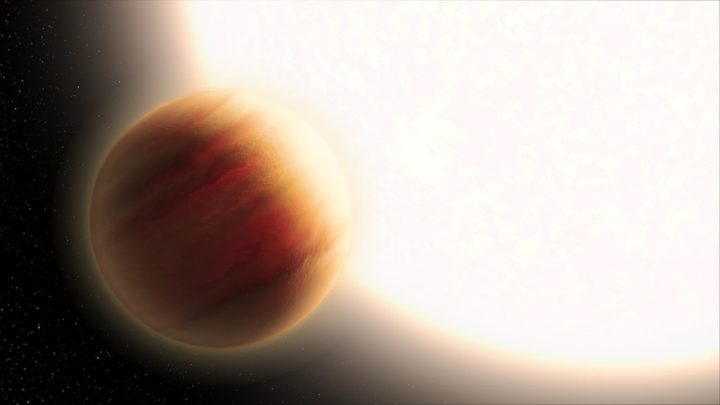
An artist's illustration of the super-hot exoplanet WASP-79b
An artist’s illustration of the super-hot exoplanet WASP-79b, located 780 light-years away. NASA, ESA, and L. Hustak (STScI)

That means that the planet would have a yellow-colored sky during the day, and the researchers have no idea why. “Because this is the first time we’ve see this, we’re really not sure what the cause is,” Sotzen said.

“We need to keep an eye out for other planets like this because it could be indicative of unknown atmospheric processes that we don’t currently understand. Because we only have one planet as an example we don’t know if it’s an atmospheric phenomenon linked to the evolution of the planet.”

And the skies aren’t the only extreme thing about this planet. As a “hot Jupiter,” the planet orbits extremely close to its star, completing an orbit in just three and a half Earth days. That means its atmosphere is phenomenally hot, reaching up to 3,000 degrees Fahrenheit, which is hot enough to cause molten iron to rain down onto the surface from manganese sulfide or silicate clouds.

As well as being a quirky object of interest, astronomers think that studying this planet could help them learn about how planets form, because it has an unusual polar orbit around its star which brings into question theories about how hot Jupiters develop. It will be one of the first targets of study for NASA’s upcoming James Webb Space Telescope.


Georgina Torbet
Georgina has been the space writer at Digital Trends space writer for six years, covering human space exploration, planetary…
Dimming the sun sounds unhinged, but this new study on El Niño makes a surprisingly good case for it
A natural test case, Australia's worst-ever wildfire season, suggests the idea deserves serious consideration.
Nature, Outdoors, Sky

When I first saw "scientists propose dimming the sun," I rolled my eyes. It sounds like a science fiction movie cooked up after watching many climate documentaries. But a new study, published on July 8, 2026, in the journal Science Advances, seems to have a genuinely compelling argument.

A Super El Niño is currently forming in the Pacific, feared to be the most intense in decades. It could escalate floods, wildfires, and extreme heat events worldwide. However, Researchers at UC San Diego's Scripps Institution of Oceanography, led by climate scientists Kate Ricke and Jessica Wan, are now proposing one of the most interesting solutions I’ve come across.

Read more
You can now walk through space and gaze into a black hole at this VR exhibit
Smithsonian Starstruck lets you drift past dying stars and see the origin point of the universe for as little as $18 a person.
Smithsonian Starstruck featured

Most planetarium shows ask you to sit still and look up. The Smithsonian's new VR exhibit takes a different approach, letting visitors walk through the vast expanse of the universe, drifting past stars, planets, and a black hole to get a physical sense of its true scale.

A $29 ticket to the edge of the galaxy

Read more
Scientists warn Elon Musk’s orbital data centers could blind Earth’s biggest telescopes
A new ESO study suggests millions of satellites could make parts of the night sky effectively unusable for astronomy.
One hour of satellites over the northern Atacama Desert in Chile (October 2025)

The race to blanket Earth with satellite internet has unlocked faster connectivity for millions. But according to the European Southern Observatory (ESO), it could also make one of humanity's oldest hobbies, and one of its most important sciences, a whole lot harder. The organization warns that the rapid growth of satellite mega-constellations could severely disrupt observations made by some of the world's most powerful telescopes.

Astronomers say the night sky is reaching its limit

Read more