  1. Home
  2. Space
  3. News

How engineers for NASA’s Ingenuity helicopter do tech support on another planet

Add as a preferred source on Google

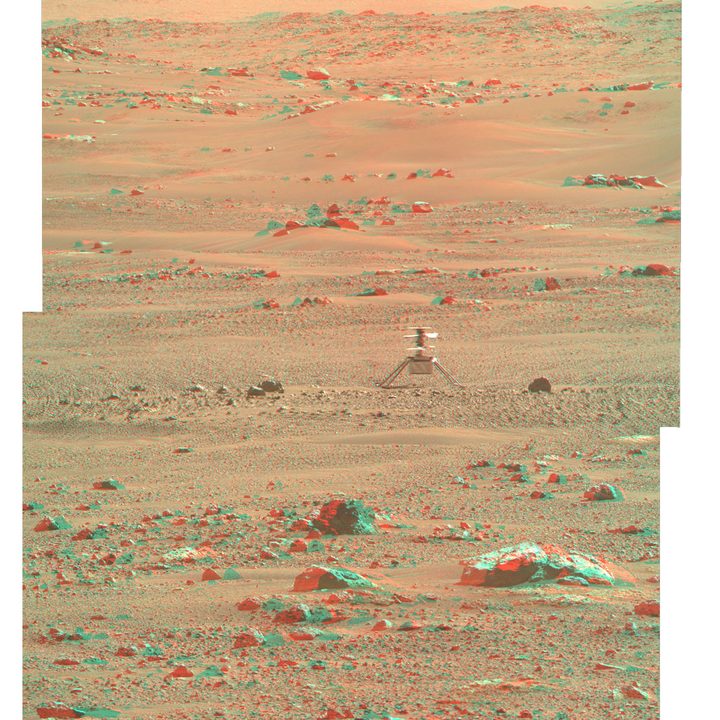
Ingenuity Helicopter in 3D: NASA's Ingenuity Mars Helicopter is seen here in 3D using images taken June 6, 2021, by the left and right Mastcam-Z cameras aboard NASA’s Perseverance Mars rover.
Ingenuity Helicopter in 3D: NASA’s Ingenuity Mars Helicopter is seen here in 3D using images taken June 6, 2021, by the left and right Mastcam-Z cameras aboard NASA’s Perseverance Mars rover. NASA/JPL-Caltech/ASU/MSSS

NASA’s Ingenuity helicopter has captured the world’s imagination with its exploration of Mars from the air. It recently completed its eighth successful flight, but as an experimental piece of technology it hasn’t all been smooth sailing for the plucky little helicopter — it has also had to deal with two software issues during its operations. Now, Ingenuity Operations Lead Teddy Tzanetos has shared some insights into how the team fixes software problems on a piece of tech on another planet.

Recommended Videos

The first issue arose in the preparations for flight four when the rotors failed to spin up correctly. The Ingenuity team report that the helicopter was having a problem transitioning into its “flight-state” mode, which stopped the blades from spinning up to full speed. This turned out to be due to overcautious software, in which the Field Programmable Gate Array (FPGA) component was detecting very slight variations in timing and was therefore preventing the helicopter from flying.

This issue was fixed by creating a temporary workaround to allow the helicopter to keep performing its flights. But there was a possibility that the issue could reoccur and require multiple attempts at flights in the future. Now, the team has updated the Flight Controller software to permanently fix this issue which they tested with a slow-spin test of the blades last week.

The second issue is to do with the camera that the helicopter uses to position itself. The helicopter has both color and black and white cameras which it uses to capture images of the ground below and make rapid adjustments to its movements, up to 500 times per second. To maneuver effectively, the helicopter needs exact timestamps for the images it captures so it can make these adjustments correctly.

The problem that arose during flight six was a glitch in the pipeline for processing images. When using the color camera, this glitch caused one single frame to be dropped. But this meant that timestamps on subsequent images were incorrect, which lead to the helicopter trying to overcorrect its movements and it ended up swinging back and forward.

Fortunately, the helicopter was able to land safely, but the team decided not to use the color camera on subsequent flights seven and eight. They think it is the more intense processing requirements for color images that lead to the glitch, so they have stuck with the less demanding and therefore safer black and white cameras for now.

Fixing this issue will require updating a large portion of the helicopter’s software. The team will create a software addition that detects if a frame has been dropped and which will correct any subsequent timestamps, allowing them to use the color camera once again. They are planning to make this update in the next few days.

Georgina Torbet
Georgina has been the space writer at Digital Trends space writer for six years, covering human space exploration, planetary…
Space is becoming Bezos and Musk’s next data center site, and we have every reason to worry
The AI boom is coming for the night sky
How Vast's space station will look in orbit.

AI data centers already consume vast amounts of electricity and water on Earth, so Silicon Valley has begun looking somewhere considerably more spacious... literally.

Elon Musk's SpaceX and Jeff Bezos' Blue Origin, along with several other companies, have proposed enormous constellations of satellites designed to operate as orbital data centers. However, environmental groups and former space officials are now warning that putting them into orbit at the proposed scale could have severe consequences for Earth's atmosphere and the night sky.

Read more
The first possible exomoon is here, and it makes our Moon look hilariously tiny
Scientists may have found the first exomoon, except this one is the size of Jupiter
This artist’s concept depicts a potential volcanic moon between the exoplanet WASP-49 b, left, and its parent star. New evidence indicating that a massive sodium cloud observed near WASP-49 b is produced by neither the planet nor the star has prompted researchers to ask if its origin could be an exomoon.

We have already discovered more than 6,000 planets outside of our immediate neighborhood. Yet, finding a moon orbiting one of those distant worlds has proved considerably harder. Astronomers may finally have something close to the real deal, but this particular object stretches the word “moon” almost beyond recognition.

Using the European Southern Observatory’s Very Large Telescope in Chile, researchers detected strong evidence for a moon-like object in the CD-35 2722 system. Further observations are still necessary to confirm the discovery, but it could become the first confidently detected natural satellite outside our solar system. There is still one tiny complication though. This moon is apparently massive.

Read more
China’s answer to SpaceX’s reusable rockets literally catches boosters in a net
SpaceX catches boosters on legs. China just used a net.
Ammunition, Missile, Weapon

SpaceX's playbook for recovering a rocket booster generally involves legs, a precisely controlled vertical landing, and either a concrete pad or a drone ship. 

China just managed to pull off something similar, but in a slightly different way, and on July 10, it tested the method as well.

Read more