  1. Home
  2. Space
  3. News

Mars helicopter Ingenuity is getting ready for its first flight

Add as a preferred source on Google

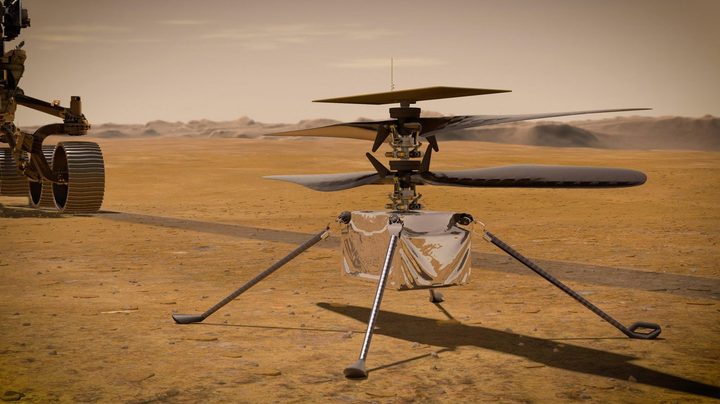
In this illustration, NASA's Ingenuity Mars Helicopter stands on the Red Planet's surface as NASA's Perseverance rover (partially visible on the left) rolls away. Ingenuity arrived at Mars on Feb. 18, 2021, attached to the belly of NASA’s Mars 2020 Perseverance rover.
In this illustration, NASA’s Ingenuity Mars Helicopter stands on the red planet’s surface as NASA’s Perseverance rover (partially visible on the left) rolls away. Ingenuity arrived at Mars on Feb. 18, 2021, attached to the belly of NASA’s Mars 2020 Perseverance rover. NASA/JPL-Caltech

As much as the public has embraced the Mars rover Perseverance, people’s imaginations have been perhaps most captured by the rover’s plucky little sidekick, the helicopter Ingenuity. This tiny helicopter is set to become the first aircraft ever to fly on another planet, and now NASA has announced that it plans to begin Ingenuity’s test flights in the first week of April, depending on vehicle positioning and other details.

Recommended Videos

The reviews of the integration between the rover and the helicopter have been completed and the team at NASA’s Jet Propulsion Laboratory (JPL) is performing final checkouts to make sure the system is ready.

In a recent update on the helicopter from JPL’s Farah Alibay, Perseverance integration lead for Ingenuity, and Tim Canham, Ingenuity operations lead, the team confirmed they are almost ready to launch Ingenuity on its first flight. “Right now, the helicopter is still attached to the rover,” Canham said. “We’re keeping it warm and fed,” he said, by charging the batteries, and the team is working on selecting a final site for the first flight test.

Choosing a location for the test flight requires careful consideration. The team is looking for the perfect flat area which doesn’t have too many rocks which could provide a hazard, but where the surface does have enough texture that the navigation cameras can use these fluctuations to find their way.

And once a site is selected and the mission begins, there are several complex procedures that need to occur to get Ingenuity ready to fly. “Once we start the helicopter mission, the first thing that we have to do is drop the debris shield,” Alibay explained. This shield protected the delicate parts of the helicopter from the heat and vibration of the Mars landing. “Then we’re going to travel several days to the helicopter drop-off location. Once we get there, it’s actually going to take us about a week to deploy the helicopter.”

It takes a while for the helicopter to be deployed due to its positioning within the rover. It’s currently tucked up snugly and horizontally beneath the rover and it will need to be carefully deployed in a number of steps, each of which needs to be confirmed before moving onto the next. Then it can finally be separated from the rover, and the rover will drive away to a safe distance leaving Ingenuity free to fly.

NASA will likely release more details about the planned test flight next week, and we’ll keep you updated on the plans for little Ingenuity’s first big mission.

Georgina Torbet
Georgina has been the space writer at Digital Trends space writer for six years, covering human space exploration, planetary…
China’s answer to SpaceX’s reusable rockets literally catches boosters in a net
SpaceX catches boosters on legs. China just used a net.
Ammunition, Missile, Weapon

SpaceX's playbook for recovering a rocket booster generally involves legs, a precisely controlled vertical landing, and either a concrete pad or a drone ship. 

China just managed to pull off something similar, but in a slightly different way, and on July 10, it tested the method as well.

Read more
Dimming the sun sounds unhinged, but this new study on El Niño makes a surprisingly good case for it
A natural test case, Australia's worst-ever wildfire season, suggests the idea deserves serious consideration.
Nature, Outdoors, Sky

When I first saw "scientists propose dimming the sun," I rolled my eyes. It sounds like a science fiction movie cooked up after watching many climate documentaries. But a new study, published on July 8, 2026, in the journal Science Advances, seems to have a genuinely compelling argument.

A Super El Niño is currently forming in the Pacific, feared to be the most intense in decades. It could escalate floods, wildfires, and extreme heat events worldwide. However, Researchers at UC San Diego's Scripps Institution of Oceanography, led by climate scientists Kate Ricke and Jessica Wan, are now proposing one of the most interesting solutions I’ve come across.

Read more
You can now walk through space and gaze into a black hole at this VR exhibit
Smithsonian Starstruck lets you drift past dying stars and see the origin point of the universe for as little as $18 a person.
Smithsonian Starstruck featured

Most planetarium shows ask you to sit still and look up. The Smithsonian's new VR exhibit takes a different approach, letting visitors walk through the vast expanse of the universe, drifting past stars, planets, and a black hole to get a physical sense of its true scale.

A $29 ticket to the edge of the galaxy

Read more