  1. Home
  2. Space
  3. News

NASA to perform second test of its massive SLS rocket core

Add as a preferred source on Google

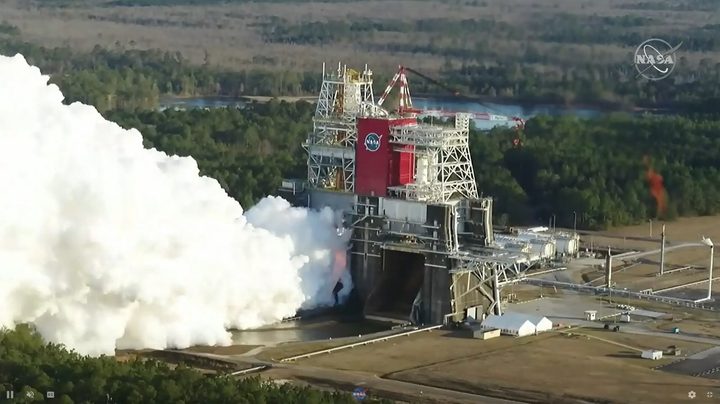
The core stage for the first flight of NASA’s Space Launch System rocket is seen in the B-2 Test Stand during a hot fire test Jan. 16, 2021, at NASA’s Stennis Space Center near Bay St. Louis, Mississippi.
The core stage for the first flight of NASA’s Space Launch System rocket is seen in the B-2 Test Stand during a hot fire test Jan. 16, 2021, at NASA’s Stennis Space Center near Bay St. Louis, Mississippi.  NASA Television

NASA is in the process of testing the world’s largest rocket core stage, which is part of its Space Launch System (SLS) program designed to carry astronauts to the moon and eventually on further to Mars. But the project has been troubled, running over deadlines and over budget. Now, NASA has announced it will be performing a second hot fire test of the mighty SLS engines.

Recommended Videos

The hot fire test is the culmination of a test fire series called the Green Run, in which the core is powered up and the engines are fired together for the first time. The first hot fire test took place several weeks ago, but although the engines did fire successfully, they only fired for around one minutes instead of the planned eight minutes. Early data from the test indicated that the engines were shut down by automatic safety parameters after there was an issue with the power unit’s hydraulic system.

NASA says that there are no repairs required to the SLS hardware, so it now wants to try the test again. “Inspections showed the core stage hardware, including its engines, and the B-2 test stand are in excellent condition after the first hot fire test, and no major repairs are needed to prepare for a second hot fire test at NASA’s Stennis Space Center in Bay St. Louis, Mississippi,” the agency wrote in a blog post.

The plan is to conduct another hot fire test for the full eight minutes, which simulates the amount of time that the engines would be firing for in a real launch. NASA says that the test can provide additional data on the operation of the engines and reduce risk for future missions using SLS, such as the upcoming Artemis missions to the moon.

No firm date has been set for the second hot fire test, but it could be as early as the end of February.

Georgina Torbet
Georgina has been the space writer at Digital Trends space writer for six years, covering human space exploration, planetary…
China’s answer to SpaceX’s reusable rockets literally catches boosters in a net
SpaceX catches boosters on legs. China just used a net.
Ammunition, Missile, Weapon

SpaceX's playbook for recovering a rocket booster generally involves legs, a precisely controlled vertical landing, and either a concrete pad or a drone ship. 

China just managed to pull off something similar, but in a slightly different way, and on July 10, it tested the method as well.

Read more
Dimming the sun sounds unhinged, but this new study on El Niño makes a surprisingly good case for it
A natural test case, Australia's worst-ever wildfire season, suggests the idea deserves serious consideration.
Nature, Outdoors, Sky

When I first saw "scientists propose dimming the sun," I rolled my eyes. It sounds like a science fiction movie cooked up after watching many climate documentaries. But a new study, published on July 8, 2026, in the journal Science Advances, seems to have a genuinely compelling argument.

A Super El Niño is currently forming in the Pacific, feared to be the most intense in decades. It could escalate floods, wildfires, and extreme heat events worldwide. However, Researchers at UC San Diego's Scripps Institution of Oceanography, led by climate scientists Kate Ricke and Jessica Wan, are now proposing one of the most interesting solutions I’ve come across.

Read more
You can now walk through space and gaze into a black hole at this VR exhibit
Smithsonian Starstruck lets you drift past dying stars and see the origin point of the universe for as little as $18 a person.
Smithsonian Starstruck featured

Most planetarium shows ask you to sit still and look up. The Smithsonian's new VR exhibit takes a different approach, letting visitors walk through the vast expanse of the universe, drifting past stars, planets, and a black hole to get a physical sense of its true scale.

A $29 ticket to the edge of the galaxy

Read more