  1. Home
  2. Space
  3. News

NASA practices emergency procedures for crewed Boeing Starliner flights

Add as a preferred source on Google

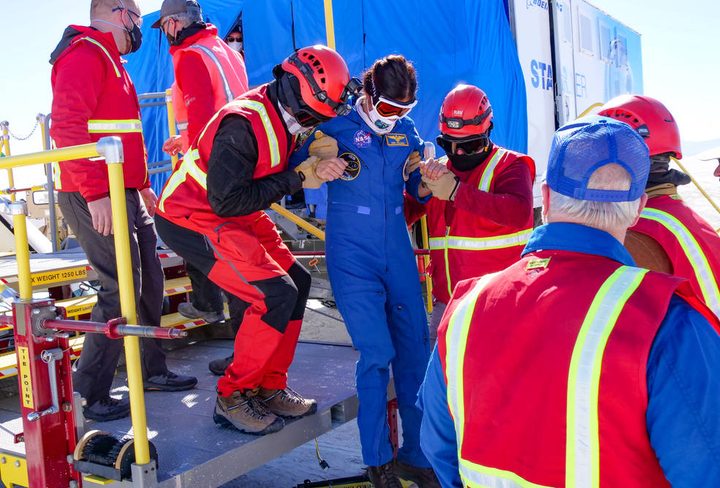
Landing and recovery teams from Boeing and NASA take part in a crew landing dress rehearsal at the U.S. Army’s White Sands Space Harbor in New Mexico in preparation for missions returning with astronauts from the International Space Station as part of the agency’s Commercial Crew Program.
Landing and recovery teams from Boeing and NASA take part in a crew landing dress rehearsal at the U.S. Army’s White Sands Space Harbor in New Mexico in preparation for missions returning with astronauts from the International Space Station as part of the agency’s Commercial Crew Program. Boeing

Boeing is working on a capsule for carrying crew into space called the Starliner, which will eventually be used by NASA to ferry astronauts to the International Space Station (ISS) and back. The company is gearing up for its second orbital flight test of the Starliner, though this test will be uncrewed. But future test flights and operational flights will be crewed, and that means that procedures need to be in place in case of emergency.

Recommended Videos

This week, NASA tested out these emergency procedures in a dress rehearsal at the U.S. Army’s White Sands Space Harbor in New Mexico, simulating what would happen if there were a medical emergency during a Starliner flight. This particular test simulated astronauts coming back from the ISS and landing, with a crew member who needed to be evacuated to a hospital by medical helicopter.

“We are working with Level 1 trauma centers that are fully staffed and have a full complement of doctors and nurses for a variety of conditions and disciplines, allowing us to plug into a network of the best very quickly,” said Michael Schertz, Boeing Starliner medical coordinator and a leader on the landing and recovery team, in a statement.

“While the likelihood of a medical incident requiring this level of care is small, we just don’t know enough to rule out the risk. As such, we prepare for the worst in the hope we never need it,” said Chris Ferguson, Boeing astronaut and director of Commercial Crew Mission Integration and Operations.

The Starliner will land on land, unlike SpaceX’s Crew Dragon capsule which lands in the ocean. It will come in for landing at one of five sites in the U.S., meaning each site needs to have a safety team prepared for any emergencies.

The test at New Mexico succeeded in locating the capsule and getting the crew member out in less than an hour, which is within the timeframe that the agency aims for.

“Commercial Crew Program missions do not end until crew members are safely out of the Starliner,” said Steve Stich, manager of NASA’s Commercial Crew Program. “Training exercises like this are essential to ensuring the entire team is prepared for every scenario.”

Georgina Torbet
Georgina has been the space writer at Digital Trends space writer for six years, covering human space exploration, planetary…
China’s answer to SpaceX’s reusable rockets literally catches boosters in a net
SpaceX catches boosters on legs. China just used a net.
Ammunition, Missile, Weapon

SpaceX's playbook for recovering a rocket booster generally involves legs, a precisely controlled vertical landing, and either a concrete pad or a drone ship. 

China just managed to pull off something similar, but in a slightly different way, and on July 10, it tested the method as well.

Read more
Dimming the sun sounds unhinged, but this new study on El Niño makes a surprisingly good case for it
A natural test case, Australia's worst-ever wildfire season, suggests the idea deserves serious consideration.
Nature, Outdoors, Sky

When I first saw "scientists propose dimming the sun," I rolled my eyes. It sounds like a science fiction movie cooked up after watching many climate documentaries. But a new study, published on July 8, 2026, in the journal Science Advances, seems to have a genuinely compelling argument.

A Super El Niño is currently forming in the Pacific, feared to be the most intense in decades. It could escalate floods, wildfires, and extreme heat events worldwide. However, Researchers at UC San Diego's Scripps Institution of Oceanography, led by climate scientists Kate Ricke and Jessica Wan, are now proposing one of the most interesting solutions I’ve come across.

Read more
You can now walk through space and gaze into a black hole at this VR exhibit
Smithsonian Starstruck lets you drift past dying stars and see the origin point of the universe for as little as $18 a person.
Smithsonian Starstruck featured

Most planetarium shows ask you to sit still and look up. The Smithsonian's new VR exhibit takes a different approach, letting visitors walk through the vast expanse of the universe, drifting past stars, planets, and a black hole to get a physical sense of its true scale.

A $29 ticket to the edge of the galaxy

Read more