
Scientists from Harvard University and the Black Hole Initiative are planning to investigate the mysterious Planet Nine, a proposed ninth planet in our solar system. They have found a method to determine whether the theoretical object could be a miniature black hole, which will be published in the journal Astrophysical Journal Letters.
To look for evidence of Planet Nine, the team will search for accretion flares, which are bursts of energy that occur when a comet passes close to a black hole and begins to melt and produce gases. If they were able to detect such flares, this would provide supporting evidence for the existence of a small black hole in our solar system.
“In the vicinity of a black hole, small bodies that approach it will melt as a result of heating from the background accretion of gas from the interstellar medium onto the black hole,” Amir Siraj, a Harvard undergraduate student working on the project, said in a statement. “Once they melt, the small bodies are subject to tidal disruption by the black hole, followed by accretion from the tidally disrupted body onto the black hole.”
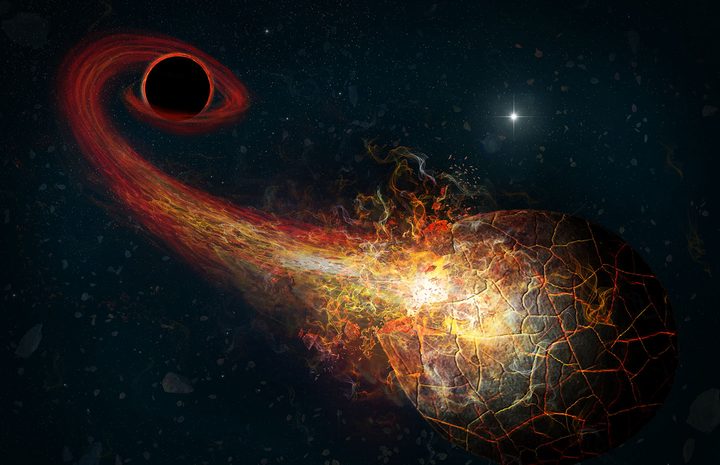
The team will search for these flares using the upcoming Legacy Survey of Space and Time (LSST) mission at the Vera C. Rubin Observatory, which will be able to survey the sky two times per week in more depth than other tools.
“LSST has a wide field of view, covering the entire sky again and again, and searching for transient flares,” Avi Loeb, Professor of Science at Harvard, explained. “Other telescopes are good at pointing at a known target, but we do not know exactly where to look for Planet Nine. We only know the broad region in which it may reside.”
The possible existence of Planet Nine has been hotly debated in the astronomical community in recent years, and although the movements of bodies in the Kuiper Belt beyond the orbit of Neptune do suggest something strange could be going on there, many astronomers are doubtful that this is due to the presence of a ninth planet.
However, the possibility that Planet Nine could be a miniature black hole has been raised before, with researchers speculating that the movements of bodies in the solar system could be affected by a theorized type of black hole which is too small to be observed directly. Such a primordial black hole has never been observed before, though physicists including Stephen Hawking agree that they could exist.
Even if the search for Planet Nine is considered somewhat outlandish, the potential ramifications of discovering such a body so close to Earth are profound.
“The outskirts of the solar system is our backyard. Finding Planet Nine is like discovering a cousin living in the shed behind your home which you never knew about,” Loeb said. “It immediately raises questions: Why is it there? How did it obtain its properties? Did it shape the solar system history? Are there more like it?”



