Here’s our full Asus PadFone X review.
You can call Asus crazy, but you can’t call it a coward. Today at CES, the Taiwanese computer company unveiled a bold new lineup of phones, tablets, and phones that want to be tablets. We’ve laid out the three major announcements below.
America, we’re getting the PadFone
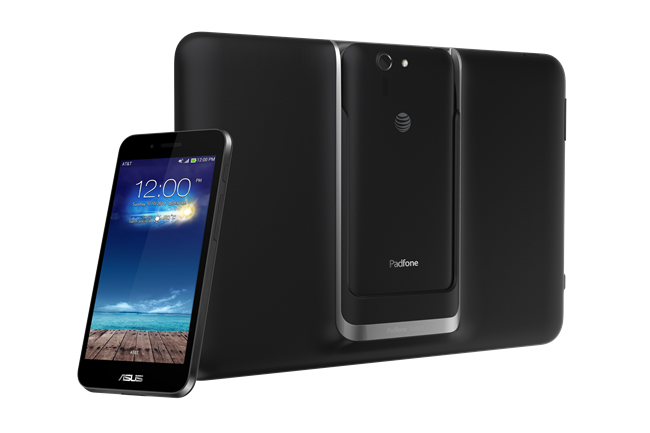 If you’ve followed the latest mobile endeavors of Asus, you’re likely aware of the PadFone, the firm’s unusual mashup of tablet and smartphone. However, despite vague promises in the past, the PadFone and its sequels has never been released through a network in America. Clearly, none of them were brave enough to pick up such a quirky piece of hardware. That is, until now, as Asus has convinced AT&T to take on the latest iteration, the PadFone X.
The PadFone X package consists of a 5-inch smartphone and a 9-inch tablet, where the phone acts as the tablet’s brain when it’s slotted into it, just like a dock. Both screens have a 1080p resolution, and apps running on the phone appear on the tablet’s display when they come together. Once the phone is in place, the tablet’s battery pack not only takes over, but charges the phone’s battery, too.
There’s a considerable benefit to the customer of using a smartphone and tablet combination in this way, as two devices share the same data plan. Of course, the overall cost of the PadFone itself is high, but you do get two devices in one, and the brushed metal frame should make it feel like a premium setup. In the past it has worked out cheaper than buying a phone and tablet separately, with a data plan on both.
We’re waiting for confirmation of the phone’s complete specs, such as the processor, which will be confirmed shortly after the CES 2014 press event. If it’s anything like the PadFone Infinity, expect a Snapdragon 800 chip, and another 13-megapixel PixelMaster camera. Asus loves to tinker with the PadFone, and the PadFone X is the third full-size version announced in the past year, alongside the smaller PadFone Mini.
Will AT&T’s PadFone gamble pay off for both companies, or is there a good reason why no-one else has ever taken it on? Only time will tell.
Asus lays it on Samsung with the VivoTab Note 8
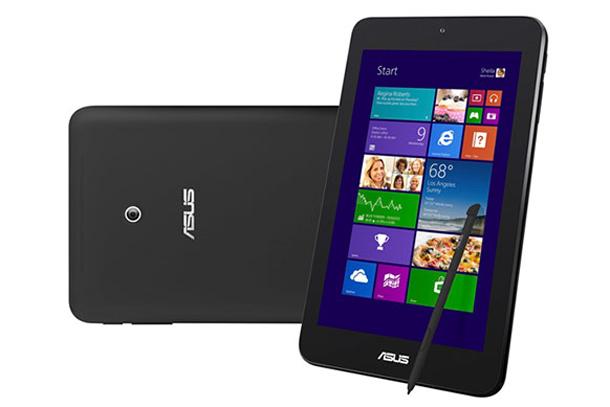 In an attempt to steal some of the thunder Samsung has built with its successful line of ‘Note’ tablets and phablets, Asus showed off the VivoTab Note 8, a Windows 8.1 tablet with a Wacom screen and built-in stylus. Running Windows 8 is as much a curse as a blessing, but we’re excited to see it using Wacom tech, which allows for much more precise pen interaction than you’re use to. Samsung has integrated it into its Note 8.0, Note 3, and Note 10.1 2014 Edition, and the level of precision it offers sets those tablets apart from others with styli.
On the inside, the VivoTab Note 8 will have an 8-inch 1280 x 800 pixel IPS LCD screen, run on an Intel Atom Z3740 processor, have a 5-megapixel rear camera with ‘HD webcam, have 2GB of RAM, and come loaded with (up to) 64GB of memory for storing documents or files. The Wacom screen offers about 1,000 levels of pressure sensitivity, which is comparable to Samsung’s Note products.
ZenFone is Asus’s first standalone Android phone
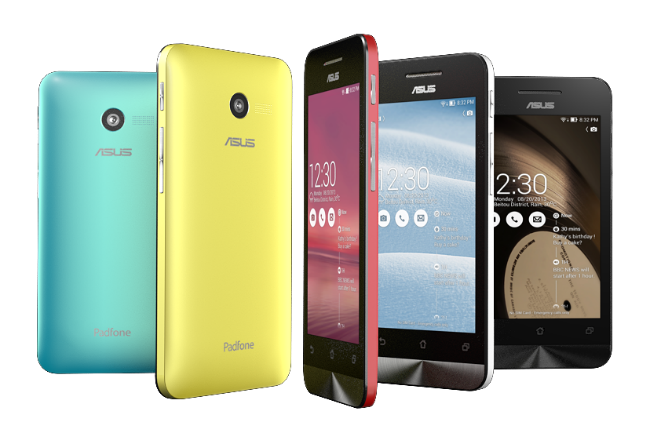 Asus has released Android phones before, but only the PadFone – a phone that plug into a tablet – or the dreaded FonePad, which was a full-fledged 7-inch tablet that happened to also work as a phone. Now, with the ZenFone 4, ZenFone 5, and ZenFone 6, it’s done beating around the bush. The ZenFones range in size from iPhone-sized to phablet, and each run on Android 4.3 Jelly Bean and dual-core Intel Atom processors. The specs seem decent, though the petite ZenFone 4 has a lower-resolution 800 x 480 pixel TFT LCD screen and the ZenFone 6 has an impressive 13-megapixel camera. All 3 come in a simple color palette and Asus promises an upgrade to Android 4.4 KitKat at some point.