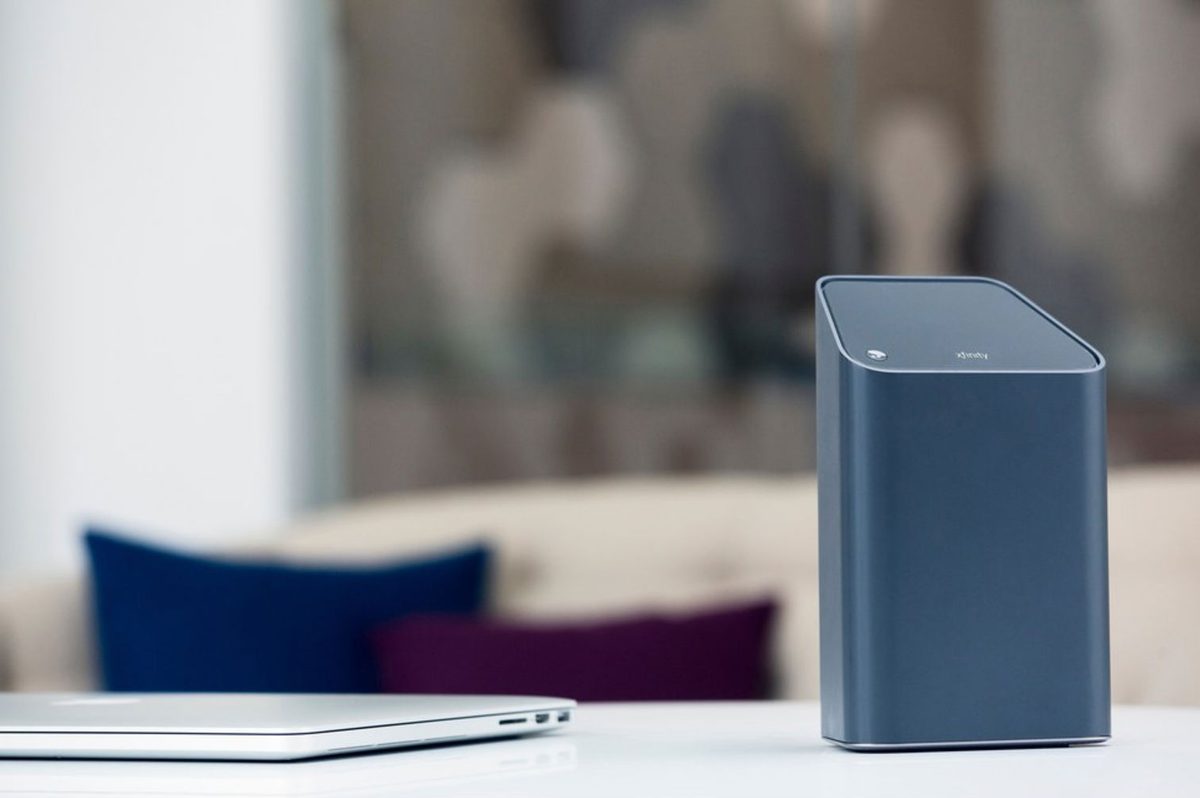
Comcast’s new xFi Advanced Gateway is now available to all Xfinity broadband markets, the company said Wednesday. According to a blog written by Comcast’s Fraser Stirling, this new all-in-one device reportedly supports wireless speeds of more than 1.5 gigabits per second in the Comcast labs. It also includes an 8×8 antenna setup, meaning your connected device must have eight incoming and eight outgoing antennas to support the reported 1.5Gbps speeds.
In reality, promoted wireless speeds which are theoretical in nature, never translate into real-world speeds. Many factors come into play, including the channel width, local radio interference, neighboring networks, and more. Stirling says the new gateway sports an additional 160MHz channel width, which means there’s more air space for sending data back and forth from devices. Modern routers and gateways typically include 20MHz, 40MHz, and 80MHz channel widths.
“We use MU-MIMO (multi-user, multi-input, multi-output) technology to make sure that the xFi Advanced Gateway doesn’t just deliver great speed to one device, but because of the spatial diversity built into the design, it can simultaneously power dozens of devices without sacrificing performance on any of them,” Stirling says.
Of course, you can’t squeeze gigabit speeds out of a 300Mbps broadband subscription. The new xFi Advanced Gateway is available to all markets that support 300Mbps and up, and would seemingly be more ideal for the company’s Xfinity Gigabit Internet subscribers. Still, you’re not going to experience real-world wireless gigabit speeds with devices that aren’t built to support the technology. Comcast is merely laying a foundation for future devices.
“While there are currently no mass-market Wi-Fi connected devices capable of receiving gig speeds over Wi-Fi, those devices are coming,” he adds. “In the meantime, the power of the xFi Advanced Gateway delivers ultimate performance to your connected home.”
But speed isn’t the only selling point of Comcast’s new gateway. Because it resides in a central location in the home, the company wanted it to properly blend into its surroundings. Typically, gateways, modems, and routers are ugly devices with multiple flashing LEDs — some can even resemble mechanical spiders that are flat on their backs. But Comcast wanted a more elegant look, thus it switched out the LEDs for a single, soft and steady light. It also features a blend of neutral colors and soft-touch materials.
The company also considered the connected home when it designed the new gateway. The device includes not only a Bluetooth Low Energy component, but stand-alone radios for Zigbee and Thread (NEST, Philips Hue Home Automation) Internet of Things devices. The new gateway also provides plenty of customizable xFi-branded features, including per-user profile creation, access restrictions, device assignments, and more.
Comcast also plans to introduce a mesh-based networking system later this month. This won’t be a centralized unit like the new gateway, but will be made up of two or three satellite units that will blanket the entire home with mesh-like coverage. Additional details will be made available in the coming weeks.