1. Home
  2. Phones
  3. Android
  4. Mobile
  5. News

Google cut down app update sizes by 65 percent — but there is a catch

Add as a preferred source on Google

There was a time when updating an app required downloading a whole new version of that app, even if you already had parts of it. These days, however, updating an app really only requires downloading, well, the parts that are different. Google has been figuring out ways to reduce update sizes over the past four years or so and on Tuesday, announced it devised a way to reduce app updates by 65 percent.

The way Google does this is somewhat complicated. Android apps are basically ZIP archives that make use of a few special standards. The archives themselves are compressed to be smaller using a technology called Deflate, which certainly makes the app smaller, but also makes it hard for the changes in updates to be identified.

Recommended Videos

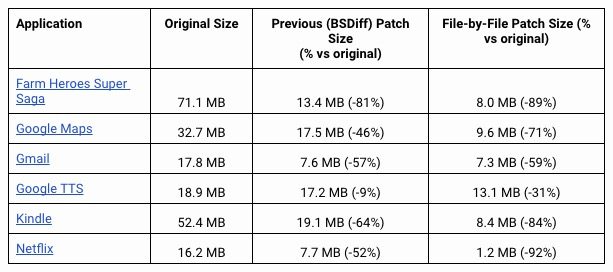
Google, however, is now taking a different approach, which it calls file-by-file patching. This approach basically makes it easier to find changes in an app and implement those changes in a new Android APK. Check out the data savings Google has been able to achieve:
file-by-file
Image used with permission by copyright holder

File-by-file patching basically works by comparing new and old archives. Google goes through these to identify the changes, applies the changes, then checks to ensure that the patched app matches the updated version on the Google Play Store.

There is a downside to this method — it takes longer for your phone to process. In fact, by cutting the patch size in half, it will probably double the amount of time it takes to install the update and it is a lot harder for older devices to handle the updates.

Because of the fact that it takes longer, Google is not implementing the change for all apps just yet — for now, only auto-updates that take place in the background will use the new update method.

Christian de Looper
Christian de Looper is a long-time freelance writer who has covered every facet of the consumer tech and electric vehicle…
TSMC might set up a price hike that could come straight for your next phone, laptop, or tablet
Here's what TSMC's rumored 10% chip price increase actually means in dollar terms, and why your next phone or laptop could end up costing more.
TSMC Fab

My wallet flinched the second I saw the words "TSMC" and "price increase" in the same headline, and honestly, yours should too.

Turns out the company behind the silicon powering basically every flagship device out there, including Apple’s A-series and Qualcomm’s Snapdragon processors, is reportedly about to make all of it a little pricier.

Read more
Samsung’s free storage doubling for preorders is gone in Austria, and the replacement isn’t as sweet
Samsung's free storage doubling deal might just be history.
The back of the Galaxy Z Fold 7

If you've pre-ordered a Samsung foldable purely for the free storage bump, tomorrow's Unpacked event might sting a little.

For years, pre-ordering a new Galaxy meant automatically getting double the storage at no additional charge. Buy the 128GB model, walk away with 256GB for the same price. The same applied to the 256GB and 512GB models. However, that might change at the upcoming Galaxy Unpacked event. 

Read more
Apple fixes Hide My Email bug that exposed users’ real email addresses
Here's how Apple's Hide My Email flaw leaked real addresses for over a year, and why it only got fixed once the story went public.
apple-merging-sign-in-with-apple-hide-my-email-icloud+

Turns out the "Hide" part of Hide My Email wasn't doing its job quite as advertised, something that I covered early in July. Security researcher Tyler Murphy reported the flaw in June 2025, but despite Apple claiming it was resolved in March 2026, independent tests confirmed it remained exploitable, at least until July 3, 2026.

So how did this bug actually work?

Read more