1. Home
  2. Phones
  3. Android
  4. Business
  5. Mobile
  6. News

Google patent shows off a hinged smartphone with selectable displays

Add as a preferred source on Google

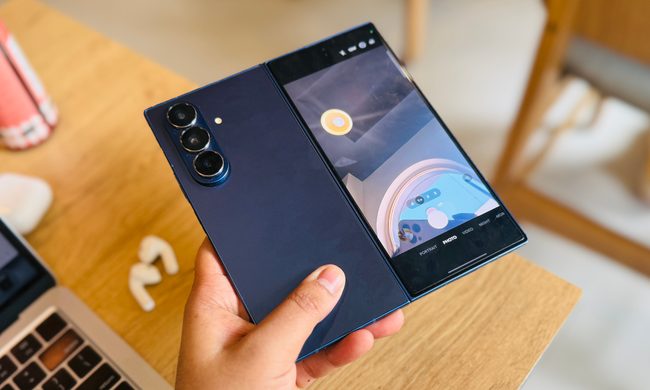
We’re approaching the end of an epoch in smartphone design, and it’s clear that phones are about to get a whole lot weirder. Samsung, Huawei, and Apple have all thrown their hats into the ring with smartphones that unfold to create a larger display — but Google has been largely quiet on the subject. However, that’s no longer the case, as Google has been awarded a patent on a folding, hinged smartphone by the U.S. patent office.

So much of the patent describes a device we’ve seen in multiple other folding smartphones — the device would be able to be used as a regular phone in its folded position or unfolded into a tablet mode. Other inclusions in the patent are not as common, such as the laptop-style desktop mode, or the tent-like dual user mode, which would allow the use of both screens at once by two different users. That usage, in particular, could be the start of a whole new local multiplayer trend on mobile devices, with both players being able to make use of the same device or even watch different video streams on the same device.

Recommended Videos

Another interesting element of the patent is an emphasis on being able to swap screens on the fly while in phone mode. The patent mentions user input is used to select a screen but also mentions using other, intelligent methods to swap screen, including object proximity (so if it’s been placed facedown it will use the other screen), detected user grip, or data from other sensors. Interestingly, this implementation would allow a manufacturer to remove camera lenses from one side of the phone entirely, as the phone would — in theory — be able to sense if the user had turned the device around to take a selfie, and would show the viewfinder on the side facing the user.

Interestingly, some of the patent images include Motorola’s logo. It would be odd for this to be a placeholder logo when Google’s own would have done, so it’s possible Google is working with Motorola to design a foldable smartphone. Motorola was previously awarded a patent for a foldable smartphone, so it’s possible the two companies are combining forces like the Nexus phones of yore.

However, with the patent only having just been awarded, it’s likely this theoretical device is still some years away. With Samsung gearing up to release its foldable smartphone and other manufacturers seemingly not much further behind, Google or Motorola would definitely be playing catch-up.

Mark Jansen
Former Mobile Evergreen Editor
Mark Jansen is an avid follower of everything that beeps, bloops, or makes pretty lights. He has a degree in Ancient &…
The Pixel 11 is almost here, and these are the 3 upgrades I’m begging Google to make
Electronics, Mobile Phone, Phone

We're only a month away from Google's next big hardware event, with the Pixel 11 series officially arriving on August 12. 

After living with the Pixel 10 Pro and the Pixel 10a over the past year, I've come to appreciate what Google's phones do well — and, more importantly, where they still fall short. With the smartphone landscape evolving faster than ever, there are three upgrades I'm hoping Google finally delivers this year. If you're a fellow Pixel user, chances are these are on your wishlist too.

Read more
5 reasons I keep coming back to Apple Reminders despite paying for premium task managers
I rely on OmniFocus for complex projects, but Apple Reminders still handles my everyday tasks better than any paid app.
Apple Reminders open on iPhone

The App Store is filled with premium task managers, and like Things 3, Todoist, and OmniFocus, despite buying and switching between several of them, I keep coming back to Apple Reminders. 

Don’t get me wrong, I still use OmniFocus to manage my projects. But when it comes to daily tasks and quick capture, Apple Reminders still remains my go-to app. In this guide, I'll walk you through the five biggest reasons why.

Read more
Google may finally ditch Samsung’s modem in the Pixel 11, and Tensor G6 could be better for it
FCC paperwork for Google’s next foldable points to MediaTek, raising hopes for lower power use and a cleaner break from Tensor’s Exynos roots
AI recreation of Pixel 11's Pixel Glow feature.

Google may be preparing its biggest Tensor hardware split yet. As spotted by Android Authority, FCC testing for an unreleased foldable Google phone includes a reference to MediaTek radio-frequency software, adding weight to reports that the Pixel 11’s Tensor G6 could leave Samsung’s Exynos modem behind.

Every previous Tensor chip has used Samsung modem hardware. Changing suppliers won’t guarantee better battery life or reception, but it gives Google a fresh path after years of leaning on the same underlying technology.

Read more