You have today more options than ever to limit how much data you concede on the seemingly free services by Facebook, Google, and others. These privacy options, however, are almost never enabled by default or explicitly recommended and are often buried deep inside menus — which means you may never discover them or be aware of how much of your sensitive information is being scooped up.
An app called Jumbo could be that missing, accessible link to these privacy controls, and its latest update could prove an even bigger nightmare for companies that furtively track what you do on your phone.
Doing your digital privacy chores
Jumbo acts as a sort of personal digital privacy assistant. The app can comb through your profiles, such as Facebook, and tell you where and how you can reduce what information you share, without the technical lingo. You can pick which trade-offs you’re comfortable with and instantly switch them off from the Jumbo app itself.
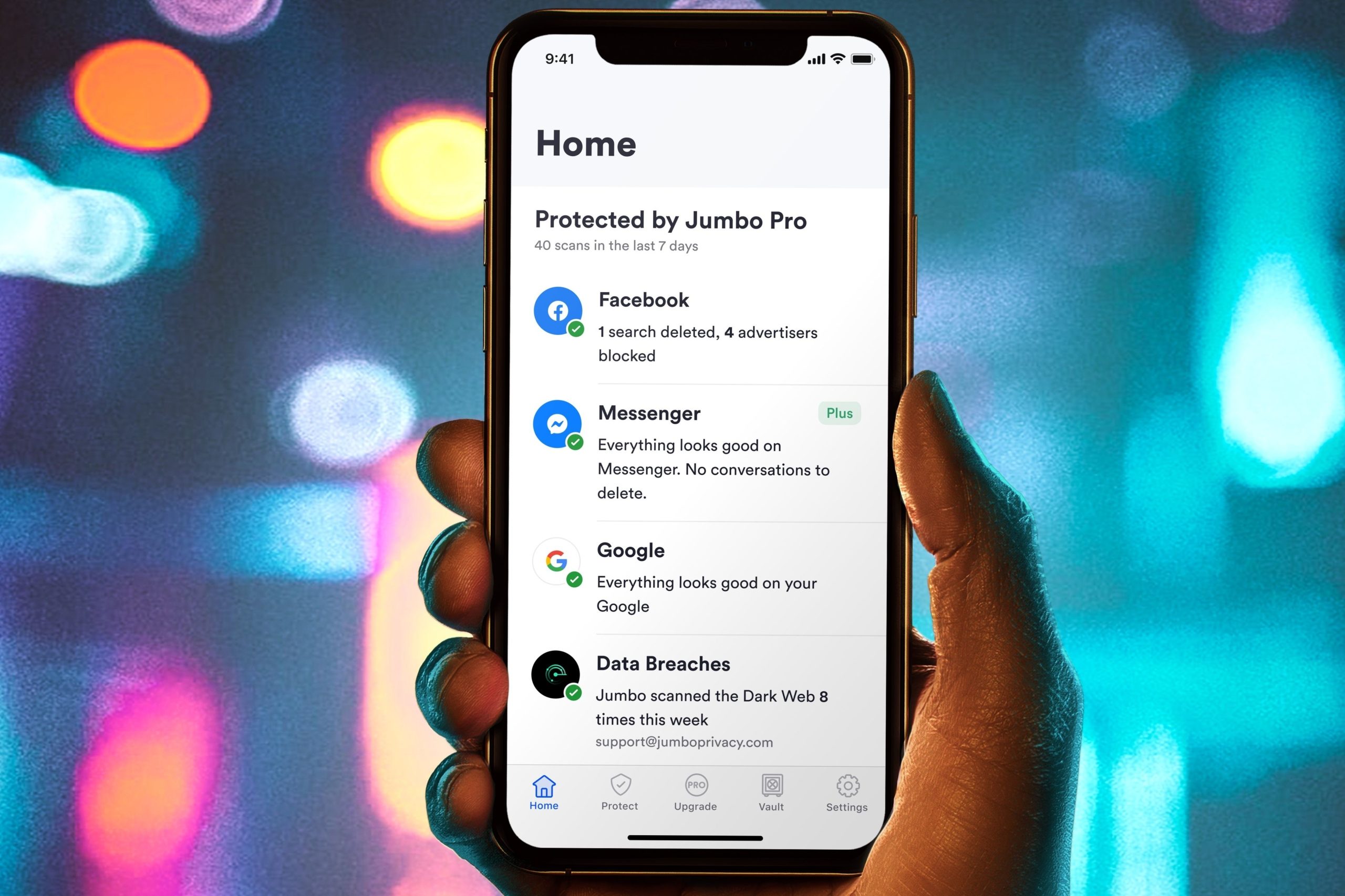
When I punched in my Facebook credentials, for instance, I found out that my relationship status and work history could be used by advertisers to target me. I was able to click the Stop Tracking button beneath these cards and shut that practice down. Another such recommendation informed me that my activity is being used to show me ads outside of Facebook as well.
“Facebook is for connecting people, not ads,” read a note at the bottom of the card.
Similarly, Jumbo can sift through the privacy settings of your Google and LinkedIn accounts. The way Jumbo accomplishes this is both creepy and clever. It’s not built with support from these tech giants, nor do they have official developer packages to enable such functionality. What Jumbo does is, when you sign in to your profiles, it crawls through websites on your behalf, and its automated bots replicate the process of manually clicking on settings to alter them.
Jumbo promises that it won’t misuse this access and says it’s not in the business of selling ads since its revenue stems from premium subscriptions.
“Our customers have already shown us that they are willing to pay for the additional privacy features our team will keep building, and most importantly to help us build a company that will never sell our users’ data,” the company said in a blog post.
“Your authentication information stays on your phone the whole time. In no event will we have access to your password on our cloud,” Jumbo’s CEO, Pierre Valade told Digital Trends.
Clean up your old posts
Jumbo’s other highlight is its ability to clean up your social profiles and digital footprint. The app can quickly help you take down old tweets or archive Instagram pictures you now find yourself cringing at. This feature works across services. You can plug in your Amazon account to delete Alexa voice recordings or your Google account for purging your YouTube searches, location data from Maps, and more.
The process remains identical. You add your profile, select the time period, and Jumbo takes care of the rest depending on the quantity of data. Jumbo also lets you save those tweets or pictures locally on your phone before you boot them off the internet forever. The company will soon add options for cloud storage, like Dropbox, as well.
Block third-party tracking
What truly sets Jumbo apart, however, is its built-in third-party blocker. On your phone, Jumbo can prevent trackers from actively prying into each and every one of your moves. Most apps come packaged and teeming with these trackers that can you follow you around. Trackers don’t usually come under the purview of privacy settings and even the most data-frugal and vigilant users can fall prey to them.
Jumbo’s newest update allows you to block more than 400 major trackers. To do this, the app, through your phone’s local VPN function, monitors your network traffic and if it detects a tracker that’s present on its list, it cuts it off.
Limitations
Jumbo offers what tech companies should have baked into their platforms in the first place — if they had been committed to preserving user privacy. The app presents how a service is siphoning up your personal data front and center — accompanied by straightforward tools to terminate any practice you’re not comfortable with.
However, since it’s not supported by tech companies, Jumbo’s future largely hinges on whether it is continued to be allowed to crawl these services to edit privacy settings on your behalf. Because of that restriction, Jumbo already falls short when it comes to how much it can do on sites other than LinkedIn, Google, and Facebook. It can’t, for instance, help you secure your Twitter or Instagram profile. Nevertheless, given its current capabilities, Jumbo is a no-brainer and deserves a place on your phone especially for banning third-party trackers.
As for revenue, Jumbo is today also raising $8 million in fresh funding and Valade tells me it needs about 100,000 subscribers to remain profitable. At the moment, it hosts over 60,000 monthly active users.
Most of Jumbo’s features are available for free. But a few premium tools like third-party tracker blocking and Instagram scanning are locked in behind a subscription that starts at $2.99.