
Nvidia has made a big deal over its new Tegra K1 mobile processor. For a start, it’s telling us the chip has 192 cores. While this may be factually correct, behind all the graphics cores, the K1 is still the familiar old four-core-one-companion-core chip we’re used to seeing from Nvidia. It doesn’t stop there either. We’re told it’s the first mobile processor to use a PC-style graphics chip and will come in 32-bit and 64-bit versions. Crop circle evidence (not really) also points to it being made with alien technology. Yep, Nvidia is very keen to let us know the Tegra K1 is really exciting. However, it’s what’s missing from the feature line up which will dictate how many smartphones end up using the K1; and it’s the same problem which plagued the Tegra 4: lack of 4G LTE.
Before we get too negative, let’s look at what does make the Tegra K1 standout. Nvidia has pushed it as the first mobile chip to blur the lines between mobile, desktop, and console gaming, saying that for the first time “Next generation PC gaming will be available on mobile platforms.” The K1 is equipped with the same Kepler architecture seen on its most successful PC graphics cards, supports DirectX 11 and Open GL 4.4, and is the first mobile processor to support Nvidia’s own CUDA platform. It’ll run Epic Games’ Unreal Engine 4, and Nvidia claims it has faster performance than the Xbox 360 and PlayStation 3.
During the first half of 2014, Nvidia will produce a 32-bit version of the Tegra K1, based on the ARM Cortex A15 with the same 4-Plus-1 companion core system used in previous Tegra chips. The quad-core processor will be capable of speeds up to 2.3GHz. In the second half of the year, a 64-bit dual-core Tegra K1 should arrive, with an increase in speed to 2.5GHz, all based on ARMv8 architecture.
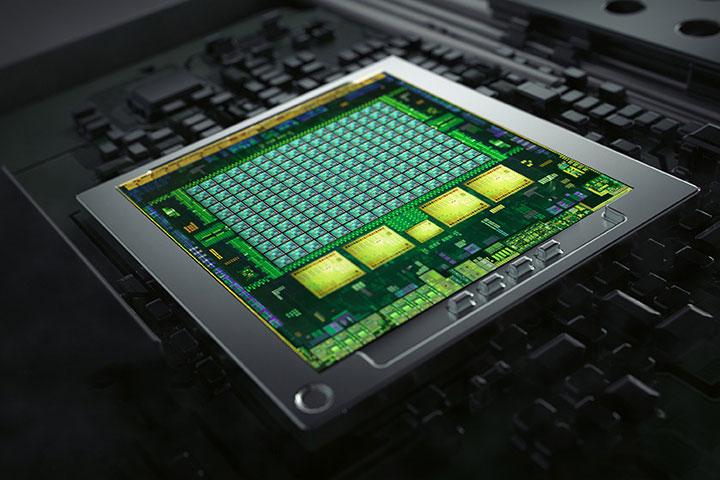
So, mobile gamers can rejoice, as it bodes well for the future. Except, we’re not sure how many manufacturers will choose to adopt the Tegra K1. The perfectly capable Tegra 4 severely lost out to Qualcomm’s Snapdragon 800 during 2013, thanks to its lack of high speed data. We’re still waiting for the Tegra 4i to arrive, inside which will be Nvidia’s own Icera 4G LTE modem. Why hasn’t this been included in the K1’s spec?
In February 2013, Nvidia CEO Jen-Hsun Huang was quoted as saying “we’re not expecting to have a whole lot of phone design wins until we engage the market with LTE.” Strange then, it should decide to announce another high-end, non-LTE chip nearly twelve months on. Stranger still, Nvidia snapped up Icera back in 2011 (for a mere $370 million), with the intention of creating a 4G Tegra, “Super chip.” Nvidia claims it created the strange crop circles you see above because the K1 is so cool it’s “otherworldly.” We feel bad for the aliens without LTE. But maybe the real reason why Nvidia has chosen to promote the Tegra K1 using crop circle pictures is to get some help. It can’t figure out LTE, but maybe someone in the cosmos has. Perhaps a Qualcomm ship will pass by at LTE speeds soon.


