External game controllers have had a somewhat storied history in mobile gaming, and over the past few years, we’ve seen a wealth of new options as Apple has finally chosen to take gaming much more seriously.
While the iPhone had always been as much about gaming as anything else, in the early days, Apple took the somewhat opinionated stance that the touchscreen should be more than sufficient for mobile gaming. It took four years before the first Apple-approved game controller appeared in 2012. Still, even then, support for it was minimal and inconsistent, as developers had to build in that support for themselves, with no help from Apple.
A few Apple-certified game controllers followed in the years after that, but the concept never really took off due to the higher price tags demanded by Apple’s Made-for-iPhone program. Fortunately, a lot has changed in the past few years. In 2019, Apple stunned the gaming industry with the announcement of native support for Sony PlayStation and Microsoft Xbox controllers in iOS 13, and it’s been building on that momentum ever since.
Although wireless game controllers are the most popular choice these days, many serious gamers still prefer the better reliability and lower latency offered by a wired connection. This is where the RiotPWR ESL controller comes in.
Lightning-based gaming
Sporting a design that will be familiar to any Xbox gamer, the RiotPWR ESL comes in both iPhone and Android configurations. I tested the iPhone version. It relies on a built-in Lightning cable to link up with your iPhone. This lets you avoid the usual Bluetooth pairing process — it’s ready to go as soon as you plug it into your iPhone — and you also won’t have to worry about interference causing dropped connections or lag. After all, there’s nothing worse in competitive gaming than having your controller stop responding just as you’re about to make that critical kill shot.
Like many third-party Lightning accessories, once you plug the RiotPWR ESL into your iPhone, you’ll be prompted to visit the App Store to install a companion app. However, in this case, you’ll be taken to a page that offers a selection of controller-friendly games, ranging from EA’s Real Racing 3 to Sega’s Sonic The Hedgehog. It’s far from a comprehensive list of games with support for third-party controllers, but it’s not a bad way to get started.
The design
RiotPWR partnered with ESL (formerly known as Electronic Sports League) to design this controller, and it shows. In addition to the prominent ESL logo on the iPhone mount, it’s embellished with the ESL’s signature green, yellow, and white color scheme.
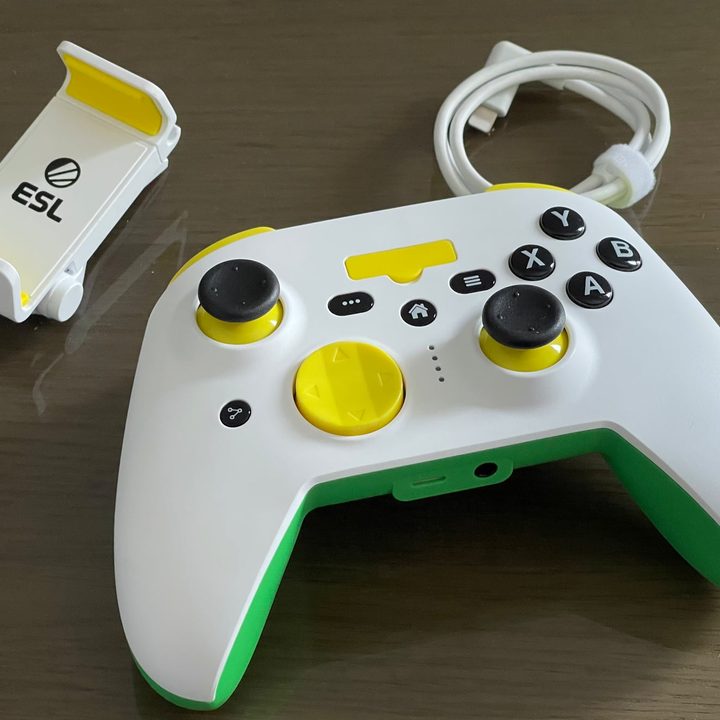
Those colors won’t be everyone’s cup of tea, but RiotPWR did a sensible thing by putting them primarily out of sight so they won’t be a distraction during normal gameplay. The top of the controller is predominantly white, with black for the buttons and the top of the analog sticks. The eight-way D-pad, the four triggers on the front, and the cover for the iPhone mount hole are yellow, which also accents the base of the analog sticks. Green is reserved for the bottom.
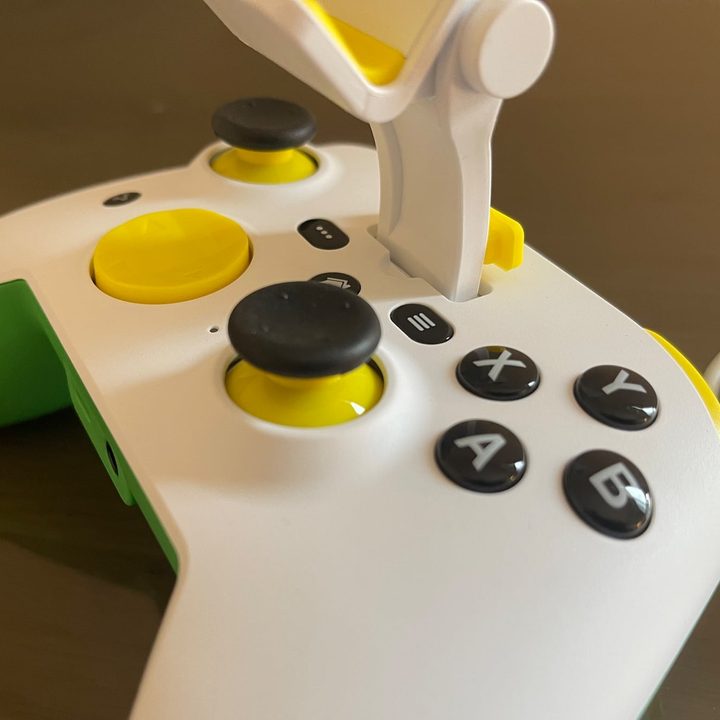
The RiotPWR ESL includes a detachable iPhone mount, which fits into a slot just above the three menu buttons. This can be tilted from about a 30-degree, front-facing orientation all the way around to where the top touches the rear of the controller. A yellow rubber flap keeps the slot closed if you prefer to use the controller without the iPhone mount.
Yellow-accented rubber grips hold an uncased iPhone securely without fear of scratches or scuffs, and the spring-loaded bracket expands enough to handle even the bulkiest iPhone cases. The RiotPWR ESL had no problem handling an Otterbox Defender or even Catalyst’s Waterproof Case in my testing. The more significant issue is that the Lightning connector may be a tight fit in some cases, as it has a slightly wider base than Apple’s standard Lightning cable.
The back of the RiotPWR ESL features a nondetachable two-foot Lightning cable, with a built-in hook-and-closure strap for coiling up the excess length — which you’ll almost certainly need to do when using it with the iPhone mount.
The cable length is a bit awkward. Although the RiotPWR ESL can be used with an iPad — as long as it has a Lightning port — it’s a bit too short for using comfortably. However, it’s also much longer than it needs to be for use with a controller-mounted iPhone. It’s easy enough to coil up the extra cable at the back, but it feels a bit inelegant.
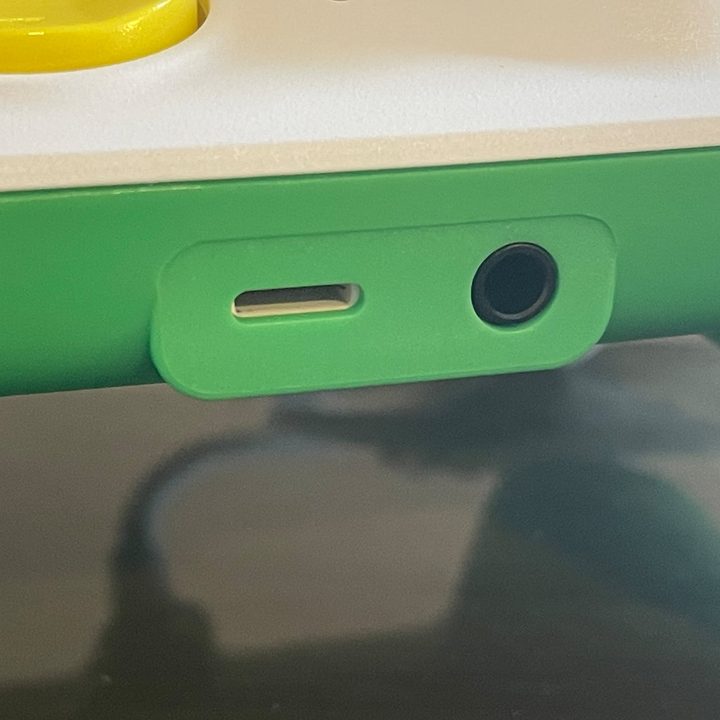
There are also two ports on the front of the controller: Aa standard Lightning port for passthrough charging, plus a 3.5mm audio output for connecting a set of wired headphones — a nice touch for competitive gamers who need zero-latency audio.
Gameplay experience
What the RiotPWR ESL lacks in some of its design choices, it more than makes up for in overall gameplay.
The tactile feel and heft of the RiotPWR ESL is very similar to a standard Xbox One controller. Although you’ll naturally have to deal with a bit of extra weight if you’re mounting an iPhone on top of it, the position of the stand makes it feel remarkably balanced and comfortable to use, even during extended gameplay sessions.
I put the RiotPWR ESL through its paces in an assortment of games across various genres. These included Leo’s Fortune, Ms. Pac-Man, Sonic: The Hedgehog, Star Wars: Kotor, Real Racing 3, Asphalt 9: Legends, PUBG Mobile, and Genshin Impact.
In all cases, the RiotPWR ESL met or exceeded my expectations. The ergonomics and the feel of the buttons were highly responsive and pleasant. The balance of the controller also meant that it can even be comfortably used with accelerometer-based controls, such as tilt-to-steer in Real Racing 3, while still using the triggers for things like acceleration and braking.
The few problems I encountered were more the fault of either iOS 15 or the games I was using, as the RiotPWR ESL wasn’t the only controller to be impacted by them. For instance, it took me a bit of effort to get some games to recognize the controller, but I had the same difficulties with a SteelSeries Nimbus+ and Sony Dualshock 4.
Beyond the usual game controls, the RiotPWR ESL has another nice trick that’s worth mentioning: A “share” button to the left of the D-pad that lets you quickly and easily capture a screenshot or screen recording of your gameplay. By default, a single-press takes a screenshot while pressing and holding it down starts or stops a screen recording.
As with most game controllers, these can be customized or disabled under General > Game controller in your iPhone’s Settings app. You can also program the button to capture a video of the last 15 seconds of gameplay instead.
Conclusion
While the RiotPWR ESL offers a great gameplay experience, it also feels a bit niche. Since Apple opened up the doors to Xbox and PlayStation controllers three years ago, there’s a good chance that most mobile gamers already have a compatible controller handy, and adding an iPhone mount will only set you back around $10.
On the other hand, the zero-latency gaming offered by the Lightning connection has a certain appeal to the fans of competitive gaming, where every millisecond counts. If that’s you, and you can get past the color scheme, the RiotPWR offers a great iPhone gaming experience that won’t disappoint.
Pricing and availability
The RiotPWR ESL Gaming Controller for iOS is available from most major retailers, including Amazon, Best Buy, and Target, as well as the RiotPWR website, for $70. It requires an iPhone, iPod Touch, or iPad with a Lightning port running iOS 7 or later.