July is National Cell Phone Courtesy Month. An entire month dedicated to back-patting among those who likely already display such values, and chastising the poor saps unlucky enough to use their phone in a situation deemed inappropriate by the tech police.
It’s an almost complete waste of time. The boorish, the rude, and the cretinous will continue to use their phones in places where it’s a common courtesy not to, entirely unaware of what month it is, while the rest of us have to hear about what a societal blight we are every time we dare to look at a notification.
The good news is seismic changes in the industry itself have the potential to stop it happening from 2020 onwards, but in the meantime we could all do with adjusting our phone use a little, to make sure we don’t need similarly irksome courtesy months in the future.
Stop the hate from spreading
It’s genuinely astonishing the message still hasn’t got through to people that sometimes, it’s best to put the damn phone down. Not only have smartphones been around for more than 10 years — the iPhone launched in 2007, and they were around before then — but even National Cell Phone Courtesy Month isn’t a new idea either. It pre-dates the iPhone itself, with coverage being found online as far back as 2005.
Let’s be clear. I hate National Cell Phone Courtesy Month.
Let’s be clear. I hate National Cell Phone Courtesy Month. I hate that it has to exist at all, and I hate that there is a website where you can buy a t-shirt of a mug with the name splashed across it. The turgid smugness that comes with vocally “supporting” this cause is no different from the eye-rolling calls for kids to spend more time kicking balls, and for adults to disconnect and go convene with nature. It’s the domain of busybodies that should really mind their own business.
The busybodies do have a slight point though, and in preparation for a more pleasant tech future, we can make a few behavioral changes now.
Three steps to heaven
Carry on using your phone on the street, in the office, at dinner, in bed, in the bath, in Starbucks, and even in the middle of a conversation. It’s fine. It will still hurt the feelings of a few, but not to worry. That tweet needed liking. This is not a call to use your phone less, it is a call to curb usage in a select few very specific situations. They’re sensible ones, and will go along way to placating the complainers.
An easy one to start with: The movie theater, or anywhere a performance is happening. We’re there to watch and be entertained by someone, so let’s do that. Few establishments take measures beyond an on-screen announcement, apart from the Alamo Drafthouse, which clearly states on its website that it has a zero tolerance to phone use and says, “We’ll kick you out, promise. We’ve got backup.” Good for it.
Musician Jack White took a more drastic approach when he banned phones at several gigs earlier this year. He called it an art experiment, and complained people can’t clap anymore because they’ve got a phone in one hand and a drink in the other. We’re sure the lack of attention is frustrating, so let’s appease Jack and our fellow cinema-goers by just not touching our phones for 120 minutes or so.
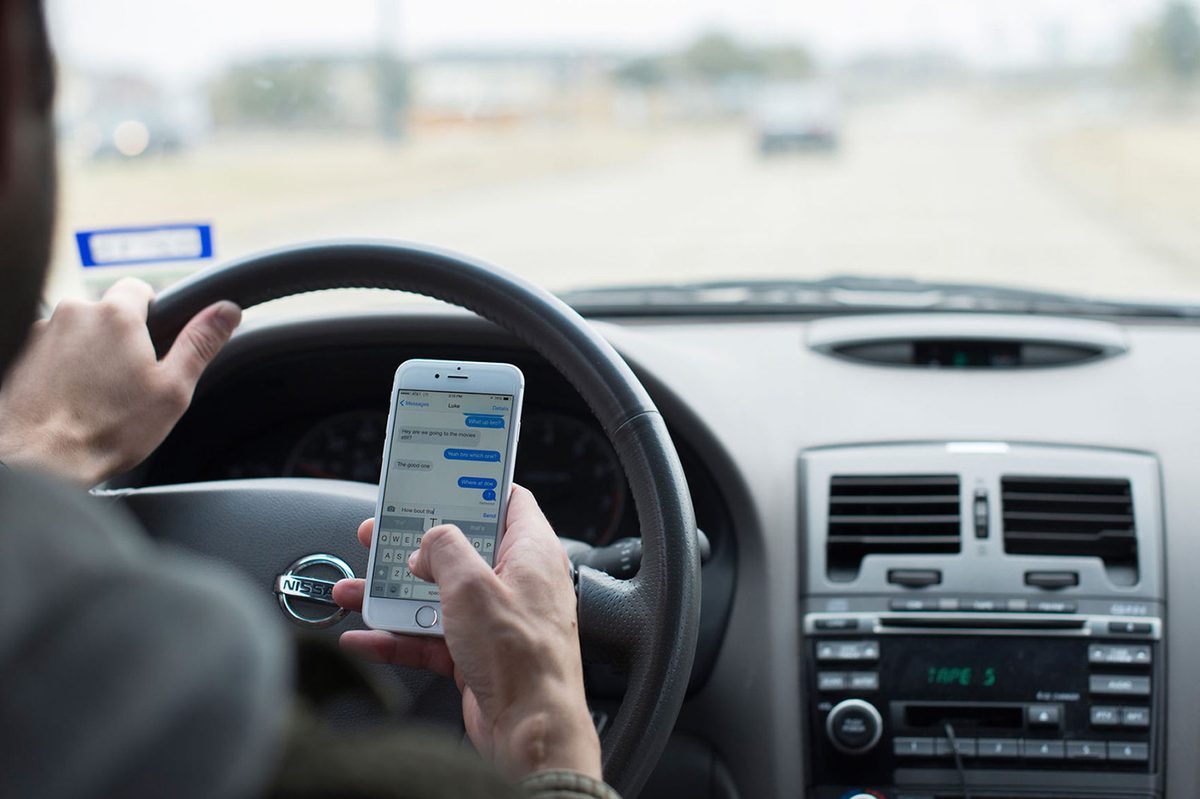
Next is in the car. All the tools are there to help us not touch our phones. For example, the Android Auto app minimizes interruptions by automatically activating Do Not Disturb, or use Apple’s driving mode in iOS that does the same. If you have a new car with Android Auto or CarPlay, use it instead of your phone. The AAA says it’s safer in many situations. Don’t become, or force someone else to become, another of the 3,500 deaths on the road due to distracted driving.
Don’t become, or force someone else to become, another of the 3,500 deaths on the road due to distracted driving.
Finally, on a plane. Like the movie theater, someone always loudly tells you to put your phone in airplane mode when the door is secured. Countless people don’t, because obviously the rule applies only to other people. I’ve sat next to someone who hid their phone away when the steward walked past to check seat belts, and continued sending messages after they’d moved on. Congratulations on being a complete arse. Just turn on Airplane Mode and go to sleep.
See a theme here? They’re all easy, and situations when we’ve actually got something else to occupy our time, so boredom can’t be used as an excuse. The effort, in the long run, will be worth it.
Tech has the answer
While National Cell Phone Courtesy Month squarely puts the onus on you to make changes, ironically it’s the tech industry itself that has the long-term solution. Screens, and our need to stare at and touch them, are the main reason smartphones are considered “rude,” as we’re seen to be giving it our complete attention. That’s going to end, and with it the view that the geeky are all ignorant, or socially inept. Gartner, in a late 2016 report, predicted that by 2020, “the majority of devices will be designed to function with minimal or zero touch.”
It foresees voice, gestures, biometrics, and ambient tech as being key replacements to the way we interact with devices now. By minimizing or completely doing away with touch interfaces, our reliance on screens will also lessen. In his book on the future of technology, author David Rose said screens slow us down anyway, but “enhanced objects” connected to the cloud and operated with gestures — an evolution of smart home devices we’re seeing now — will reduce distractions generated by a screen, and make tech more convenient and inclusive.
The emergence of artificial intelligence, augmented reality (AR), and next-generation hardware that supports it such as Magic Leap, is another piece of the puzzle that will shift us away from handheld devices, and towards something that doesn’t require that eyes-down level of involvement like a phone. Apple CEO Tim Cook said AR would change the way we use technology forever, and we’re not going to argue. At the moment we tend to think about AR being all about games, but it’s not. It’s a part of the complex equation that will shift personal tech away from the phone.
When smartphones are tech dinosaurs, then Cell Phone Courtesy Month will also become extinct. Worryingly, AR Courtesy Month will probably be ready to replace it. But if we all try a bit harder now, perhaps we’ll be better prepared, courtesy-wise, for the imminent future of mobile devices, leaving the busybodies with no choice but to turn their attention to something else.