“Why you can trust Digital Trends – We have a 20-year history of testing, reviewing, and rating products, services and apps to help you make a sound buying decision. Find out more about how we test and score products.“


The Xiaomi Mi 9T is a great little phone, and if it’s sold where you can buy one, it should go right alongside the Google Pixel 3a on your shopping list, because it’s excellent value. But it’s also confusing.
Why? Xiaomi enjoys going out of its way to make its range as broad and complicated as possible, and the Mi 9T you see here is no different. It’s only known as the Mi 9T in some markets –elsewhere it’s known as the Redmi K20 — and it’s an entry into the growing Mi 9 range. The range includes the regular Mi 9 and the Mi 9 SE, which also shares similarities with the Mi 9T. The Redmi K20 is joined by a K20 Pro too, but it has better internals than the 9T. That’s a lot of phones, a lot of names, and a lot of confusion.
Nevertheless, I’ve spent a few weeks with the Mi 9T, and have been consistently impressed by it. Here’s what it’s like.
Design
The Mi 9T is a fabulous looking phone. It’s not that the shape is anything special, it’s the nano-holographic effect on the back that sets it apart. Similar to the finish on the Honor View 20, it gives the impression the back of the phone has flames embedded under the surface. Available in red or blue, the blue version here has flashes of blue, purple, green, and even a rainbow effect streaking along the edge, blending into a deep, solid dark blue in the center. It’s genuinely beautiful.
It’s not just the color giving the phone some personality. It has a pop-up selfie camera, which in addition to a tiny circular notification light on the top, the module itself has a blue light that illuminates as it rises from the phone’s body. It serves no obvious purpose aside from looking awesome, and it does that well. At 191 grams it’s much heavier than the Pixel 3a and the Samsung Galaxy S10e, and it’s a little thicker at 8.8mm too.

While it’s comfortable to hold and good to look at, there’s a reason why a silicone case comes in the box, because the Mi 9T is slippery. It attempts to slide off every surface, and more than once I had to retrieve it from the back of the couch after it played hide-and-seek.
The Xiaomi Mi 9T avoids the trap Honor fell into with the Honor 20, by ensuring its mid-range phone also has a striking, individual design. Whether you choose the red or blue model (don’t bother with the black one, it’s not as exciting) this phone is really going to stand out in your hand. The glass body feels expensive too, and few will believe its low price.
Software and performance
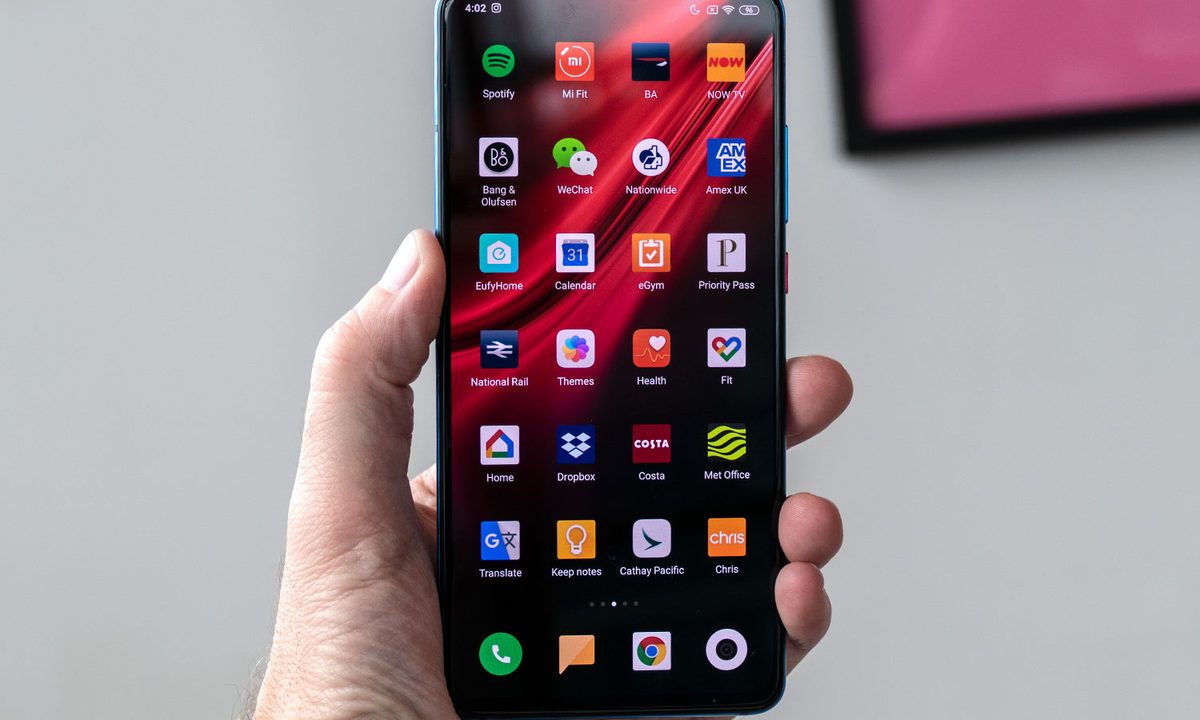
The Xiaomi Mi 9T is built around a Qualcomm Snapdragon 730 processor, and our review version has 6GB of RAM and 64GB of storage space. The AMOLED screen measures 6.4-inches and has a 2,340 x 1,080 resolution. It runs Android 9.0 with Xiaomi’s MIUI 10.3 user interface over the top, complete with the May 2019 Android security patch installed.
When it comes to MIUI I’m usually quite forgiving. The design is way better than some of the other user interfaces originating in China, such as Oppo’s Color OS and even Huawei’s EMUI, but the stability and usability can suffer, often depending on the phone it’s installed on. Here, app stability was an issue, especially with social networking apps, which tended to lock up and not grab a connection properly.
It’s not as fast as a flagship phone, but never too slow to use.
Other examples of things not quite operating as you hope include the system-wide Dark Mode. It looks good, except when notifications slide down from the top of the screen, as text is turned black making it impossible to read. Not very helpful when previewing emails without entering the Gmail app. Naturally, there are many pre-installed apps that duplicate the Google apps, including a web browser, an email app, and a calendar. They aren’t intrusive, but can be confusing as other apps use them as the default until you manually change the settings.
The gesture control system is very natural, and conforms with others available, meaning it’s a swipe up to go home, swipe up and hold for the app menu, and swipe left or right to go back. The always-on AMOLED screen is another winner. It has a cool moon phase design, and the time and notification icons are all clearly displayed. I wouldn’t do without it, but it’s unfortunate you have to take a deep dive into the settings menu to activate Google Assistant after long pressing the power button, which is disabled by default.
There is plenty of speed, and my experience using the phone was very similar to using the Pixel 3a. It’s not as fast as a flagship phone, but never too slow to use, and I was never in the situation where it wouldn’t do as I asked. The days of worrying about mid-range phone performance have long since disappeared.
Camera
For a supposed mid-range phone, the Mi 9T has a fantastic camera on paper, which happily translates into some seriously good photos. A 48-megapixel, f/1.8 aperture main lens is joined by a 13-megapixel wide-angle lens and an 8-megapixel telephoto lens. This gives plenty of versatility, due to the wide-angle photos and optical 2x zoom, and the software includes a 48 megapixel mode, and a Night mode.


Photos are highly shareable, although some may consider the saturation level too high. Detail is excellent. The 2x optical zoom produced some great photos, with some lovely colors, while Night mode performs excellently — opening up shadows, and brightening scenes without losing too much atmosphere. For the price, the Mi 9T’s camera is excellent, and I’ve not been disappointed by any results.
Battery and security
A great reason to buy the Xiaomi Mi 9T is the battery. It has a 4,000mAh capacity and even on a long, hard day of use I’d go to bed still seeing 30% to 40% remaining. As I write this, the phone has been on and used normally since around 8 a.m., and at 6:30 p.m. the battery is at 74%. It’s very reassuring to have a phone with such a rock-solid battery life.
From the high point of the battery, we go to the low point of the under-display fingerprint sensor. It’s not very good at all. Accuracy is above average, but it takes at least a second to unlock the phone — this is too long. Worse is the way the sensor won’t always pre-activate when you pick up the phone or touch the screen. I’d often have to sleep the screen again before it sprang into life.
Face unlock isn’t much better, as it requires the pop-up camera to operate. It’s not very fast and doesn’t have an option to swipe up the screen to kickstart the process. Compare it to the OnePlus 7 Pro and the sloth-like performance and unnecessary steps are instantly noticeable. Slow security systems stop people using them, and this is not good. I’d have much rather Xiaomi adopted a side-mounted fingerprint sensor, like the Honor 20 Pro.
Conclusion
Xiaomi’s policy is to not mark up the price of its phones over a certain amount, which means prices are always more reasonable than you expect, and the Mi 9T is no exception. It’s available for 330 euros, which is about $340. And you thought the $400/400 British pound Google Pixel 3a was a bargain.
But you’re going to have to make an effort to buy one, compared to the Pixel. Neither the Mi 9T or the K20 have been announced for the U.K. yet, and Xiaomi hasn’t started selling its smartphones officially in the U.S. at all. That means you’re going to have to rely on an importer to get one. This can lead to problems and extra work for you if the phone goes wrong and a warranty claim is required.
Is it worth the trouble? It’s impossible to ignore the stunning value on offer here. The eye-catching rear panel is beautiful, the screen is colorful and bright, the camera takes photos you’ll want to share, and the battery life is really excellent, but the software is frustrating and not as good as other devices on sale for similar money, including the Google Pixel 3a and the Motorola One Vision.
Accept the difficulty it will take to get one and the software’s little niggles, and the Mi 9T is yet another hugely capable mid-range phone from Xiaomi.