  1. Home
  2. Social Media
  3. Mobile
  4. News

Facebook Instant Articles aren't doing that well, and publishers aren't pleased about it

Add as a preferred source on Google

Not everything Facebook touches turns to gold. It’s just that it normally does a better job of hiding that stuff. Not so with Facebook Instant Articles, which has now drawn the ire of heavy hitting publishing partners like the Washington Post and the New York Times.

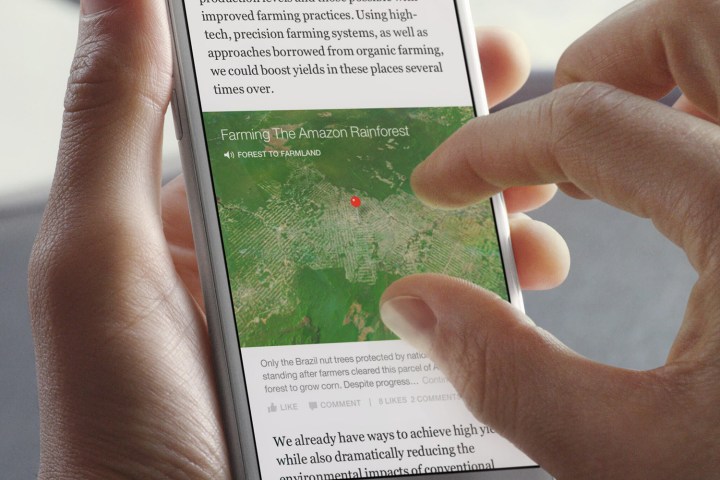
Instant Articles, launched last month, is heralded as the best way for media outlets to push content. According to Facebook, the platform leverages “the same technology used to display photos and videos quickly in the Facebook app,” which allows articles to load instantly, “as much as 10 times faster than the standard mobile Web.”

Recommended Videos

But speed aside, according to a report from The Wall Street Journal, these media outlets “are finding it difficult to extract as much revenue per article from Instant Articles as they do from pages on their own websites.” And that means that Facebook is going back to the drawing board with new advertising schemes, because let’s be honest, you’re connecting more with advertisers than you are with your friends when you’re logging onto social media these days.

As per sources familiar with the issue at hand, the problem with Instant Articles lies in its strict rules on ad volume and type. According to Facebook’s guidelines, advertisers are allowed one “large banner” ad (320 x 250 pixels) for every 500 words of text. When compared to how content appears on the publisher’s native platform, like the mobile app of The New York Times, three or sometimes four ads will appear within a single article. A bit annoying for the reader? Sure. More effective for the publisher? Absolutely.

Moreover, the WSJ notes, “Facebook is also restricting the type of ads publishers may place in Instant Articles,” and currently bans “rich media” ads, or those that allow for readers to interact with the content. But all these strict rules may change very soon, Instant Articles product manager Michael Reckhow says, and already, the platform is running some experiments with a greater number of banner ads and interactive, animated media.

“It’s early days with Instant Articles,” Reckhow says, “But one of our principles from the beginning has been to work collaboratively with our publishing partners to understand their needs and shape the product.”

Lulu Chang
Fascinated by the effects of technology on human interaction, Lulu believes that if her parents can use your new app…
Instagram will limit reach for AI influencers who skip AI-generated label on their profile
Instagram tightens AI influencer disclosure rules with a clearer profile label
instagram-ai-generated-profiles

Instagram just drew a hard line around AI influencers pretending to be real people. The platform is renaming its old AI creator label to AI-generated profile, and this time it comes with penalties too. Accounts featuring a fully AI-generated person will see their reach cut if they skip the label, meaning your feed is about to get a lot more honest about who is actually behind the account.

So what counts as an AI-generated profile?

Read more
Bluesky now has a feature to save you from accidentally going viral. I want it everywhere.
Bluesky now lets users opt out of its algorithmic Discover feed.
Social profile page of Bluesky.

There's a specific kind of dread that comes with posting something small and watching it explode to a million strangers who missed all the context. Thankfully, Bluesky just built an escape hatch to avoid this horror. The platform now lets you opt out of its algorithmic Discover feed, meaning your posts stop getting pushed to people who don't already follow you.

How Bluesky's algorithmic opt-out feature works

Read more
Meta’s new teen restrictions will only apply to users in the US for now
Facebook and Instagram teens are getting new limits on screen time and content
Facebook logo on iPhone

Meta is implementing new restrictions on U.S. teens who use Facebook and Instagram, but the changes could have repercussions far beyond U.S. screens. Meta’s new protections come after a series of settlements relating to allegations that social media sites endanger children, with the company facing as much as $18 billion in expenses.

For now, the new rules will be applied only to U.S. users. The measures include limitations on how long younger users can spend on Meta’s apps and limits on their ability to disable certain safety settings, Bloomberg reported. The company says it will watch the changes and continue discussions with governments elsewhere.

Read more