  1. Home
  2. Entertainment
  3. Social Media
  4. Legacy Archives

Man claims to find Mars base using Google Mars

Add as a preferred source on Google
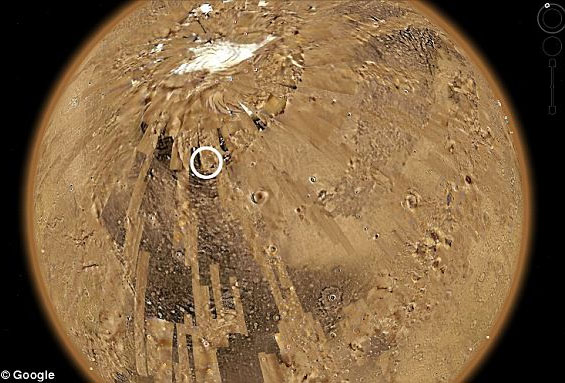
Google Mars Martines location highlight
Image used with permission by copyright holder

Mars has fascinated humanity since pre-historic times, but the notion of little green men and Martian Society really got its start in the 19th century when Italian astronomer Giovani Schiaparelli noted “canali” on the visible surface of Mars. American Percival Lowell took the idea much further from 1885 to 1908 with a series of three books detailing his observations of the Martian surface and the intelligent civilization that he believed existed there. Now in the 21st century a man named David Martines claims to have found evidence of intelligent life on Mars—this time in the form of a long cylindrical base. And he didn’t find it with a telescope: He found it using Mars surface imagery available via Google Mars.

According to Martines’ calculations, the object is more than 700 feet long, 150 feet wide, and has red and blue strips on its white surface. He’s dubbed the visible anomaly “BioStation Alpha” because he assumes it either housed or houses living creatures.

Google Mars Martines location highlight
Image used with permission by copyright holder

“It could be a power station or it could be a biological containment or it could be a glorified garage—hope it’s not a weapon,” Martines says in a video he posted to YouTube. Martines speculates the station could belong to the U.S. NASA space agency, but doubts it would be possible for humans to get that much material to Mars in secret. “I don’t know if NASA even knows about this.”

Recommended Videos

Before jumping to the conclusion that aliens have set up a surveillance post to watch I Love Lucy reruns as they whisk past the Red Planet, it’s important to note that Google’s Mars imagery pulls from information published under the JMARS data project, and is comprised of different types of filtered imagery from a number of different sources and probes from present day (like Mars Global Surveyor and Mars Odyssey) all the way back to the 1960s and 70s. Google has also done some of its own work on the imagery, adding high-resolution images from infrared and other sources to heighten detail on points of interest. Imagery in Google Mars is far from a high-resolution photograph: It’s an enormous amount of highly-specialized, highly-processed data from a number of sources cleverly stitched together to resemble a 2D or 3D flyover of Mars.

Mars enthusiasts looking to follow up on Martines’ discover should have little difficulty finding other visual anomalies in Google’s Mars presentation. A few minutes of random searching in the area surrounding Martines’ discovery—at 49’19.73″N 29 33’06.53″W—turned up a few more suspicious blips nearby. All in all, Martines’ discovery—and the media’s reaction to it—may serve as a testament to how badly humans want to believe there’s life on Mars

Martines has removed his original videos announcing the discovery from YouTube, but a few sites still have them available.

Geoff Duncan
Former Contributor
Geoff Duncan writes, programs, edits, plays music, and delights in making software misbehave. He's probably the only member…
EXCLUSIVE: X-Men ’97 star Jennifer Hale talks season 2 and returning as Jean Grey
Jennifer Hale: 'I feel like I won the Golden Ticket' playing Jean Grey
Cyclops and Jean Grey in X-Men '97 season 2.

As X-Men '97 continues the epic saga of Marvel's mutant heroes, voice actor Jennifer Hale returns as one of the team's most iconic members, Jean Grey. After the events of season 1, the show follows the X-Men, who have been scattered across history, as they try to return to their original era and prevent the rise of their most powerful enemy: Apocalypse.

In an interview with Digital Trends, Hale discussed returning to voice Jean Grey after doing so in many of Marvel's animated projects. She also broke down the evolution of Jean's character and what fans can expect from season 2 of X-Men '97.

Read more
Spotify’s new Running Mode knows exactly when your playlist should speed up
Spotify Running Mode could replace the playlist you build before every workout
Running mode on Spotify

Nothing destroys the running pace quite like a slow track from your Spotify library. To deal with this, the music streaming platform has built a new personalized mode that aims to keep your soundtrack aligned with the workout from the first step to the final cooldown.

Spotify has introduced Running Mode, a Premium feature that builds a workout and accompanying playlist around your pace. From your music taste to your preferred tempo, it wants to keep up with your fitness journey. The feature offers 25 curated running presets right off the bat. These can be further customized according to workout type, duration, genre, and beats per minute.

Read more
YouTube Premium is becoming a streaming bundle by adding Peacock
YouTube and NBCUniversal have struck a new deal that bundles Peacock with YouTube Premium.
YouTube Premium with NBCUniversal and Peacock Premium Featured

YouTube Premium is about to become much more than an ad-free YouTube subscription. Google and NBCUniversal have announced a new multi-year partnership that will bring Peacock Premium to eligible YouTube Premium subscribers in the U.S. beginning in early 2027. Once the rollout begins, subscribers will be able to access Peacock's ad-supported tier directly within the YouTube experience at no additional cost, combining YouTube's existing perks with one of the largest streaming libraries in the U.S.

What YouTube Premium subscribers are getting

Read more