For those of us who signed up for Facebook back when it was a novel digital toy for college kids, we may brag to our grandchildren someday about how we used the Mark Zuckerberg production back when you could only upload one photo and there was nary an ad to be found, just a sleek, simple interface for interacting with friends.
Just kidding, our grandchildren aren’t going to care about Facebook. They’ll be too busy mind-sexting each other with Google BrainFeed. But still, it’s already hard to imagine the 2005-era Facebook that was seemingly impossible to monetize and devoid of advertisements and marketers.
Facebook needed to monetize to survive, and it’s done a remarkable job luring advertisers in the past year, particularly on mobile, which investors and analysts worried would sink the company. It hasn’t.
And now Facebook is taking another step to sweeten the digital pot for potential advertisers — the company is super-sizing its ads.
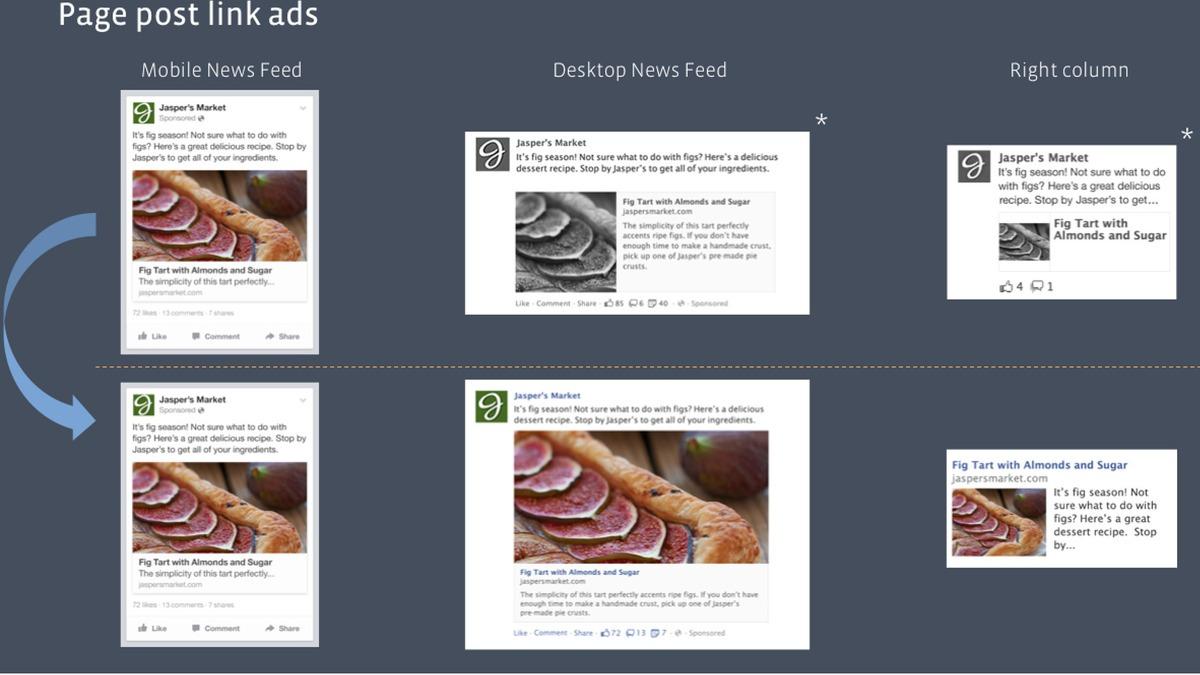
Facebook’s ads are getting bigger this week, as the company rolls out changes it announced earlier. And the ads aren’t growing incrementally — in some cases, they will be 3.5 times larger than they were in the past.
By changing the sizes for ads, Facebook is making things easier for advertisers. Now the sizes are consistent across platforms, so groups who want to advertise don’t need to come up with campaigns with a variety of image sizes. The ad they make to be seen on a desktop will look the same from an iPhone.
That change won’t really have much of an impact on users, but another aspect of this ad shift will have an annoying consequence. To get more people to click on ads, now if a user clicks on the text or image of a page ad, it will take them to the advertiser’s landing page. Previously, users had to click on a hyperlink within the ad to be rerouted. That change is annoying because most of the ads we see on Facebook are for stuff we don’t want, and it may increase the chances of getting redirected somewhere we don’t want to go after accidentally clicking or tapping on an ad.
Here’s an image, per Mashable, showing the changes.
Now, accidentally clicking on an ad is annoying, but when you look at the changes Facebook is making, this larger-and-more-easily-clickable ad thing is one of the least obnoxious things the company has done to alter its services in an attempt to boost profits. Facebook is a profit-driven company, and it’s always going to tweak thing to become a better, more attractive advertising platform. It won’t start making tweaks in an effort to woo users until another website threatens its dominance.
The changes the company is making to be more like Twitter are efforts to attract business and partnerships — Twitter isn’t as big as Facebook, but it’s known as the premiere digital location to enter into public discussions about current events, so companies that want to advertise through a social network that facilitates truly global conversation will choose Twitter over Facebook.
Facebook’s announcement that it will make it easier to discover (or “surface”) conversations underlines how the company is trying to make users treat Facebook like Twitter. And even though bigger ads certainly don’t enhance the user experience on Facebook, they also don’t awkwardly try to force a change in user behavior. So in that way, bigger ads are the least offensive of Facebook’s recent changes.