  1. Home
  2. Space
  3. News

Europe to launch renewable wooden satellite made of plywood

Add as a preferred source on Google

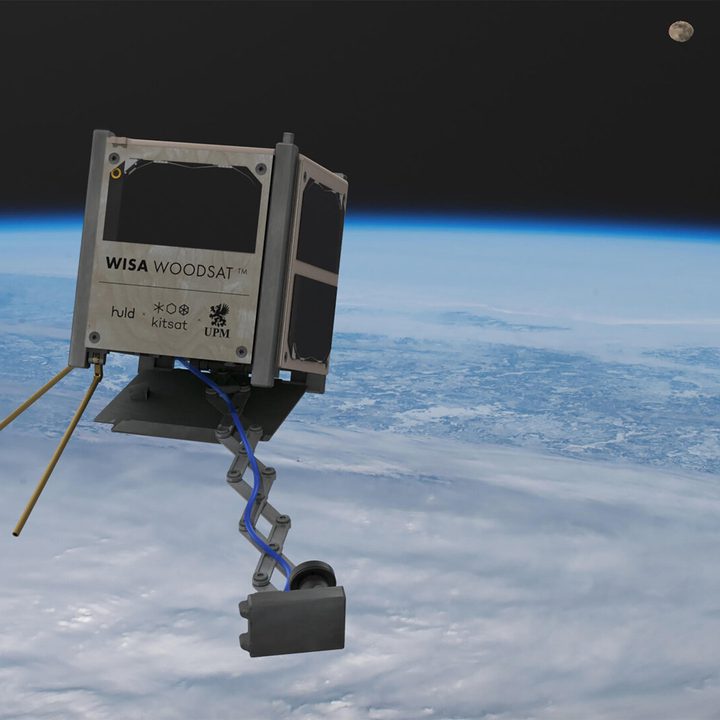
WISA Woodsat is a 10x10x10 cm ‘CubeSat’ – a type of nanosatellite built up from standardised boxes – but with surface panels made from plywood. Woodsat’s only non-wooden external parts are corner aluminium rails used for its deployment into space plus a metal selfie stick.
WISA Woodsat is a 10-by-10-by-10-centimeter CubeSat, a type of nanosatellite built up from standardized boxes but with surface panels made from plywood. Woodsat’s only non-wooden external parts are corner aluminum rails used for its deployment into space, plus a metal selfie stick. Arctic Astronautics

A Scandinavian company plans to launch the world’s first wooden satellite to bring attention to the use of renewable materials in space.

Recommended Videos

We’ve previously reported on plans from Japan for the world’s first wooden satellite, aimed for launch in 2023, but it now looks like Europe will snatch that achievement with plans to launch its wooden satellite before the end of the year.

The European design is being put forward by Finnish company Arctic Astronautics, whose founder, Jari Makinen, said he was inspired by his hobby of making model planes. His company flew a wooden satellite aboard a weather balloon in 2017 and decided to upgrade their plans to a fully orbital satellite to be launched by New Zealand company Rocket Lab.

The satellite, which measures roughly 10cm on each side, is constructed from simple materials and weighs just one kilogram. The team hopes that their design can help move space technology away from fossil-based materials and toward more renewable materials like wood.

“The base material for plywood is birch, and we’re using basically just the same as you’d find in a hardware store or to make furniture,” explained Woodsat chief engineer and Arctic Astronautics co-founder Samuli Nyman.

“The main difference is that ordinary plywood is too humid for space uses, so we place our wood in a thermal vacuum chamber to dry it out. Then we also perform atomic layer deposition, adding a very thin aluminum oxide layer — typically used to encapsulate electronics. This should minimize any unwanted vapors from the wood, known as ‘outgassing’ in the space field, while also protecting against the erosive effects of atomic oxygen. We’ll also be testing other varnishes and lacquers on some sections of the wood.”

The mini-satellite will carry sensors on board, including a pressure sensor and an LED with a photoresistor, which can be used to monitor the satellite’s condition. It will have a selfie stick as well, with a pair of onboard cameras that can take pictures of the satellite. The team hopes that the end result will be beautiful and inspiring as well as functional.

“In the end, Woodsat is simply a beautiful object in terms of traditional Nordic design and simplicity; it should be very interesting to see it in orbit,” said Makinen. “Our hope is it helps inspire people to take [an] increased interest in satellites and the space sector as something that already touches all our lives and is only going to get bigger in [the] future.”

Georgina Torbet
Georgina has been the space writer at Digital Trends space writer for six years, covering human space exploration, planetary…
China’s answer to SpaceX’s reusable rockets literally catches boosters in a net
SpaceX catches boosters on legs. China just used a net.
Ammunition, Missile, Weapon

SpaceX's playbook for recovering a rocket booster generally involves legs, a precisely controlled vertical landing, and either a concrete pad or a drone ship. 

China just managed to pull off something similar, but in a slightly different way, and on July 10, it tested the method as well.

Read more
Dimming the sun sounds unhinged, but this new study on El Niño makes a surprisingly good case for it
A natural test case, Australia's worst-ever wildfire season, suggests the idea deserves serious consideration.
Nature, Outdoors, Sky

When I first saw "scientists propose dimming the sun," I rolled my eyes. It sounds like a science fiction movie cooked up after watching many climate documentaries. But a new study, published on July 8, 2026, in the journal Science Advances, seems to have a genuinely compelling argument.

A Super El Niño is currently forming in the Pacific, feared to be the most intense in decades. It could escalate floods, wildfires, and extreme heat events worldwide. However, Researchers at UC San Diego's Scripps Institution of Oceanography, led by climate scientists Kate Ricke and Jessica Wan, are now proposing one of the most interesting solutions I’ve come across.

Read more
You can now walk through space and gaze into a black hole at this VR exhibit
Smithsonian Starstruck lets you drift past dying stars and see the origin point of the universe for as little as $18 a person.
Smithsonian Starstruck featured

Most planetarium shows ask you to sit still and look up. The Smithsonian's new VR exhibit takes a different approach, letting visitors walk through the vast expanse of the universe, drifting past stars, planets, and a black hole to get a physical sense of its true scale.

A $29 ticket to the edge of the galaxy

Read more