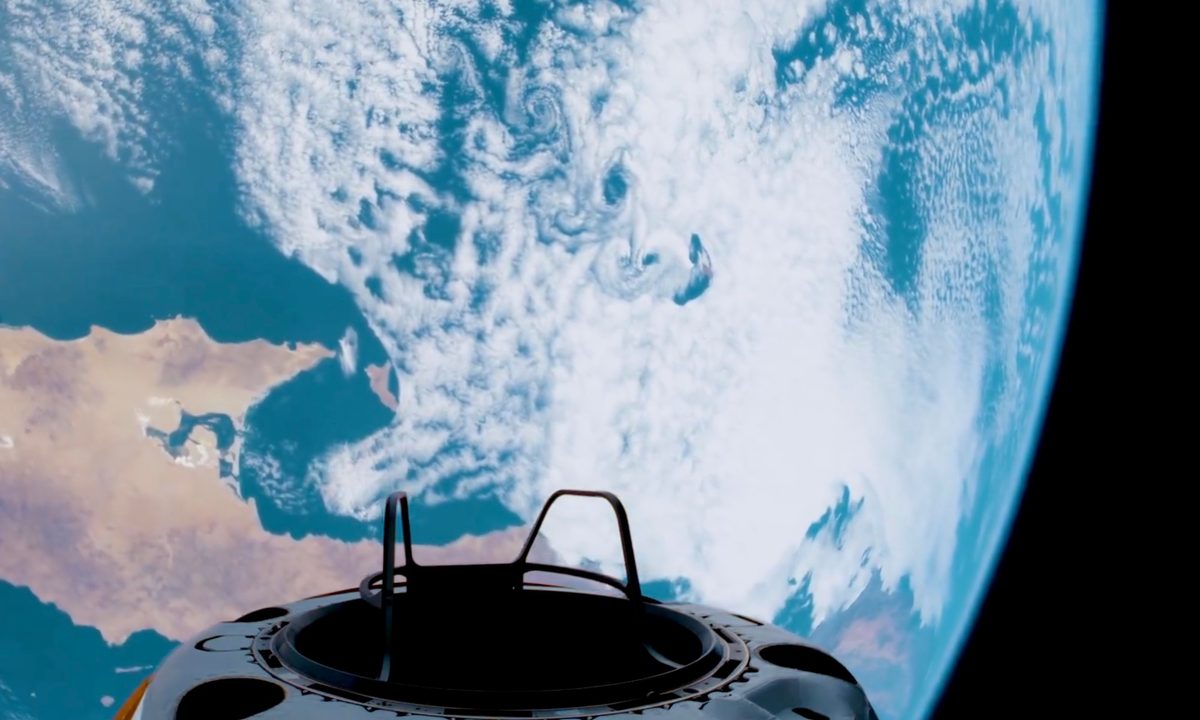
SpaceX has shared some breathtaking footage captured from a Crew Dragon spacecraft during the recent Polaris Dawn mission.
The video (below) was recorded by an external camera from an altitude of about 450 miles (730 kilometers) during the spacecraft’s 75 orbits of Earth across the historic five-day mission.
“Looks like CGI, but these are all real video highlights from the Polaris Program space mission,” SpaceX chief Elon Musk said in a post on social media.
Views from Dragon in flight 🐉🌎
During its five day mission, Dragon and the Polaris Dawn crew completed 75 orbits around Earth pic.twitter.com/NzIFElzXAm
— SpaceX (@SpaceX) September 27, 2024
The footage is dramatically different from that beamed back from the International Space Station (ISS) as the station’s orbit is much closer to Earth at around 250 miles. The Crew Dragon’s higher orbit therefore gives a much wider perspective, with the Earth’s curvature much more prominent.
The same camera was used to record the first-ever commercial spacewalk, which was performed by Polaris Dawn crew member Jared Isaacman, the man who funded the all-civilian mission. Following Isaacman, fellow crew member Sarah Gillis became the first woman to perform a commercial spacewalk. The event also marked the first time for someone to emerge from the Crew Dragon spacecraft in the vacuum of space. The main goal of the spacewalk was to test a new spacesuit that offers greater mobility and comfort than the current design used for such endeavors. It’s expected that a version of the suit will be used for future missions to the moon and possibly beyond.
Traveling alongside Isaacman and Gillis were Scott Poteet and Anna Menon. While Isaacman had been to orbit before — as part of the privately funded Inspiration4 mission in 2021 — his three fellow crew members were on their first trip to space.
During the flight, the four non-professional astronauts traveled further from Earth — 870 miles (1,400 kilometers) — than anyone has traveled since the Apollo missions five decades ago. The crew also tested out a laser-based communications system, and carried out science experiments that included health and human performance research for NASA’s Human Research Program.
The Crew Dragon and its occupants returned safely to Earth on September 15, with the journey home captured in a stunning photo taken by NASA astronaut Don Pettit aboard the ISS.