1. Home
  2. Space
  3. Emerging Tech
  4. News

‘Oumuamua isn’t alone: More interstellar objects found in our solar system

Add as a preferred source on Google

The ‘Oumuamua space object made headlines last year when it was revealed to originate from outside of our Solar System, making it a special rarity as other comets and asteroids studied before all originated from within the Solar System. However, the exact nature of ‘Oumuamua and whether it is actually a comet has been called into question recently, with scientists arguing that if it were a comet, it would have broken apart when it passed by the Sun. And now the mystery deepens, as a new paper argues that there could be hundreds of ‘Oumuamua-sized interstellar objects in our Solar System, some of which could be identifiable by the Large Synoptic Survey Telescope (LSST).

Researchers from Harvard University, undergraduate Amir Siraj and Professor Abraham Loeb, Chair of the Harvard Astronomy Department, have made their paper available on pre-publication archive arXiv while it is reviewed for publication in the Monthly Notices of the Royal Astronomical Society. They used computer models of asteroid-like objects to see how they would be captured by the gravity in the Jupiter-Sun system, and then used these models to identify four objects in our Solar System that are thought to have originated from elsewhere.

Recommended Videos

The objects, 2018 TL6, 2017 SV13, 2011 SP25, and 2017 RR2, were identified by looking at factors like their eccentricity, inclination, orbital period, perihelion distance, and aphelion distance, which are mathematical descriptions of the movements and positions of the objects. In total, there could be around 350 trapped interstellar objects in our Solar System, of which 66 would be detectable by LSST, and these objects would provide a potentially valuable target for research in order to understand how planetary systems form. Siraj and Loeb suggest that high-resolution spectroscopy could be used to measure the ratios of chemicals in the tails of the objects, which would show whether the objects did in fact originate from outside our Solar System.

These objects are trapped in our Solar System because of the massive planet Jupiter, which forms its own system with the Sun with gravity that scoops up objects as they pass. “The Sun-Jupiter system acts as a fishing net that collects interstellar objects,” Loeb told Forbes. “At any given time, there are a few thousand trapped objects within the Solar System.”

Georgina Torbet
Georgina has been the space writer at Digital Trends space writer for six years, covering human space exploration, planetary…
NASA is investing $590 million in private contractors to build humanity’s first Moon outpost
NASA is counting on private companies to land its Moon Base dream.
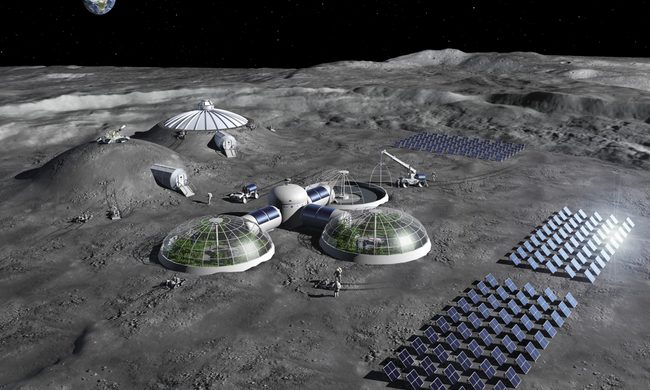
Artist impression of a Moon Base concept, with solar arrays for energy generation, greenhouses for food production, and habitats shielded with regolith.

Building a permanent base on the Moon sounds like science fiction, but NASA is making it feel a lot more real. The agency just handed $590 million in contracts to three private companies for four uncrewed lunar lander missions launching in late 2028.

These missions are part of Phase 1 of NASA's broader $30 billion Moon Base program, which needs to deliver landers, rovers, and scientific cargo up there before astronauts eventually move in. These efforts are closely tied NASA's Artemis program, which sent humans on a lunar flyby in April for the first time since the Apollo era.

Read more
Getting to Mars may require a pit stop in orbit, and NASA just tested the nozzle to make that happen
A gas pump nozzle for spacecraft sounds simple. It is not, and that's what makes this test worth paying attention to.
Architecture, Building, Factory

Getting a spacecraft to Mars or beyond requires an enormous amount of fuel, most of which has to be hauled from Earth, adding to the overall cost and weight of the spacecraft. NASA has been working on a different approach, one that could be more efficient and effective.

It wants to refuel a spacecraft in orbit before heading out for the mission. What’s even more interesting is that the space agency just finished testing a component that could make that possible: a cryocoupler.

Read more
Elon Musk’ Starlink could soon offer mobile services as a US carrier
Showcase of T-Mobile Starlink service on an iPhone.

Elon Musk’s Starlink has already changed how millions of people access the internet, especially in places where traditional broadband struggles to reach. Now, the satellite internet service could be preparing for an even bigger leap — becoming your mobile carrier.

According to a Financial Times report, SpaceX has told investors it’s considering launching a retail Starlink mobile service in the US. Instead of simply partnering with wireless carriers, the company could begin selling mobile plans directly to consumers, putting it in direct competition with Verizon, AT&T, and T-Mobile.

Read more