1. Home
  2. Space
  3. News

How to watch two Russian cosmonauts spacewalk outside the ISS this week

Add as a preferred source on Google

This Thursday, September 9, two Russian cosmonauts will venture outside the International Space Station (ISS) to continue preparing the newly arrived Nauka module for science operations. You can watch along at home as they step out of the station and work on the new module, hooking it up to existing systems so it can be integrated into the rest of the station. We’ve got the details on how to watch below.

NASA Live: Official Stream of NASA TV

What to expect from the spacewalk

The new Russian module for the ISS, Nauka, was launched this summer and, after a dramatic incident in which the module’s thrusters fired unexpectedly, was attached to the station with no further problems. In August, European Space Agency astronaut Thomas Pesquet gave a video tour of the new module if you’d like to see the view from the inside.

Recommended Videos

However, installing a new module to the space station isn’t as simple as lining it up and plugging it in. There are many complex steps to getting the module fully integrated into the space station and ready to begin its operations. So Russian cosmonauts Oleg Novitskiy and Pyotr Dubrov performed a spacewalk to begin integrating the module last week, in what is expected to be the first of up to 11 spacewalks required.

This week, the pair will perform their second spacewalk, continuing with the task of hooking up ethernet and data cables from the other modules to Nauka and installing handrails on the exterior of Nauka to make moving around it easier.

To tell the two apart during the spacewalk, they’ll be wearing different spacesuits as described by NASA: “Novitskiy, who is designated as extravehicular crew member 1 (EV1), will wear the Russian Orlan spacesuit with the red stripes. Dubrov will wear the spacesuit with the blue stripes as extravehicular crew member 2 (EV2). These will be the second and third spacewalks for both cosmonauts; the 242nd and 243rd spacewalks in support of space station assembly, maintenance and upgrades; and the 10th and 11th spacewalks at the station in 2021.”

How to watch the spacewalk
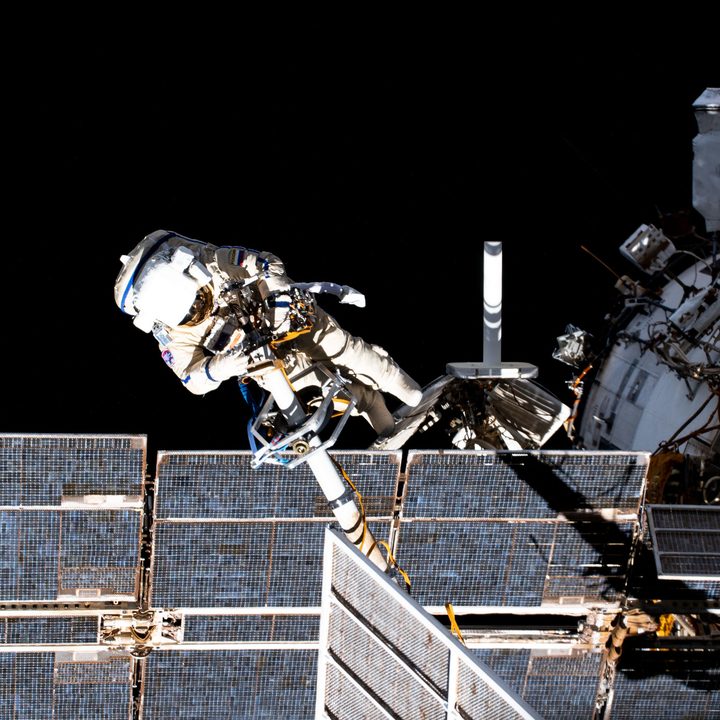
Expedition 65 flight engineer and Roscosmos cosmonaut Pyotr Dubrov, pictured during a spacewalk to perform work on the Pirs docking compartment.
Expedition 65 flight engineer and Roscosmos cosmonaut Pyotr Dubrov, pictured during a spacewalk to perform work on the Pirs docking compartment. NASA

NASA will stream the spacewalk on NASA TV, which you can watch either using the video embedded near the top of this page or by heading to NASA TV’s website.

Coverage begins on Thursday, September 9 at 10:30 a.m. ET (7:30 a.m. PT), with the spacewalk itself scheduled to begin at 11 a.m. ET (8 a.m. PT). The spacewalk is scheduled to run for around five hours.

Georgina Torbet
Georgina has been the space writer at Digital Trends space writer for six years, covering human space exploration, planetary…
China’s answer to SpaceX’s reusable rockets literally catches boosters in a net
SpaceX catches boosters on legs. China just used a net.
Ammunition, Missile, Weapon

SpaceX's playbook for recovering a rocket booster generally involves legs, a precisely controlled vertical landing, and either a concrete pad or a drone ship. 

China just managed to pull off something similar, but in a slightly different way, and on July 10, it tested the method as well.

Read more
Dimming the sun sounds unhinged, but this new study on El Niño makes a surprisingly good case for it
A natural test case, Australia's worst-ever wildfire season, suggests the idea deserves serious consideration.
Nature, Outdoors, Sky

When I first saw "scientists propose dimming the sun," I rolled my eyes. It sounds like a science fiction movie cooked up after watching many climate documentaries. But a new study, published on July 8, 2026, in the journal Science Advances, seems to have a genuinely compelling argument.

A Super El Niño is currently forming in the Pacific, feared to be the most intense in decades. It could escalate floods, wildfires, and extreme heat events worldwide. However, Researchers at UC San Diego's Scripps Institution of Oceanography, led by climate scientists Kate Ricke and Jessica Wan, are now proposing one of the most interesting solutions I’ve come across.

Read more
You can now walk through space and gaze into a black hole at this VR exhibit
Smithsonian Starstruck lets you drift past dying stars and see the origin point of the universe for as little as $18 a person.
Smithsonian Starstruck featured

Most planetarium shows ask you to sit still and look up. The Smithsonian's new VR exhibit takes a different approach, letting visitors walk through the vast expanse of the universe, drifting past stars, planets, and a black hole to get a physical sense of its true scale.

A $29 ticket to the edge of the galaxy

Read more