Stargazers in the northern hemisphere are in for a treat this week as Mars has reached its closest point to Earth, giving the best view of the red planet until the 2030s. Mars made its closest approach to Earth on the night of November 30 to December 1, but the best views are yet to come as the planet reaches a point called opposition on the night of December 7 to December 8. Opposition is when Mars is directly opposite the sun as seen from Earth, which means this is when Mars will be at its brightest.
The reason that the closest approach and opposition are a few days apart is because of the elliptical nature of the planets’ orbits. Neither Earth nor Mars orbits in a perfect circle around the sun, so there are times when they are a little closer or a little further away. These small differences account for the few days’ delay between closest approach and opposition. The elliptical nature of Mars’s orbit is also why there will be such a great view of the planet this week. Mars won’t come back this close to Earth until 2033.
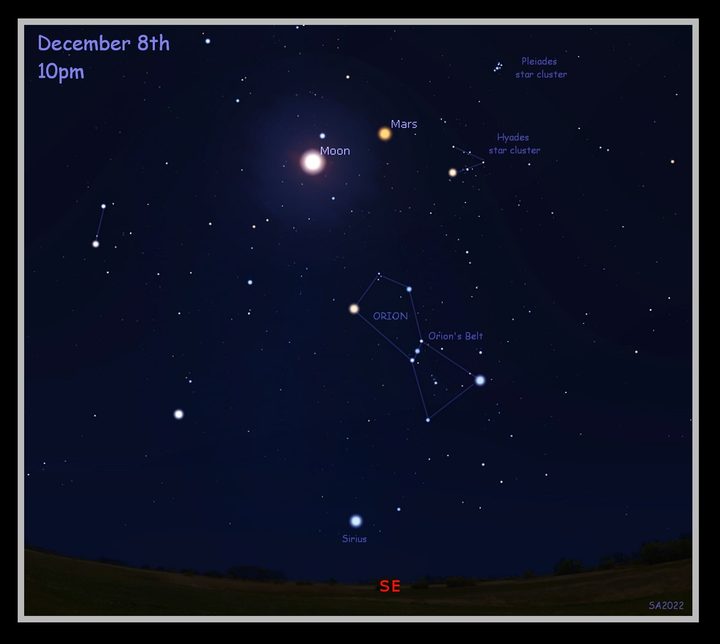
This diagram from the U.K.’s Royal Astronomy Society shows how to locate Mars in the night sky on the evening of December 8. Mars should be one of the brightest objects in the skies, so if you’re lucky to have clear weather overhead at night then you should easily be able to spot the planet with binoculars or a telescope. At this time, Mars will be around 50 million miles away.
December 8 is also a great time to look for Mars as you may be able to spot the moon moving in front of the planet, called an occultation, depending on where in the northern hemisphere you are located. For exact times to look out for this event by U.S. region, head over to Sky and Telescope for more information.
According to Sky at Night magazine, you should be able to observe Mars using almost any telescope, but adding a Barlow lens to your setup will give you a better view and enhance the darker and lighter patches on the planet. You may be able to see features on Mars like its polar ice caps, its patches of light and dark which are called albedo features, and perhaps even certain large geological features like basins and plains.
Some of the most dramatic views of Mars will be on the night of December 8, but if that doesn’t work out for you then you should also look to the skies in the week before and after this date as you should still be able to get a good view then.